 8.0 MEMBERS ITEMS
MINUTES OF MEETING
145th Edinburgh Branch Meeting
Donaldson’s College, Edinburgh – Thursday 11 September 2003
SEDERUNT:
M Bancroft I Affleck D R Staines D Richardson J Mongomery J Hooper T Sayer M Scott-Smih I Murray D Cawkwell S Boucher D Morrison I Riddle A Galvin D Bond A Diment G Lyall L Saunders P J Colqhon C Castell B Stainton R Hunter R Robertson I Wilson L Young G McGeorge C Sparling J McCraith J Cordiner J Green A A Pittendrigh R Walker A Dick C Sands B Alderson A White D Duff D Millar A Green B Byrne R Lovering J Davis M Johnstone T Mellon D Gillespie N Doherty A Sharman D Cox P Quill V Stewart P Graham L CrichtonAPOLOGIES: Karen McDonnell, David Brown, Barry Davis, D Sinclair, Scott Page
1.0 CHAIR: Richard Lovering took the Chair and outlined the Safety & Parking arrangements. He extended a special welcome to new members. He outlined the arrangements for Attendance Certificates.
2.0 MINUTES OF PREVIOUS MEETINGS (June 2003)
2.1 Receipt: These had been received as expected.
2.2 Accuracy: Noted some attendees names had been indecipherable. Dick Morrison was present. With this change the minutes were agreed a true record – proposed by A Dick and seconded by D Morrison.
3.0 MATTERS ARISING NOT ON AGENDA :
3.1 Access to Membership Lists by Members: The Exec had discussed this and the Secretary had raised with HQ – awaiting response. Possible topic of discussion at the Branch Officials Conference in November. He noted that he had been able to pass on an email query from a member to members in the forestry sector so there was a facility in this field. However, due to Data Protection the query had been handled via HQ.
3.2 Annual Statement: had gone out with the June Minutes. There were no questions.
3.3 Secretary’s Sipper (Golf tournament): Gordon McGeorge had offered to organize this but the response from the summer mailing announcement to the September date chosen had been poor so a date for Summer 2004 would be chosen instead.
3.4 Transport Safety Seminar in November: Speakers arranged, venue booked (Corn Exchange), mailshot to go out by end of Sept/early Oct.
4.0 CORRESPONDENCE
4.1 HQ: Membership numbers: IOSH National: 25939; Edinburgh Branch: 741. Annual drop since 31 members suspended for non-payment.
Corporate: 315 TechSP: 96 Associate 221
Construction: 176 Public Serices: 149 Environmental: 89 Offshore: 45
Healthcare: 35 Fire Risk: 19
4.2 HQ: European H&S Week: Poster Competition for Children (leaflets available)
4.3 HQ: Asthma Workshop (POOSH) 14 Oct 2003, London (leaflets available)
4.4 Safety, Health & Environment Show: Thistle Hotel Glasgow: 7/8 October 2003 (leaflets available)
4.5 CCA: Safety & Corporate Criminal Accountability: Conference: 23 Oct 2003: Glasgow (leaflets available)
4.6 Fife Chamber of Safety: Agenda & Minutes
4.7 Scottish Borders Safety Forum: Newsletter
4.8 Fourth Behavioural Safety User Conference: Manchester Conference Centre on October 30th 2003.<http://www.rydermarsh.co.uk/conferencehome.html>
4.9 Fire Prevention Association – details had been received of the Edinburgh meetings and these would be posted on the website.
5.0 BRANCH EDUCATION DEVELOPMENT ADVISOR - Liz Young. Liz would be attending the annual BEDA meeting at HQ on the 25th September.
6.0 SPECIALIST GROUPS
6.1 PUBLIC SERVICES - Marion Johnstone reported a successful National safety Symposium in York although attendance had been somewhat down on previous years. The second day had been very good. Next year’s symposium might be held in Scotland.
6.2 CONSTRUCTION - Roddy McLean. Nothing to report
6.3 FIRE RISK MANAGEMENT - Dave Sinclair: (in his absence)
6.3.1 FRMSG Networking Meeting on 18th September at Fire Brigade Training Centre, Tyne and Wear. It starts at 1.30pm and last till about 4.00pm. Open to members and non-members. Presentations include Fire Risk Management Strategy, update on Fire Safety Reform, Generic Approach to FRAs, and Open Forum. Any interested needs to contact Mary Sturgess at IOSH 01162573199. This is the nearest planned Forum to Scotland.
6.3.2 FRMSG Seminar on 3rd December in Manchester. Theme is "Everyone out safely" and will focus on less able-bodied. Places will be limited so get it in your diary now. £99 + vat for IOSH Members. This topic is in response to questions / advice sought from members recently.
6.4 HEALTHCARE - Martin Scott-Smith.
6.5 ENVIRONMENT – Julian Davis had been appointed as Branch Rep in succession to Max. Julian reported he would be attending the next quarterly meeting at HQ. He reported a recent case of a company found guilty on 15 charges and being fined the maximum £20K on each charge. The environment agency had just issue advice on whether fluorescent lights were special waste or not at www.environment-agency.co.uk.
6.6 OFFSHORE - Tam Boyd:
6.7 RAILWAYS - Need a representative
6.8 CONSULTANCY - Derek Cawkwell:
6.9 SAFETY SCIENCES - Steve Boucher:
6.10 TELECOMMUNICATIONS – need a representative
6.11 EDUCATION - need a representative
7.0 FORTH and TAY DISTRICT REPORT
First meeting of the session had been held but nothing further to report.
8.0 MEMBERS ITEMS
8.1 Peter Conway (one of our members) works for Kier's as Safety Advisor was collecting a National Safety Award on behalf of his company on 11th September 2003.
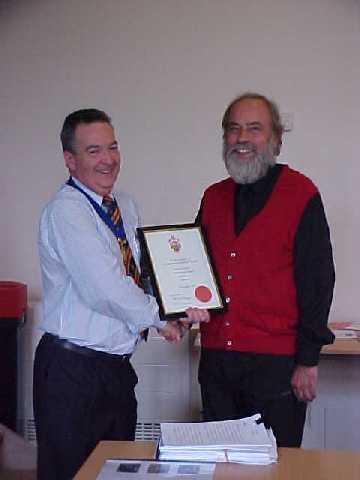
8.2 Martin Scott–Smith was presented with his certificate on achieving Corporate membership of IOSH.
9.0 GUEST SPEAKER
Laura Cameron, Director: McGrigor Donald, Solicitors: Health & Safety Law Update
Andy Sharman introduced the speaker to the group and pointed out that it was not usual to have the law presented by someone who was able to entertain by their presentation at the same time as looking attractive. Apparently Laura’s childhood ambition was to be a dentist, but instead she qualified as a Solicitor and was now set to fill our ears with exciting and interesting fact from recent case studies, rather than looking into out mouths.
Laura then indicated that she works as a Solicitor within McGrigor Donald in the litigation unit taking on the specialty of Health & Safety Law. Added to this she also was associated with guidance on Policy, health effects, crisis management and general compliance issues of just how close to the HSE line it was possible to go without getting some undesired legal action.
Most of her time was spent on defending prosecutions and she had looked through a number of the latest cases to see what may be of interest and benefit to the members considering the audience make-up was likely to include people from Construction, Public services, Retail, Consultancy, etc and when this was added to the fact that few if any clients are likely to agree to "washing their dirty linen in public" she concluded it was probably better to look at one fairly recent high profile case from the courts = HMA (Her Majesty’s Advocate) –v- Transco
Introduction
This case relates to an explosion under a bungalow in Larkhall – Lanarkshire at 5.30 am on 22nd December 1999, when four people died and several properties were damaged due to a gas leak. The charges put forward against Transco the gas supplier included one of Culpable Homicide and this charge was challenged in the courts and the challenge was upheld at which stage the Prosecution appealed and the decision was agreed by the Law Lords.
Currently prosecutions under Health & Safety legislation can attract a fine of up to £20k per offence in the lower courts and whilst the fine level can be unlimited in the higher courts, there are few particularly high fines passed out and Scotland is still trying to catch up on the level of fines issued. A lot of faith is placed on adverse publicity and on the HSE "name and shame" web site. The UK are currently looking into the issue of a Corporate Killing Bill and it is felt this charge may have been an attempt by the Crown to show there is no need for a Corporate Killing Bill within Scotland as the existing legislation can cover the effects.
The Case - Facts
It is alleged by the Crown that a 10 inch ductile iron gas main being used to supply gas to 42 Carlisle Road, Larkhall, was extensively corroded and not in good repair or working order, such that quantities of gas migrated under the ground and under the floor void forming an explosive atmosphere which ignited and exploded.
The house was completely destroyed, adjoining properties were damaged and four people (Andrew Findlay 34yrs, Janette Findlay 37 yrs, Stacey Findlay 13 yrs and Daryl Findlay 11 yrs) received injuries from which they died there and then.
The Crown also allege that several instances of leaks had been reported by members of the public relating to the main in question over the preceding 11 years which were not actioned fully.
The Charges
The indictment was cited against all forms of Transco – Transco plc, British Gas, BG plc, BG Transco plc and listed places of business in Midlands, Reading, Leicestershire, London, Edinburgh, Glasgow, Uddingston and others, this was to make sure past cases which occurred prior to a name change could be cited.
It stated that they failed under the Gas Act to have safe system for transmission of gas, through a number of engineering and other management committees and posts that decisions were made with a complete and utter disregard for the safety of the public.
It then stated alternatively that they failed under section 3 of the Health & Safety at Work Act to ensure so far as it was reasonably practicable that persons not in their employment who may be affected were not exposed to risks to their health or safety.
Several past incidents were cited of risk to human life from explosion and fire as a result of leakage of gas from such pipes as illustrations of the knowledge of the need for action to be taken, but through a number of groups (Production & Supply Policy Committee, Engineering Committee, Engineering Operations Group, The Transco Management Team, The Director – Transportation Services, The Director – Transport Operations, The Director – Licence to Operate) failed to devise, institute or maintain = accurate records, procedures, information collating statistics, monitoring or auditing.
The evidence was stated to include potentially 1000 memos, emails and records, 100 physical items to be presented in court (valves, pipes etc) and 250 witnesses. For the court to deal with this volume would require the case to run for approximately 12 months.
The Challenge to the Charge.
The Company challenged the charge on grounds of – Competency, relevance & Human rights
1 Grounds of competency & relevance
Defence argued - There is not an offence of culpable homicide which can be brought against a Company as Culpable homicide is a Common Law offence which requires a criminal act (actus reus) = and the Company can’t commit the offence – the charge failed to say "who" PLUS it also requires mental intention (mens rea) for the act to be culpable homicide = again the Company does not have a "controlling mind" and as the charge failed to identify the person with the "directing or controlling mind" of the Company through whom the crime was committed.
Prosecution argued – Case authorities supported the contention that a company could be prosecuted and the Committees & defined posts were "the company"
The Judge stated – Authorities support a company being prosecuted and quoted 2 cases from 1981 and 1987 (one on shameless indecency the other on fraud relating to beef carcasses) and the Law Lords stated it was a question of law based on fact – were individuals acting as servants of the company. Also there is sufficient in the charge because the prosecution have offered to prove that the committees and Posts acted in a grossly negligent or reckless manner.
2 Human Rights Challenge
Defence argued – Whole trial was flawed as everyone is entitled to a fair trial such that they were challenging the Jury system in total. Juries do not give reasons on WHY they find one way or the other, Juries are not aware of the issues of fact and law until the end of the case when the Judge gives the summary, Juries do not get to ask questions, It is not impartial or independent Tribunal as jurors can be excused and then presented details of percentage of jurors who were excused or did not turn up such that the group would not be a mixed group.
The Judge stated – Juries do not need to give reasons, it is down to the Judge to make decisions on law while the jury decide on the facts presented. The jury can take notes and it is not widely known but they can ask questions through the court but this should not be necessary if the case is presented fully. It is still a random selection of individuals despite some jurors being excused.
The Appeal
Being dissatisfied, the defence appealed and this was heard on 3rd June 2003 by Lords MacLean, Osborne and Hamilton at which stage the appeal was upheld stating the culpable homicide charge was irrelevant, however they did indicate that the reasons for their decision would not be stated at that stage as they would be issued in writing later – however that is still awaited.
 Summary
Although it had never been tested, it was felt that the law in Scotland allowed for a conviction for corporate killing without the English system’s need to prove "a controlling mind" in the company, but far from being better of in Scotland we are now perhaps worse off. The decision means the law on both sides of the border is the same, but south of the border at least there is a change mooted where legislation is being considered to strip away the need for an individual to be identified before a company can be charged with manslaughter.
Supplementary Topics – Recent Regulations
DSEAR – (Dangerous Substances and Explosive Atmospheres Regulations)
These came onto the Statute books on 7th December 2002 and required the changes to be in place by 30th June 2003. It is concerned with places of work having defined zones – hazardous or non-hazardous places
Noise at Work
A European Directive requires regulations to be in place by February 2006. These will set new lower action levels = First action will drop from 85dBA to 80dBA and the second level (max exposure) will drop from 90dBA to 85dBA
Control of Asbestos at Work Regulations 2002
Whilst there is a legal duty already to prevent exposure to asbestos, these regulations require the duty holder (anyone who has control of a non-domestic premise) to define what asbestos is on site and what condition it is in and then to complete a specific risk assessment of exposure to any person working on the site. There is an 18 month lead in period = by 21st May 2004.
10.0 DATES OF NEXT MEETINGS
11.0 CLOSURE
|
Max Bancroft, MRSC, TechSP Branch Secretary |
Richard Lovering, FIOSH, RSP Branch Chair |