INSTITUTION OF OCCUPATIONAL SAFETY AND HEALTH
EDINBURGH BRANCH
MINUTE OF MEETING
143rd Edinburgh Branch Meeting
Donaldson’s College, Edinburgh - Thursday 8 May 2003
Sederunt: R McLean L Johnson R Walker A Milne J Davis P J Colquhon M Bancroft R Lovering J Hay T Sayer J McCraith C Dick L Young A Levinson V Stewart D Morrison C Wilmott I Wilson S Young T Ambler D Sinclair S Macdonald D Duff J Brannigan S Boucher A Reid L Crichton
Apologies: B Pill, William, McCafferty, Cathy Cave, David Richardson, Scott Page, John Usher, Chris White, Kevin Llyod, Marion Johnstone, Allan Dick, Bob Stainton, Martin Scott-Smith, N Doherty, Barry Davis, Derek Cawkwell, A Sharman.
1.0 CHAIR: Richard Lovering was in the chair, welcomed especially new members to the Branch who should make themselves known.
2.0 MINUTES OF PREVIOUS MEETINGS (Feb and March 2003)
2.1 Receipt: Those present had received their copies.
2.2 Accuracy: February Meeting: were agreed a true record: Proposed – Liz Young, Seconded – Jim McCraith. March Meeting: Dr Fletcher had become Dr Shepherd in the Appendix. Otherwise they were agreed a true record: Proposed – Roddy McLean, Seconded – Jim McCraith.
3.0 MATTERS ARISING NOT ON AGENDA : None.
4.0 CORRESPONDENCE
HQ: Membership: National 26885 (last year 26029) Branch 763 (last year 749)
Corporate 328 TechSP 99 Associate 237
Construction – 183; Public Services – 155; Environmental – 92; Offshore – 46; Healthcare - 38; Fire Risk Management – 21
HQ: the present Learned Journal was going to be replaced by a new publication:
Policy and Practice in Health and Safety.
Edinburgh Electrical Society - request a speaker on H&S for their next session.
Scottish Borders Community Safety Forum: Crime Survey (secretary will email form to anyone interested)
A member new to the area, Tina Ambler, was looking for employment – particularly in the Construction area.
5.0 BRANCH EDUCATION DEVELOPMENT ADVISOR - Liz Young.: Nothing to report.
6.0 SPECIALIST GROUPS
6.1 PUBLIC SERVICES - Marion Johnstone. Nothing to report.
6.2 CONSTRUCTION - Roddy McLean. Nothing to report.
6.3 FIRE RISK MANAGEMENT - Dave Sinclair.
Our last meeting took place on the 19th March 2003 in Dublin: Main Topics:
MEETING VENUES – Going on the feedback forms returned, our open forum after the main FRMSG meeting in Dublin was a huge success. As a result of the contact made we have asked one of the Dublin Member to officially join the Group.
FRMSG NEWSLETTER – Latest issue has been sent out to all FRMSG members. It is also available on the Web. Topics include "New Fire Alarm standards (BS 5839 Part 1)" and "Dangerous Substances and Explosive Atmospheres Regulations". It also discusses a fire at a chemical plant in North Shields, the following prosecution and the resultant fine of £39000 against the company.
ACTION PLANS – 2003 plan is now agreed and will, along with the updated Five Year Plan, be available on the Web Site.
2003 FRMSG SEMINAR – 18th of September 2003 at Lancashire County Cricket Ground, Manchester. Change of location to bring cost down to £99. Feedback from last year indicated that Manchester was a good central venue. Main theme will be "Everyone Out, Safely" and will focus on "Less Able-bodied Evacuation". I will update the Branch when the agenda is finalised.
FIRE STATISTICS 2001 / 2002 – Have been released recently and are available at
www.safety.odpm.gov.uk/fire/rds/monitor/index.htm
6.4 HEALTHCARE - Martin Scott-Smith. The Secretary reported that this SG would soon be organizing meetings in Scotland. Of its 1500 members, 100 were in Scotland.
6.5 ENVIRONMENT - Max Bancroft. He had discussed the possibility of an Edinburgh Branch member attending the quarterly meetings at the Grange on an ad-hoc basis and would be interested to hear from any members of the Group who might wish to do this.
6.6 OFFSHORE - Tam Boyd. Nothing to report
6.7 RAILWAYS - Need a representative
6.8 CONSULTANCY - Derek Cawkwell
6.9 SAFETY SCIENCES - Steve Boucher
6.10 TELECOMMUNICATIONS – need a representative
6.11 EDUCATION - need a representative
7.0 FORTH and TAY DISTRICT REPORT
District Executive Committee would be meeting on 12th May to finalise programme for 2003/2004.
8.0 MEMBERS ITEMS
8.1 Treasurer's Report: from AGM: in his absence, it was reported that Kevin now had the most up-to-date format fro the Annual Accounts and should have an audited set available soon for presentation.
8.2 Roger Midson Challenge Trophy. The last winner, who was supposed to organize the enxt event in conjunction with the Social Secretary, had decided to stay on in New Zealand. No arrangements had been made and the event was therefore postponed.
8.3 Site Visit: Marion Johnstone: names in to Secretary. Lunch booked at McCowans in FountainPark for 1215pm. Able to leave cars there and walk to Scottish Courage Brewery in Fountainbridge for 2pm tour.
8.4 Branch Executive planning a seminar in November - Transport Safety (Public Road and at the workplace)
9.0 GUEST SPEAKER
Dr Anita Levinson
Stress Management Consultant – Stress Management Developments
Dr. Levinson stated it good to be back presenting a paper to the Branch members, but she was not sure just what the members thought they may be expecting as she had some difficulty in defining a heading for the topic for the paper, as the HSE have not been forthcoming with their guidance on what should be included in any Risk Assessment for Stress.
As a consequence the speaker indicated that she intended firstly to give a quick resume on what stress is to ensure we were all thinking along similar lines and would then go through the seven categories which she believed, would be making up the management standards for us to undertake benchmarking against.
During the 1990s there were 829 cases of stress reported per 100,000 employees whereas by last year this had risen to 1,700 per 100,000 employees. This is a substantial increase but it was not clear as to the basis for the increase being there was a greater number suffering from stress or whether we were just becoming more adept at reporting it. The other main factor of course also being what was stress, as it is totally subjective to the individual’s perception – what one person sees as stress could be being busy and quoted the example of how the members were feeling at that stage on a scale of 1 to 10 – it would be likely to vary from 5 to 7 = no consistency.
It also had to be borne in mind that not all stress was harmful. There is a strong analogy between pain and stress. Pain has a functional aspect as it helps us to survive – the more pain we feel the more preventative actions we are likely to take. But what of stress – the more aware we become of stress, the more we are getting aware of the symptoms and may therefore be taking more corrective actions – but are they truly justified.
Definition
It was for the reasons stated that it was felt we needed to understand the definition of what is stress.
Stress is the product of a mismatch between an individual and his/her social environment
.
We feel stressed when the perceived demands on us are more than our perceived ability to cope. But positive stress (Eustress) is the result of healthy pressure – it gives us the "buzz". It will give us an increase in energy levels, make us more alert, make us feel in control and self confident, which raises our self esteem and we can relax when the pressure is off.
We work the longest hours in Europe such that some Companies are now getting into the business of telling employees to go home – it being better to have defined hours of work gaining a quality output rather than overloading and being driven too hard.
This is the condition which often leads to negative stress (Distress), where the individual may be active at first but gradually looses control such that they go from crisis to crisis, being very anxious, exhausted apathetic depressed and then unable to relax and enjoy life.
Most jobs have peaks and troughs and fortunately we can see the "light at the end of the tunnel" during the peak times which allows us to get through, but if this was not possible individuals can get into a Chronic condition where the stress just continues mounting.
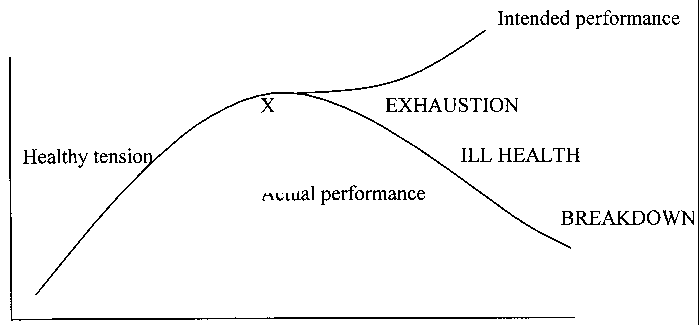
Human function curve.
Anita then showed the Human Function Curve
Here the Performance is plotted against Stress and the optimum performance is just before point X, as here there is an optimum amount of arousal/stress which is needed for optimum performance, but all too often the stress increases beyond that point and instead of increasing performance we see a substantial drop due o ill health and eventually a breakdown.
Signs of stress to look for
Organisational
In creased labour turnover, absenteeism and lateness, more requests for early retirement – all signs of the employees "voting with their feet". Poor employee relations and low moral. Stressful climate/environment with above normal hours being worked
Individual
Poor physical/mental health evidenced by low self-confidence, low job satisfaction, low motivation and very little effort. Poor quality work output and a reluctance to delegate. Changes in the individual temperament where they become tearful, irritable, aggressive, withdrawn or more resistant to change. Changes in personal appearance/behaviour often linked to increased use of alcohol or misuse of drugs.. Absence and lateness and deadline not being met.
All of these issues have an obvious potential to increase accident rates, from loss of sleep, medication, use of alcohol and other distractions can easily lead to slow reaction times, impaired memory, fatigues, lack of concentration, short attention span, inability to follow procedures.
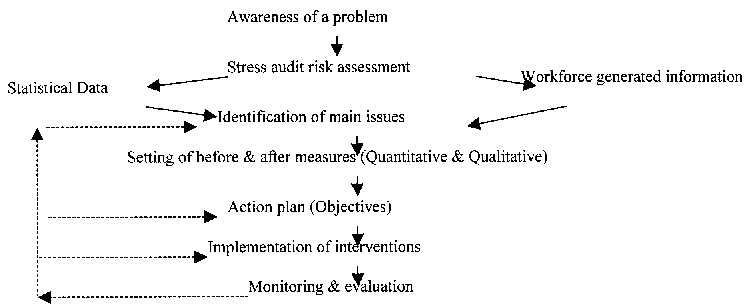
Tackling workplace stress
Anita provided a nominal workflow diagram for the process as follows:-
One of the problems of working in Organisations in defining the measures is the mis-use of the terms stress, where it is often used in place of the terms "busy", or "pressure" or even "importance".
Statistics in terms of the actual absenteeism from stress is probably way out being just the tip of the iceberg. A lot of absenteeism is frequently put down to "bad back" whereas the actual cause may be much deeper and actually be related to stress. There is often a stigma put onto detailing an absence as being stress related and one snag of gaining a greater acceptance may be to increase those who are abusing the system, but this is no reason to ignore the actual genuine cases of stress.
As yet the Management Standards from the HSE have not been identified, but Anita put forward the following factors, which she believes will form the core of the detail when it does emerge from the HSE
Culture (norms, values, attitudes)
A lot of this revolves around the management style – productivity or people centered – consultative/participative or blame. What is the attitude toward stress and do they have a working policy or is there a stigma to stress issues. Do staff feel appreciated, valued, respected, empowered and involved or is it all left to rewards for good performers where the hours of work tend to grow and the work/life balance is thrown into disarray.
Demands
Is there a work overload or even an under load such that the employees do not feel useful. Are realistic deadlines set or do they lack adequate planning to get the job done with the correct priorities and are they evenly distributed to those who are able to do the tasks. Are the individuals given adequate training to deal with the job as a whole and does that training include how to deal with violence – both physical and mental. What is the working environment like – is it conducive to good working or does it create its own problems.
Control (Low control = high stress) – Is individual decision making encouraged, enabling each person to plan their own work with a minimal level of supervision or monitoring.
Relationships
Bullying and harassment should have a "Zero" tolerance level within the organistaion, where policies and procedures are communicated and enforced with all inside the organization. The procedures should include a level of follow up mentoring, not just leaving an individual alone once the initial issue has been dealt with – there is a need for mutual respect.
Change
One of the big stress factors of modern style of management. It is often stated that you cannot stand still – to do so is to move backwards, such that constant change is an necessity but its operation needs to be carefully controlled. Are the employees who will be affected involved as early in the process as possible? Is there good communication rather than leaving it all to rumours which can be very destructive. What level of support is provided during and after the change and what level of training is provided to enable the change to be adequate dealt with.
Role
Are roles clearly understood, or are there conflicts within the role or the job demands. Again the form and level of communication plays an important part what are others expectations of the role and what are the responsibilities and objectives of the job holder – all too often these are not consistent from the job holders and those expecting tasks to be completed.
Support Training & Individual factors.
The HSE appear to be attempting to lump a considerable amount under this heading almost as a catch all condition.
There is a need to consider what level of support and encouragement is being given and is feedback to employees being undertaken in a way to make them feel valued. Long hours are not encouraged and employees should feel they can speak out about issues without recrimination. A health balance is necessary between work and personal life issues, where welfare is seen as important. Training is provided as necessary to ensure competence and individual differences are taken into account when managing people.
Summary
This concluded the presentation but Anita then opened the meeting up as an open and frank session where anyone could ask questions or make comments, which then developed in a lively discussion involving a large number of the attending members
10.0 DATE OF NEXT MEETINGS
10.1 DISTRICT MEETING -
Thursday 5th June 2003 Industrial Site Visit: WCF Potatoes, Abernethy, Perth
10.2 BRANCH MEETING
Thursday 12 June: Case Law Update: Prof Kenneth Miller, Strathclyde University
11 CLOSURE
Max Bancroft, MRSC, TechSP
Branch Secretary