MINUTES
141st Edinburgh Branch Meeting
Donaldson’s College, Edinburgh - Thursday 13 March 2003
Sederunt: N Dalrymple J McCraith D Richardson J Little K Llyod G McClure K Shaw J Slater D R Staines M Scott-Smith V Stewart M Nicol M Galloway R Walker D Calkwell E Brodie S Page C Wilmott R Reed J Hepburn A White D L Jones C Ralley R Hewitt J Brannigan C McGlade A Milne P J Colquhoun I M Murray A Green P Sivell R Lovering M Bancroft P Mainka C Black S Daly A Bell R Paterson L Young R McLean G Lyall B Davies
Apologies: S Boucher, M Johnstone, J Davis, R Bertram, D Sinclair, J Bell, R Morrison, B Sweeney, C White, B Byrne, W McCafferty, D Brown, A Sharman, R Stainton, R Brownlee, G MacNab.
1.0 WELCOME: Richard Lovering was in the Chair. Due to time constraints, most business would be taken at the next ordinary meeting (May) although some items would be recorded in the Minutes so members would have the information available before then.
2.0 MINUTES OF PREVIOUS MEETING (Feb 2003) B Byrne mis-spelt
Left till next ordinary meeting.
3.0 MATTERS ARISING NOT ON AGENDA
Left till next ordinary meeting.
4.0 CORRESPONDENCE
4.1 Letters/Email/Fax
IOSH HQ: Report of February Council Meeting: Discussed in detail the development of a competence based membership structure for ISOH and agreed to have a special Council meeting in June to consider this further.
Membership: National 26629; Branch 763;
Construction – 190; Public Services – 160; Environmental – 98; Offshore – 47; Healthcare - 38; Fire Risk Management – 20
Fife Chamber of Safety: minutes of February meeting and Safety Competition. (available by email)
Scottish Borders Safety Forum: notification of February meeting.
Hu-tech: Newsletter No 9 (available by email)
5.0 BRANCH EDUCATION DEVELOPMENT ADVISOR - Liz Young.
6.0 SPECIALIST GROUPS
6.1 PUBLIC SERVICES - Marion Johnstone.
6.2 CONSTRUCTION - Roddy McLean
The Dunedin Construction Industry Group Training Association is attempting to re-launch itself with a view to providing a training forum for local (Edinburgh and the Lothians – maybe Borders and Fife if interest is shown) building companies who wish to gain some knowledge of what training they may require and the most economical way to seek out a provider. Contact should be made through Roddy McLean or direct to Peter Campbell, local CITB Training Adviser. Nominal fee of £30 pa would be required.
6.3 FIRE RISK MANAGEMENT - Dave Sinclair.
6.4 HEALTHCARE - Martin Scott-Smith.
6.5 ENVIRONMENT - Max Bancroft.
6.6 OFFSHORE - Tam Boyd
6.7 RAILWAYS - Need a representative
6.8 CONSULTANCY - Derek Cawkwell
6.9 SAFETY SCIENCES - Steve Boucher
6.10 TELECOMMUNICATIONS – need a representative
7.0 FORTH and TAY DISTRICT
Nothing to report
8.0 MEMBERS ITEMS
8.1 Branch AGM: following posts due for re-election:
Chair, Vice-chair, Secretary, Treasurer, 2 Committee members, 2 Auditors. All current holders eligible for re-election. Nominations in writing required by today.
9.0 OHSAS WORKSHOPS
Introduction
Gail McClure the Business Development Manager from OHSAS (Occupational Health and Safety Advisory Service) provided a brief insight into what OHSAS was and where it fitted within the NHS in Scotland.
OHSAS has offices within the Tayside, Forth valley, Fife, Lothian and Borders areas from where they provide a wide range of services including - Occupational Health; Health and Safety; Psychology/Counselling; Occupational Hygiene; Ergonomics; Stress Management/awareness; Research; Management of violence advice; Manual handling advice; Occupational re-habilitation.
To do this have they have staff within the following specialties - Occupational Physicians; Occupational Health Nurses; Health and Safety Advisers; Occupational Hygienists; Physiotherapists; Occupational Therapists; Manual Handling Advisers; Management of Violence Advisers; Qualified Counsellors/Psychologist; Admin & Clerical Support
From there the group disseminated to the various locations within the college to see and hear two of the following workshop presentations
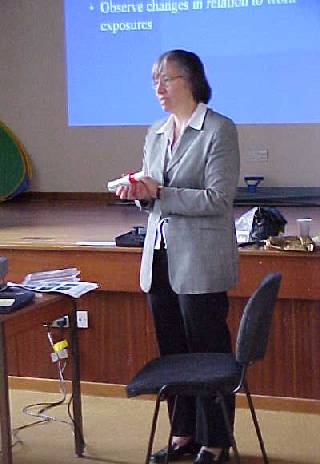
RESPIRATORY HEALTH SURVEILLANCE – Dr Gillian Fletcher
The speaker introduced herself to the group and indicated that the bulk of her activities have been within the pharmaceutical industries and/or associated with animal welfare etc. and a lot of the activities have been in compliance with the COSHH regulations.
Need for Health Surveillance
In order for a medical surveillance activity to be appropriate there should be –
The speaker then took as an example Occupational Asthma – which is a constricting of the airways which can be caused by an exposure to a number of products, as detailed within the HSE list of asthagens.
e.g. R42 may cause sensitisation
Cause – does not mean that it will trigger an ashmatic attack in someone who already has asthma, which can be caused by a number of exposures such as low levels of nuisance dusts, chemical or fungal spores or grass pollen
Risk Assessment
From the intial risk assessment it must be defined who may be harmed and then decide if a health surveillance programme is needed and the input from an Occupational Health Professional may be necessary in making this decision. It is important not to invoke such a programme if it is not necessary.
FULL PRESENTATION
Respiratory Health Surveillance
i) an identifiable disease or adverse health effect may be related to exposure
ii) there is a reasonable likelihood that the disease or effect may occur under the particular circumstances of work, and
iii) There are valid techniques for detecting indications of the disease or effect,
And the technique of investigation is of low risk to the employee.
Identifiable Disease
"Asthma" is characterised by periodic attacks of wheezing, chest tightness or breathlessness resulting from constriction of the airways. A substance is considered to cause occupational asthma if, as a result of exposures in the workplace it both :
a) produces the biological change known as the hypersensitive state in the airways; and
b) triggers a subsequent reaction in those airways
Occupational asthma
- unless work activity generates them or leads to their occurrence at higher concentrations than are normally present in the general environment
Does not apply to substances eg general dust where exposure may produce symptoms in a person with pre - existing asthma but the itself substance is not a cause of occupational asthma
- phthalic anhydride, tetrachlorophthalic anhydride, trimellitic anhydride or triethylene – tetramine
Risk Assessment
Health Surveillance
Information Instruction and Training
Health surveillance
Questionnaire
Lung Function Tests
Investigations
Investigations
- mainly available for large molecular weight
- eg rat urine, dog dander etc
RIDDOR
Action – for employee
Action - review
Survey
Occupational physicians report for 1 month a year cases of work related disease
Rates of asthma highest in females – associated professional and technical
male – craft and related, food and organic material manufacturing
Summary
Health surveillance
i) an identifiable disease or adverse health effect may be related to exposure
ii) there is a reasonable likelihood that the disease or effect may occur under the particular circumstances of work, and
iii) There are valid techniques for detecting indications of the disease or effect,
And the technique of investigation is of low risk to the employee.
AUDIOMETRY – Dr Andrew Mountstephen
The speaker firstly indicated that he was employed as a Consultant in Occupational Medicine both inside and outside of the NHS and his presentation would be based on his experience across a wide range of activities.
Properties of Sound Energy
He then went on to explain how sound energy was transmitted by vibration in air or water in a wave form and that the pressure variations were measured in units of intensity defined as the decibel, whilst the rate of oscillations (frequency) were measured as Hertz or cycles per second.
Whilst the ear is capable of hearing anything from 20 to 20,000 hertz, human speech is mainly within the band of 300 to 4,000 Hertz.
Sound Perception & Hearing Loss.
The make up of the ear was shown and the system of vibrations of the ear drum being transmitted via the three bones through to the Choclea was described which resulted in electrical impulses being sent to the brain which in turn interpreted it as sound.
Conductive hearing loss caused by damage to the ear drum of by blocked passageways is where there is a reduced sound passage through the normal anatomical pathway, but by vibration of the skull the inner ear still functions normally.
Sensorineural hearing loss is where inner ear problems stop the electrical impulse transmission to the brain and in Mixed hear loss there is actually a combination of both forms of hearing loss.
Noise induced hearing loss (NIHL) is the result of exposure to excessive noise energy over a period of time and is a form of irreversible sensorineural deafness. Whilst the onset can be quite quick from high energy levels even lower levels can produce temporary threshold shift. NIHL is characterised by loss of hearing acuity in the 4 to 6 kHz range which is one factor that enables its early identification by periodic health surveillance.
Requirement for Health Surveillance
The Noise at Work Regulations 1989 do not in themselves require employers to provide health surveillance, but the Management of Health & Safety at Work Regulations 1999 do require health surveillance where certain criteria are met. Those being:-
As such the Management of Health & Safety at Work Regulations rquire the employer to identify during risk assessment what activities are likely to result in NIHL and thus if health surveillance is required.
Purpose of noise health surveillance
To check the effectiveness of control measures which are supposed to be in place - provide feedback on the accuracy of the risk assessment – identify and protect those individuals at risk.
It should provide:
But do remember – no health surveillance is a substitute for corrective control measures being in place.
There is no formula to decide when noise health surveillance should be undertaken but the HSE guidance does indicate that perhaps auidomitry should be undertaken where exposure is in the order of 90dB(A)
Audiometry
People undertaken audiometry must be qualified and understand all of the implication of medical confidentiality and it is likely to be undertaken as a base line, then at three yearly intervals (unless significant abnormalities are detected)
Pitfalls
In audiometry
Failure to carry out an examination of the ear prior to audiometry, with the result that:
Failure to time audiometry to minimise the impact of temporary threshold shift.
In hearing conservation
Failure to control noise emissions at source where possible.
Failure to promote and enforce the use of hearing protection.
Bad examples from managers.
Failure of participants to appreciate what NIHL can be like.
Failure to give responsibility for compliance to immediate supervisors
Selection of hearing defenders that actually offer too much protection.
Failure to provide users with a guided choice of several appropriate types of hearing protection.
Failure to train users in effective use of hearing protection.
No clear management responsibility for the hearing conservation programme.
Failure to carry out further audiometry when results show apparent temporary threshold shift.
Failure to use group data from an audiometry programme as a check on efficacy of noise exposure control
OCCUPATIONAL SKIN DISEASES - Dr Trevor Cattermole
Health Surveillance
Classical definition: systematic application of methods to detect adverse effects of work on health of workers.
This could involve air monitoring, and /or even biological exposure monitoring both of which are aimed at assessing the exposure and the potential uptake of a substance once a hazard has been identified and assessed.
Biological effect monitoring is in fact the element of the process involving health surveillance, by monitoring the effect by recognition of the disease.
Why bother?
5% of all self-reported illness is a result of skin problems encountered at work where 56,000 cases are caused by work whilst a further 41,000 are made worse by work.
5% of the attendances at a dermatology clinic are due to contact dermatitis.
Under the Management of Health & Safety at Work Regulations of 1999, regulations 6 requires – health surveillance as appropriate for risks identified in risk assessment
- health surveillance for activities / agents not covered in COSHH or specific regulations
Whilst COSHH 2002, Regulation 11 requires -
- Perform health surveillance where appropriate for the protection of the health of employees exposed, or potentially exposed to substance hazardous to health
and Schedule 6 defines the list of substances and activities associated with this need.
What is suitable health surveillance?
This can only really be determined by a competent person.
It may take the form of biological monitoring, biological effect monitoring, medical surveillance (EMA & appointed doctor), enquiries about symptoms, inspection or examination by a suitably qualified person, inspection by a responsible person, review of health record as considered appropriate to the circumstance.
Several specific examples were then utilised to show the variations which may be encountered and the differing needs.
The risk assessment – identifying the risk agents
What should be done?
What should be recorded?
In COSHH
(a) identifying details & exposure
(b) results of surveillance record of conclusions of fitness to work
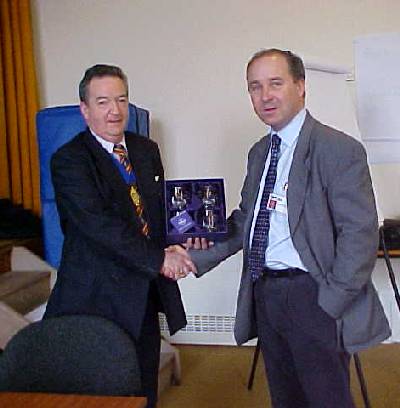
After the workshops, members and speakers gathered in the Lecture Theatre once more and small tokens of the Branch’s appreciation were given to the three speakers.
10.0 DATE OF NEXT MEETINGS
10.1 DISTRICT MEETING -
Thursday 3rd April 2003: 730pm: Happy, Healthy and Here: a proactive partnership approach to Health at Work Scottish Power
10.2 BRANCH MEETING
Thursday: 10th April: Annual General Meeting: Free Buffet Lunch at 1230. 130pm: IOSH President - Eleanor Lawson. AGM business. Interest: Olefactory Excitement - the Taster's Art: Wine Tasting.
Members were encouraged to stay and chat over tea and new members were encouraged to make themselves known to the Executive.
|
Max Bancroft, MRSC, TechSP Branch Secretary |
Richard Lovering, FIOSH RSP, I.Eng MIIE Branch Chair |
