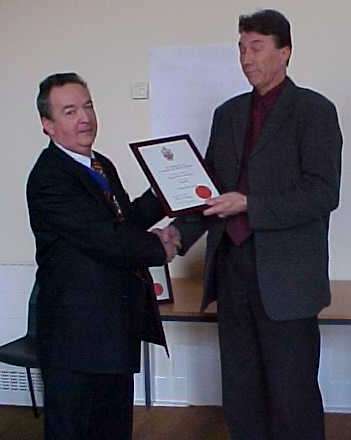
Dick Morrison
Vick Stewart
Minutes
140th Edinburgh Branch Meeting - IOSH
Donaldson’s College, Edinburgh - Thursday 13 February 2003
Sederunt: AHamilton J Hay G B Dick A Dick C Shand D Morrison D R Staines N K Stewart J Davidson C Gilchrist K Glynn J Pitkethly D Gillespie I McDonald J McCraith M Bancroft A Reid A Sharman D Duff J Fisher K Llyod L Young D Bond B Stainton D Cawkwell P Mainka A Evans J Conway M Scott-Smith L Crichton G Horsman M Johnstone J Hepburn B Bryne N Doherty R McLean P Quill J Cowlan S Deans S Davidson J Waddell N Bissett D Meikle J Brannigan H Fraser Wood RR Thomson R Lovering D Petrie
Apologies: Brian Sweeney, Chris White, Iris O’Neill, Graham Lyall, Graham Pearson, David Brown, Steve Boucher, Julian Davis, Calum Wilson, Bob Bertram, Barry Davies, Scott Page, Russell Brownlie
1.0 WELCOME: Richard Lovering was in the Chair. He explained safety and parking arrangements. He welcomed any new members and asked them to make themselves known to members of the Executive at the end.
2.0 MINUTES OF PREVIOUS MEETING (Jan 2003)
These had been distributed as required. With one correction - B Sweeney not B Sweenie, they were agreed a true record – proposed by Andy Sharman, seconded by Jim McCraith.
3.0 MATTERS ARISING NOT ON AGENDA : None.
4.0 CORRESPONDENCE
4.1 Letters/Email/Fax
Fife Chamber of Safety: minutes of January meeting – also notification that their website is now operational.
Scottish Borders Safety Forum: report of last meeting – also reporting that their website (webkeeper Neal Robertson of IOSH Edinburgh Branch) had won one of the Alan Butler Memorial Awards For Excellence, sponsored by BT, and awarded by the National Health & Safety Groups Council. The council is made up of representatives from local health and safety groups across the UK, and is closely linked to RoSPA. They were judged to have made the best use of communications by providing health and safety information to Borders businesses.
Frank Connolly, doing an MSc in Occupational Health through the University of Greenwich had sent a questionnaire which he would like people to complete and return. Copies will be sent out by email.
H&S Consultant needed to advise on construction related project from May 2004, on a flexible basis for approx 15 months. Significant involvement with CDM issues; safety plans and audits. Contact Steve Reid, University of Abertay, Mobile 07812 151822.
HQ Mailing of Branch & District Programme plus 3 calendar cards sent out in January. Cards still available for members to take and give out.
Scottish Health and Safety Revitalizers Forum. In conjunction with the Federation of Small Businesses they are running free short seminars over Scotland in February/March 2003 for SMEs. Please pass message on.
Membership: National Total: 26448 Branch: 764
Corporate – 320; Associate – 248; TechSP – 98
Construction – 190; Public Services – 159; Environmental – 98; Offshore – 47; Healthcare – 39; Fire Risk Management - 20
5.0 BRANCH EDUCATION DEVELOPMENT ADVISOR - Liz Young.
Occupational Nurse Forum: speaker in Glasgow required in early April. Any volunteers please contact Liz.
6.0 SPECIALIST GROUPS
6.1 PUBLIC SERVICES - Marion Johnstone.
National Symposium 1-3 September 03 details given of the subject to be covered – Procurement from HSE Perspective; Environmental Law; Recycling and Waste Management; Violence and Aggression; HAVS; Access and Work Design; Legal Issues; Latex Allergies; Pest Control. Cost £415 + VAT
6.2 CONSTRUCTION - Roddy McLean
SAFETY Health Awareness day at Ingliston had attracted a large number – 350 plus 150 on waiting list.
6.3 FIRE RISK MANAGEMENT - Dave Sinclair. Nothing to report.
6.4 HEALTHCARE - Martin Scott-Smith. Nothing to report.
6.5 ENVIRONMENT - Max Bancroft. Nothing to report.
6.6 OFFSHORE - Tam Boyd. Nothing to report.
6.7 RAILWAYS - Need a representative
6.8 CONSULTANCY - Derek Cawkwell. Nothing to report.
6.9 SAFETY SCIENCES - Steve Boucher. Nothing to report.
6.10 TELECOMMUNICATIONS – need a representative
7.0 FORTH and TAY DISTRICT REPORT
7.1 AGM held – very successful. Good attendance (>40). Constitution adopted and Executive Committee elected: Kirsten Paterson – Chair, Dave Devey – Secretary.
7.2 Karen McDonnell now on Branch Executive as District Liaison in succession to Brian Pill who had presented District with wooden gavel for the Chair at the AGM as a parting gift.
8.0 MEMBERS ITEMS
9.1 Presentations of Certificates etc
Corporate|
Dick Morrison |
Vick Stewart |
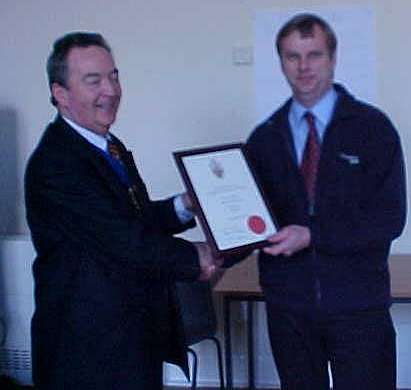
Tech SP – Bob Stainton
9.2 Branch AGM: following posts due for election:
Chair, Vice-chair, Secretary, Treasurer, 2 Committee members, 2 Auditors. All current holders eligible for re-election. Nominations to be with Secretary by March meeting in writing. Nomination forms available and downloadable from Branch website.
9.3 The first presentation was one of the short (10 minute) Members presentations by Andy Sharman entitled "Tackling Behavioural Safety". Andy firstly indicated that he worked within the Scottish and Newcastle group and showed an image of "Bacus" the God of Wine. He indicated that he suspected a number of workers were frequently using "beer goggles" invented by Bacus as they had magical properties of making ugly people appear beautiful and worrying for the safety Professional – unsafe conditions appear safe.
Andy then used a number of pictures of accidents (FLT overturned, Artic trailer collapse, FLT falling off loading dock) to demonstrate how he felt the employees were not taking adequate cognizance of safety in their work and how he had utilized the HSE Climate Survey Tool to develop a questionnaire to establish a benchmark of an employees perspective of safety. The questionnaire was used in both a Distribution Region and within a large brewery.
600 questionnaires consisting of 30 statements covering 9 factors and the details from the 60% return were fed into the HSE software tool to provide details which led to a number of conclusions – amongst which were –
From this is it hoped to put in place a new culture, one which will show commitment from the management, by adequate communication, involvement and teamwork and it is hoped to demonstrate this by monitoring performance and repeating the survey in a years time.
9.4 Mr B Crook, Member, of Kelso has passed on.
10.0 GUEST SPEAKER
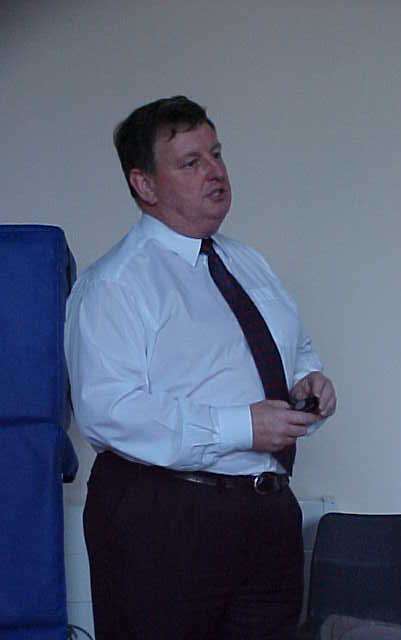
Graham Horsman of Praxis42
Regulatory Synergies between Fire safety & Scottish Building Regulations
The Chairman then introduced the speaker for the main topic as Graham Horsman, who was well versed in Fire safety having worked his way through the ranks of front-line fire fighting prior to going on to the Fire College to teach the subject to fire staff. Graham had then moved on to work for the Home Office within the Fire Prevention legislation team.
Graham then stated he had in total some 40 year experience gained within the Fire Brigades of England and Wales prior to moving into Commerce and Industry as the Global Fire Safety Manager within Cable & Wireless. Since the outsourcing of the H&S department of Cable & Wireless Graham had provided both a Fire Safety Manager’s role within the outsourced Company – Praxis42 and had operated as an Independent Consultant within the specialization of fire safety..
Fire safety advice
Fire safety legislation in the UK as a whole is still going through a fairly traumatic set of changes and a reform to the main Act is going through Parliament where a full rehash is being considered. Today’s presentation however would not be looking in detail at the actual Fire Safety Legislation but would instead be looking more into the links to Scottish Standards and how they are, or may be interpreted.
The basic form of interpretation is however one of the major issues with Fire Prevention Officers from the Fire Brigade. Members of the Brigade often look on the Fire Prevention officer as fitting into one of three categories –
Fire Safety in Scotland
The primary act is the Fire Precautions Act 1971 (frequently termed as the Principle Act) under which have been created two orders dealing with the actual requirements for fire safety within Hotels & Boarding houses and the second one on Factories, Shops & Railway Premises. The bulk of the legislation and the related orders following on from a disaster of some form, such that these orders were the result of a fire at the Rose & Crown public house where 8 people died, the fire at Bradford’s valley parade football ground and then the Kings Cross fire.
Then we started to see the influence of the EC directives and since then we have seen the Management of Health & Safety at Work Regulations and the Fire Precautions (Workplace) Regulations which has made a change of emphasis where the fire authority define safety of buildings & certification, to shift the onus from the owner/landlord over to the employer. This placing of the duty on the employer is likely to be extended further still in the future.
Building standards in Scotland are defined within the Building Standards (Scotland) Regulations of 1990, which have been amended in 1993, 1994, 1996, 1997, 1999 and the sixth amendment laid before the Scottish Parliament 24/9/2001 came into force on the 4/3/2002 (but allowed work under warrants applied for before then to be done under the fifth amendment. Will we be looking to a seventh amendment or a new act? The Building (Scotland) Bill laid before Parliament 18th September 2002
Building Control
Local authorities administer building control in Scotland enforcing regulations made by Scottish Ministers subject to approval by the Scottish Parliament.
Building control applies to – Construction, Alteration, Extension, Demolition, or and change of use which attract additional or more onerous requirements under the regulations.
It is an offence for anyone to carry out building works without a warrant fro the local authority. It is the responsibility of the building owner to apply for and obtain the building warrant. A building warrant is the legal permission to commence work. Where it is impractical or unreasonable to meet the requirements you can apply for a relaxation. A warrant is valid for three years from the date it is issued, but this period can be extended if a request is made in that period.
Before a building can be occupied it is necessary to obtain from the local authority a certificate of completion. This provide formal confirmation that the building work has been carried out in accordance with the building standards regulations.
Building Standards / Technical Standards
Technical Standards relative to fire safety of buildings are –
Technical standards refer to British Standards and there are currently 104 British Standards relating to Fire – Graham then asked the members if they knew of two BS’s = 4970 & 8300
Part E – Technical Standard Requirements
The basic intention of the requirements for means of escape is that everyone within a building may reach either a place of safety (outside) or, in certain circumstances, a protected zone within a reasonable travel distance
A building must be planned so that –
a. every escape route leads to a place of safety;
b. every escape stair which forms part of an escape route, is protected from fire, smoke and hot gases which might obscure or obstruct the escape route.
c. provision is made within a protected zone for a refuge for wheel-chair users; and
d. within those parts of a building where people are at greatest risk the layout of the building is such as to limit that risk to the utmost practical extent.
Suitable provision must be made for access to the outside of a building
a for fire-fighting and rescue vehicles from a public road.
b a water supply installation must be available and, in the case of high buildings,
c suitable provision must be made for fire-fighting within the building.
Minimum number of exits in relation to occupancy capacity
Not more than 60 persons at least 1 exit
61 – 600 persons a minimum of 2 exits
More than 600 persons a minimum of 3 exits
Travel distances for different groups – with one or more exits
| Purpose Group | One direction | More than one |
| Residential Care | 9 | 18 |
| Offices | 18 | 45 |
| Shop and commercial | 15 | 32 |
Where travel distance includes an unenclosed staircase the travel distance is measured along the pitch of the nosings including any landings and where two exits are available the enclosed angle between them must be a minimum of 45 degrees
Fire doors must:
Where a corridor forms part of an escape route and escape is available in two directions and the corridor is more than 12m long the corridor must be sub-divided for smoke control purposes.
Any part of an escape route must have:
a) artificial lighting provided from a protected circuit; or
b) emergency lighting
Every workplace must be provided with means for detecting smoke and means for raising the alarm
Summary
Whilst a number of the basic requirements for fire safety in Scotland are based on the related British Standards, the regulations from the Building Standards (Scotland) Regulations frequently allow an increased level of interpretation and common sense, but there are some areas of this same degree of common sense within the Fire Regulations throughout the UK. The requirements for means of fire detection and fire warning being examples of this level of sensibility – Graham asked the members if they thought that someone "sniffing smoke" and then shaking a school bell or shouting "fire" would be sufficient to meet the regulations = it is. This sort of interpretation was aimed at ensuring the "corner shop" could still operate legally.
There then followed a very lively and varied question and answer session which the Chair had to call to a halt as time had run out.
11.0 DATE OF NEXT MEETINGS
11.1 BRANCH MEETING
Thursday: 13 March: Occupational Health - Hot topics familiarisation workshop : skin, lung function tests, audiometry. Occupational Health and Safety Advisory Service. Members will be asked to chose two workshops out of three on arrival. Branch business will be at a minimum due to time constraints.
11.2 DISTRICT MEETING -
Thursday 3rd April 2003 Happy, Healthy and Here: a proactive partnership approach to Health at Work Scottish Power
12.0 CLOSURE
Richard closed the meeting and encouraged members to stay and chat especially new ones.
|
Max Bancroft, MRSC, TechSP |
Richard Lovering, FIOSH RSP, I.Eng MIIE |