To return to previous page, close this window
MINUTES
139th Edinburgh Branch Meeting
Donaldson�s College, Edinburgh - Thursday 9th January 2003
Sederunt: M Bancroft J Davis D Gillespie M Scott-Smith D Jones I Wilson R Brownlie S Boucher D Sinclair B Sweenie D Duff R Walker B Stainton B Byrne G Dick J Conway V W Stewart G Macnab AA Reid A Milne N Doherty S Chisolm H Fraser Wood B Anderson M Johnstone L Young J McCraith K Lloyd R Lovering A Sharman A Evans
Apologies:� G Lyall, R McLean, N Robertson, D Morrison, R Bertram
1.0������ CHAIR: �Richard Lovering welcomed those present and wished them a Happy New Year. He covered the safety arrangements.� He welcomed new members who should make themselves known to the Executive Committee.
2.0������ MINUTES OF PREVIOUS MEETING (Dec 2002)
Postal copies had not yet been distributed but hard copies were available.� Email copies had gone out. ��In the Sederunt, it should be D Morrison not P Morrison.� In section 9.3, it should state glasses not decanters.
With these corrections, the minutes were agreed as a true record � proposed by S Boucher and seconded by R Brownlie.
3.0������ MATTERS ARISING ��
3.1������ The Chairman stated he had received an electronic version of the new logo which he displayed.� Branches would start using it in April.
4.0������ CORRESPONDENCE
4.1������������������ Letters/Email/Fax���������
����������� Dick Morrison recently received Corporate Membership � he didn�t want formal presentation of Certificate but would like it recorded in Minutes.
����������� 4.2� Membership:
National total 26244���� Edinburgh Branch 757 of �which: Corporate 313; TechSP 92; Associates 252
Specialist Groups: Construction 188; Public Services 160; Environmental 98; Health 39
����������� 4.3������ Events:
����������� IOSH Conference & Exhibition � SECC Glasgow � 23/24 April.
Scottish Construction Safety and Health Awareness Days: Edinburgh 6th February; Aberdeen 11th February
5.0������ BRANCH EDUCATION DEVELOPMENT ADVISOR - Liz Young.
Liz reminded members that the route to TechSP via portfolio was now closed.
6.0������ SPECIALIST GROUPS
6.1 ����� PUBLIC SERVICES - Marion Johnstone:
PSG had met on 3rd December. The Employers Organization (equivalent of COSLA in England) will have a link into PSG website.� Very proactive in H&S and would be worth a look.�
2003 PSG plan:
Will be complete next meeting � March and be publicized in PS News and website
One objective � publication looking at �the effect of best value and best value experience�
Continue dialogue with key external organizations including HSE.�
PS group have been invited to send member to HS Forum on local government.�
PSG Mission statement being formulated in order to have clear strategic focus.
National Safety Symposium: York 1-3 Sept 2003.�
It was reported that one English Council had been advised that physiotherapy services were a benefit in kind and therefore taxable.� Some members thought this issue had been resolved in Scotland but others reported there was still dispute.� Given the clear benefit, this seemed a perverse decision.
6.2������ CONSTRUCTION - Roddy McLean .� Nothing to report.
6.3������ FIRE RISK MANAGEMENT - Dave Sinclair.
The last meeting took place on the 17th December 2002 at The Grange.
Main Topics:
FUTURE MEETINGS � Due to proposed building work later this year space will be at a premium. As a result we have looked at our �Membership Base� and have decided to hold our meetings in locations where we have a sizeable number of SG Members. They will be invited to join us after our formal meeting in �Question & Answer� session. Further details will be sent to SG Members once venues have been confirmed.
FRMSG NEWSLETTER � Next Issues being drafted now for issue late February / early March.
ACTION PLANS � 2002 has been reviewed and 2003 drafted for final comment. Five Year Plan has been updated and Issue 2 will be available on the Web Site.
CHAIR OF FRMSG � David was pleased to report to the Branch that he had been elected as successor to Gary Cutter as Chair of the SG later in the year.
FIRE SERVICES STRIKE � Although talks are ongoing, remember that dates for two 48 hour strikes are still in place for the 28th & 29th of January, and the 1st & 2nd of February 2003.
6.4������ HEALTHCARE - Martin Scott-Smith.� Nothing to report.
6.5������ ENVIRONMENT - Max Bancroft. Nothing to report.
6.6������ OFFSHORE - Tam Boyd.� Nothing to report.
6.7������ RAILWAYS - Need a representative
6.8������ CONSULTANCY - Derek Cawkwell.� Nothing to report.
6.9������ SAFETY SCIENCES - Steve Boucher.� Nothing to report.
6.10���� TELECOMMUNICATIONS � need a representative
7.0������ FORTH-TAY DISTRICT REPORT�
7.1������ Next meeting (6th February) will be first AGM as a properly constituted District and will be addressed by IOSH President Eleanor Lawson and Hazel Harvey, Head of Professional Affairs IOSH HQ.
8.0����� MEMBERS ITEMS
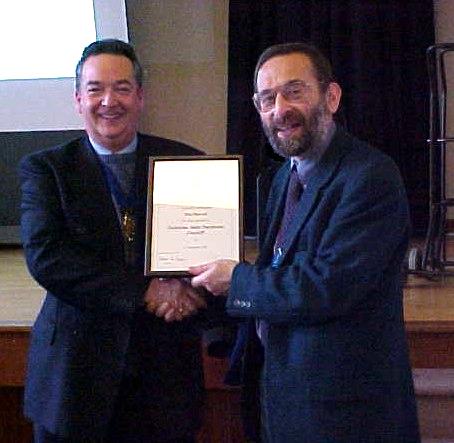
8.1������ Presentations of Certificates etc
����������� Tech SP � M Bancroft
8.2������ Jim McCraith � Carbon Monoxide.
The first presentation was one of the short (10 minute) Members presentations by retired Member Jim McCraith on the topic = Carbon Monoxide.
As Jim introduced himself to the group he stated that those members who remembered him from his days of tutoring on IOSH courses at the local college should not fear, as he was not reverting to �teaching mode�, but was purely reminding those present of the dangers associated with carbon monoxide, the bulk of his experience being from his working life within the mines.
Every month it was common place to see in the news details of someone who had died from carbon monoxide poisoning, in fact there were two such incidents during December 2002 and it was often due to some of the properties of carbon monoxide that the event had happened.
Carbon monoxide � CO - is a colourless, odourless gas, produced as a consequence of carbon being incompletely burned in air. Complete combustion produces carbon dioxide which does not provide the same level of hazard. CO has the same density as air such that it will distribute itself evenly within the air, whereas CO2 being heavier than air forms into low pockets.
Exposure to 0.25% (2500 parts per million) will kill a bird within 5 minutes whereas a man will not suffer any noticeable effects � hence the reason for birds being used as the early form of gas detection in the mines. However at exposures of 0.1% (1000 part per million) for a period of 40 minutes, the bird would only be suffering minor effects which would be making it �groggy� whereas the man would be unconscious. The frequent reasons for fatal exposure is often due to exposure to incomplete combustion of fuel gases in confined spaces, such as cookers in caravans or night-watchmen�s huts.
Effects on the individual from Carbon monoxide exposure range from � headaches, feeling drowsy, nausea, to not knowing about where you are or what you are doing. Persons suffering from CO poisoning will most likely have a flushed and have a cherry pink complexion.
Andy Sharman reported on implementing various ideas to encourage members to attend Branch and District meetings. He distributed a small pocket calendar for members and others with dates of Branch and District meetings highlighted.� This was well received.� A plastic deluxe version would also be available shortly.� Members were encouraged to take these and distribute them to those not present.
9.0������ GUEST SPEAKER
Ian Hogarth of Scottish Borders Council
� Emergency Planning
Andy Sharman introduced the speaker to the group as Ian Hogarth � Emergency Planning Officer from Scottish Borders Council. Although he did not know Ian at the time, Andy stated he had been glad to have received services provided by Ian during the recent past years, when he as a resident of the Borders he was one of the individuals cut off by the freak snow and ice problems and also suffering from flooding.
Ian then indicated that his background had been originally within the Police force and when he came to retirement, he thought of taking on a position with a lot less pressure and call on his time. He felt his background had provided him with experience of dealing with emergencies within the Police force, including an input into the Lockerbie incident, road incidents and he had covered the first military jet crash (outside Falkirk), so he applied for the position of Emergency Planning Officer in Borders Council. However, on his first day in the job, whilst his assistant was off with heart problems and his admin assistant was off on leave he found the job was likely to be a little broader than he imagined being faced with a phone call at 9.10 am on Monday 26th June 2000 from the Coast Guard stating there had been an oil slick created off the coast and what was he going to do about it.
The Borders�
The speaker showed a map of the Borders and indicated some of the factors which demonstrated the enormous nature of the task undertaken by an Emergency Planning Officer for the Borders Council. Factors like = it covers an area of 1,800 square miles; has a population in the order of 106,000, which is spread across 10 main towns, 40 larger settlements, and 100�s of smaller settlements. They are serviced by more than 1,900 miles of roads � one colleague even calculated that if all the roads in the Borders were laid end to end they would reach from Berwick to just short of Moscow.
Emergency Planning
Ian then indicated that it was generally accepted that emergency planning was all about Planning for the expected (ice, snow, flood, major accidents, etc � you knew they would happen you just don�t know when) and Prepare for the unexpected (the strike and fuel crisis, foot and mouth disease, etc) � Ian likened it to �Five minutes before the party is not the time to learn to dance�.
The basis of legislation which states there is a need for emergency planning is contained within the Civil Defence Act 1948 which was really aimed at civil emergencies, but is still the only piece of legislation relating to the requirement. It places a requirement locally on = the elected members and Chief Officers, who usually appoint an Emergency Manager to do the work on their behalf � the ultimate duty being to protect life and property.
The need for emergency planning ��
Emergencies and disasters can happen at any time and there is a perceived condition that they are increasing all the time and local authorities have an increasing duty of care.
Emergency Planning is about three things �
- promoting and developing inter-agency co-operations and co-ordination
- developing community capacity to Prevent � Prepare � Respond � Recover
- educating the public
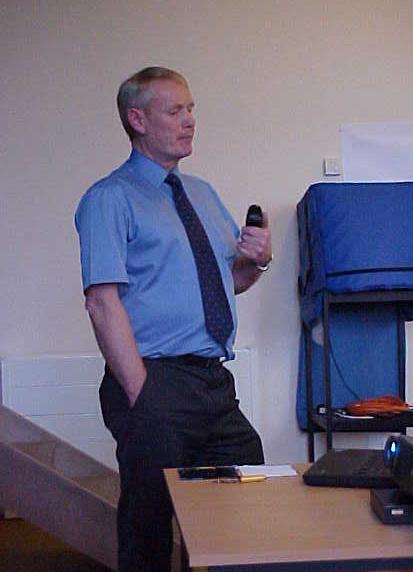
and hence the Emergency Planning Officers job is to act as Facilitator, coordinating the efforts of others. The speaker frequently heard the comment � YOU have an emergency so WHAT ARE YOU DOING ABOUT IT? such that he often had to point out HE did not have the emergency, but he would help them to control it and deal with it.
The types of threats which had to be considered included �
- Natural disasters = climate change, fires, floods, snow, drought, epidemics
- Technological disasters = Nuclear, chemical, pollution, transportation, communications
- People based disasters = Strikes � Fire service, Fuel embargo
- Attack & terrorist incidents = Chemical, biological, radiological, nuclear
In each of these conditions the Public expected to be warned in good time such that you had to be able to assess the magnitude of the event quickly and accurately so that you can keep them informed. Make arrangements for safe evacuation and rapid restoration of services and provision of assistance during the recovery process and above all never to get caught out the same way a second time, so you must learn the lessons from any shortfall
During any major incident the emergency manager must be able to coordinate and facilitate to enable others to support and assist the Blue-Light services, support and care for the community, take steps to reduce the impact of the incident � all of this emphasizing the fact that no one agency will be able to cope alone and it is only during the return to normality that the emergency officer will take the lead role.
Threat Assessment
The breadth here is extensive and has to include � Weather & climate change conditions, which Ian firmly believes is noticeable now - Transport related and Ian quoted the example of a lorry with LPG load with its rear tyres on fire � the driver had called in on a mobile stating he could not stop as the flames would engulf the tank with disastrous effects. The eventual action was for a squad of Police cars setting up at the road-side in advance of the lorry in a deserted location ready with fire extinguishers so they could deal with the fire as soon as he stopped � the Northumbrian authorities refusing to accept the burning lorry. � Military activities from crashing planes � Communications failure and a recent incident in England had shown the level of problem this had created when all of the BT lines went down � International incidents and the coach crashes of school parties abroad or even holiday maker had shown the need here for good communications in particular.
Additional to these for the Borders consideration has to be given to the local threats such as � Torness � high pressure pipelines � coastal & inland water pollution � water or airborne diseases � contaminated water supplies � diseases of animals � forest fire.
Making it work
Three basic principles have to be followed �
- Coordination = no single agency has the resources to handle it alone
- Plan, train & work together = don�t get doing things alone, follow one plan
- Normal role � unusual circumstances = get fire fighting fire, not caring for injured, use typists for admin roles and always use the specialists in the specialist role.
Within the Borders the group making up the coordinated role are =
Borders council, Fire Brigade, Police, Red Cross, Scottish Power, Ministry of Defence, Scottish Water, SEPA, WRVS, Transco, Coast Guard, Ambulance service, NHS, Scottish Executive
Summary
To round off Ian showed an number of slides demonstrating the sort of events which they have dealt with in the Borders over the last few years and showed there was an urgent need to ensure specialist activity had to be channeled in the correct manner to gain the greatest benefit and he believed that table-top exercises had great benefits whereas the use of Live Exercises could be too costly and having limited benefit. He then added that he felt any successful Emergency Manager must have �A high tolerance of ambiguity and conflict ( which he said was a polite way of stating you must have a thick skin) � Commitment to the job � A belief you can make a difference.
Finally � when your boss is snapping at your heels and everyone wants a piece of you � remember there is always someone worse off then you
10.0���� DATE OF NEXT MEETINGS
10.1���� BRANCH MEETING�
February 13: Regulatory synergies between Fire Safety & Building Standards (Scotland) Regulations Graham D Horsman GIFireE MIFPO MaPS: Fire Consultant and Fire Manager, Praxis42
10.2���� DISTRICT MEETING -
Thursday 6th February: Team Based Learning from Accidents: Mr Norman Stevenson � Group Safety, Health and Environmental Manager � Motherwell Bridge Holdings.� Also District AGM. �Free Buffet - 6 for 630 with meeting starting at 730pm
11������� CLOSURE
The Chairman reminded those members who are new to Edinburgh Branch to make themselves known to a member of the Branch Executive during the tea/coffee and mingle time
Max Bancroft, MRSC, TechSP
Branch Secretary