Minutes of 136th Edinburgh Branch Meeting
Donaldson’s College, Edinburgh - Thursday 12th September 2002
SEDERUNT:
A Dick G Barrie G Dick R Paterson D A Brown D Sinclair C Wilmott R Stainton G MacNab M Bancroft R McLean R Lovering I O'Neill A Sharman A Green A R Wallace C Lawson L Denholm N Doherty S Boucher E Ramsay P J Colquhoun A Martin J Conway V W Stewart J McCraith K Lloyd J Hepburn M Johnstone K Hill B Anderson
APOLOGIES:
Liz Young Chris White Brian Pill Julian Davis Bob Bertram J P Toland Graeme Lyall Ron Staines Jim Gaffney Scott Gartshore Barry Davies Iain Murray
1.0 CHAIRMAN - Richard Lovering took the chair and welcomed the members after the summer break.
2.0 MINUTES OF PREVIOUS MEETING (June 2002)
The Secretary applogised for non-delivery of minutes to those who receive hard copies. His PC had been struck by a bug and he was still in recovery mode. The minutes were agreed a true record proposed by A Sharman and seconded by J McCraith
3.0 MATTERS ARISING
Noted that 23 had turned up to the Falkirk Wheel and that the Secretary's Sipper had been won by the past secretary again. Again, thanks were due to the organisers,sponsors and supporters especially our Social Secretary.
4.0 CORRESPONDENCE
4.1 Letters/Email/Fax
From HQ:
If we are planning events - especially anything major - in 2003 now is the time to tell HQ so that they can put it into a crowded diary.
Volunteer Resources Working Party carrying out a survey into voluntary activities so that HQ can incorporate this aspect of IOSH into Corporate Strategy - survey copies in Sept SHP and also available at meeting for members to fill one in and send off.
4.2 Membership: 724 Branch members from a national total of 25047 - annual drop due to non-payers suspension (27 in our case)
296 Corporate 260 Associate 80 Tech SP
183 Construction 158 Public Service 91 Environmental
44 Offshore 37 Healthcare 17 Fire Risk management
4.3 Events:
BOHS: Scottish Region: Trends in Asbestos Related Disease: 19 Sept: IOM Edinburgh
IOSH: Fire Risk management - thinking outside the box: 26 Sept: Old Trafford, Manchester
IOSH: Safe Working at Heights: 8 Oct: Aston Villa FC, Birmingham
OHSAS: Asbestos: Free Seminar: 8 Oct: Navy House, Rosyth
OHSAS: Asbestos: Free Seminar: 10 Oct: Wedderburn House, Dundee
IOSH: the safety manager in hospital design: 10 Oct: Bristol Zoo
National IOSH AGM: 15 November 2002: Murrayfield. H&S Seminar 0845am - 3pm, followed by AGM followed by IOSH Dinner/Presentations including Royal Charter/Ceilidh.
4.4 Job Spot: Ana Navarrete: qualified Occupational Health Physician from Chile looking for work experience for about 6 months
5.0 BRANCH EDUCATION DEVELOPMENT ADVISOR - Liz Young - on holiday - no report
6.0 SPECIALIST GROUPS
6.1 PUBLIC SERVICES - Marion Johnstone. Nothing to report apart from highlighting the National Safety Sysmposium had taken place at the beginning of September.
6.2 CONSTRUCTION - Roddy McLean - Nothing to report.
6.3 FIRE RISK MANAGEMENT - Dave Sinclair
FIRE SAFETY REFORM
The Office of the Deputy Prime Minister has issued a consultation paper on
proposals to reform the legislation governing fire safety in England and Wales. The proposals are to introduce a new regime for fire safety, based on the risk assessment provisions in the Fire Precautions (Workplace) (Amendment) Regulations 1999. The new legislation would revoke and replace the previous Regulations, along with repealing the Fire Precautions Act 1971, and revoking other fire provisions contained in over 100 other pieces of legislation.
If the new proposals are adopted, fire certificates will no longer be required for workplaces and other non-domestic premises. Instead, the responsible person (in most cases the employer) will have a duty to:
It has been suggested that the reforms will save businesses money because they will no longer have to pay the fee that is currently required when applying to the fire authority for a certificate.
The fire authority will continue to enforce the laws by inspecting premises.
A Consultation Document on the Reform of Fire Safety Legislation can be accessed on the Internet at
www.safety.odpm.gov.uk/fire/consult/legislate/pdf/firesafe.pdf
ADVICE ON USING GAS CYLINDERS SAFELY
The Health and Safety Executive has published a new leaflet on eliminating or reducing the risks associated with using gas cylinders.
The leaflet offers simple, practical advice to reduce the risks of accidents involving gas
cylinders which can cause serious injury or even death. It is aimed at anyone who
manufactures, owns, fills, repairs or uses gas cylinders at work.
The publication explains simply what the main causes of accidents are and how to reduce
the risk of an accident. It also sets out the legal framework governing gas cylinders. The
main hazards associated with gas cylinders are:
Copies of The Safe Use of Gas Cylinders , ISBN 0 7176 2332 7, are available in priced packs of 10 and can be ordered online at www.hsebooks.co.uk or are available from HSE Books, PO Box 1999, Sudbury, Suffolk, CO10 2WA. Tel: 01787 81165. Fax: 01787 313995. Single free copies are also available from HSE Books.
6.4 HEALTHCARE - Martin Scott-Smith. Nothing to report
6.5 ENVIRONMENT - Max Bancroft. Nothing to report
6.6 OFFSHORE - Tam Boyd. Nothing to report
6.7 RAILWAYS - Need a representative
6.8 CONSULTANCY - Derek Cawkwell. Nothing to report
6.9 SAFETY SCIENCES - Steve Boucher. Nothing to report
7.0 PROPOSED DISTRICT REPORT -
7.1 The Chair reported that the application had been succesfully presented by Hazel Harvey, HQ Head of Professional Affairs to the Management & Finance Committee and was now due to go before the IOSH General Council in September. If approved by them, then the District would be "official".
7.2 Brian Pill - on holiday: written report - Committee met 19 August: well attended: arranging procedures for meeting formats and thinking of ways to improve attendance above the present regular 20.
7.3 Bob Stainton reported briefly on the interesting talk on Health and Safety Management at Edinburgh Zoo which had started their new programme.
8.0 MEMBERS ITEMS
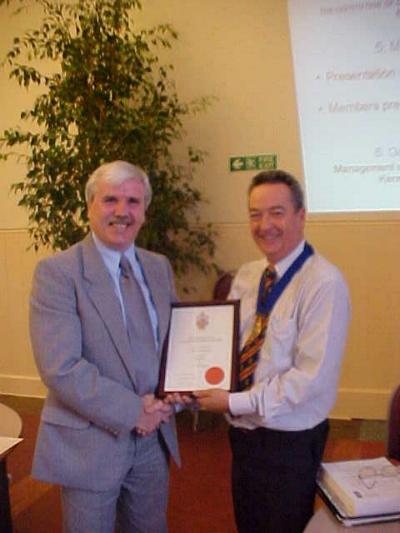
8.1 Presentation: The Chair presented Robert Paterson with his certificate on achieveing Corporate Membership of IOSH.
8.2 Chair's proposal for presentations by Branch members. The Chair had drawn up a form which would enable members to propose items that they would give brief presentations on and also allow members to suggest what they would like brief presentations on.
9.0 GUEST SPEAKER
Management of Occupational Vibration
Marion Johnstone introduced the speaker as Kenneth Hill whose background included a period as an health and safety officer in Glasgow Council, prior to him forming his own Company specializing in vibration consultancy as HSE Solutions. His organization now provides training in methods of assessing vibrations and the management of occupational vibration, as well as proving an input to BSI committee operations related to vibration safety.
Kenneth then provided an overview of the elements which he intended to cover in his presentation as = An introduction to industrial vibration exposure - Medical conditions associated with occupational vibration - Current & future legislation & standards - Civil action claims - Managing vibration
History
The first publication on cases related to hand and arm vibration was in 1911 in Italy whilst it was not until 1930 that the first British cases were reported. By 1975 there had been a draft publication of a British Standard on HAV (hand & arm vibration) and WBV (whole body vibration).
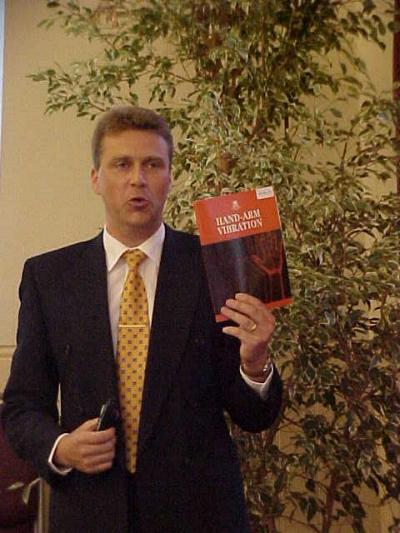
In 1986 HAVs became a reportable disease and in 1994 HS(G)88 - Hand & Arm Vibration was published by the HSE which is generally accepted as being the "date of knowledge" from when all civil claims for injury from vibration would stand a good chance of success.
From 2001there has been BS EN ISO 5349 which in particular is considering Occupational Vibration, which is described as movement of a surface in contact with the body and it is not just vibration per se as there must be contact affecting the body at risk, but it can be in many different directions at the same time
Exposure terms & Standards
The amount of movement (the magnitude) can be measured in any one of three planes (X, Y, Z) and there is currently a problem in the details provided by machine manufacturers in that they can (and do) quote any one of the magnitude figures, which may be the smallest or the largest. Current developments are requiring the use instead of Root Sum of Square figures, which is the root sum of the squares of all three axes, such that a defined figure can be utilized within standards.
The original Daily A(8) Exposure levels of 2.8ms2 on the dominant axis (after which medical surveillance is required) is being superceded in 2004 by a new standard which uses a figure of 2.5 ms2 as being the initial action figure and a maximum daily dose of 5.0 ms2
The speaker then went on to describe the use of a bar chart which they had developed to aid the ease of calculation of the level of exposure which users of kit may be exposed to. He also warned of the problems with assuming the manufacturers figures were an accurate indication and said it often pays to consider adding at least 1/3rd onto their figures to gain something closer to reality.
Often the manufacturers would suspend a piece of kit on springs - set it going and measure its vibration in free air. This does not indicate the actual levels likely to be endured by the actual user ands as such he suggested Operational Assessments were and essential part to be followed for the future legislative requirements to be met.
Daily Dose.
A system of "points" was explained where the operator was allowed to accumulate 100 points as a maximum, where the figures had been worked out previously from typical vibration levels expected from various machinery.
e.g.
For machine A with a vibration level of 5m2 (Say an angle grinder)
The points scale may be 10 points for 15 minutes use
Whilst machine B with a vibration level of 11m2 (say a chain saw)
The points scale may be 30 points for 15 minutes use
So if the persons used machine A for 60 minutes and machine B for 30 minutes the calculation would be - M/c A ( 4 x 10) 40 points + m/c B (2 x 30) 60 points = 100 points total such that after the 90 minutes the person would have reached his limit for vibration exposure for that day
Medical Conditions
Each of the stages of vibration white finger were described, where the degree of affect on the circulation and nerve damage and the length of the finger which was affected. Stage 1 which was down to the first finger joint could lead to a civil claim for between £5,000 and £15,000 whilst a stage 2 civil claim may gain between £20 and 45,000 and a stage 3 could be anywhere between £50 and 197,000. Once stage 4 has been reached such that amputation of the finger is necessary the sky is the limit.
As well as HAV syndrome there is concern that lower back pain can be linked to whole body vibrations and there is also the concern for trauma of the spine from an impact style vibration as may be endured on a hard seated vehicle.
Whilst ride on kit may generate whole body vibration, often the worst element is related to the HAV from the steering wheel.
The future
So what does the future hold?
The Health & safety at Work Act, The Management of Health & Safety at Work Regulations, The Provision and Use of Work Equipment, RIDDOR, and the Supply of Machinery Regulations all make a requirement for the control of vibration in one form or another and when you add to these the Physical Agents directive which comes into force in 2004, it is obvious that vibration needs to be considered much more as a hazard needing control than it has so far be considered. Operation of a Fork Lift Truck on smooth concrete can easily give rise to whole body vibration in the order of 1.15 m2 such that an 8 hour shift would be in excess of the limit, but by consideration during purchase it is often cheaper to consider the embodiment of vibration damping measures - such as a good seat.
So far in one local authority they have had to pay out a single claim for £197,000 for a stage 3 vibration claim and they have a further 100 claims outstanding.
Summary
Management of hand & arm vibration needs to be considered sooner rather than later -
10.0 ANY OTHER BUSINESS
Kevin Llyod reported on a new guidance from IOSH on what a company could include in its annual report on H&S. It made for interesting reading.
11.0 DATE OF NEXT MEETINGS
11.1 BRANCH MEETING - October 10: CDM ACoP: Fraser Cook
11.2 PROPOSED DISTRICT MEETING -
Thurs 7th November.: A systematic approach to managing asbestos: Douglas Collins
12.0 CLOSURE
The Chair thanked all those attending and closed the meeting.
Max Bancroft, MRSC
Edinburgh Branch Secretary