This page has been opened as a new window.
Please close it to return to the main meeting page
Minute of the 129th Meeting of the Edinburgh Branch, Donaldson’s College for the Deaf, Edinburgh at 1330 on Thursday 8th November 2001
SEDERUNT
M Bancroft J Smith J Davis K L Lloyd R Lovering C E White P Conway L Wilson F Wood R Edward J Davidson S Page C Wilmott R Walker C Arnott A Whyte G McNab R Wilson G Dick T McGowan D Forfar D Slack V B Jigajinni G McMahon R McLean V Stewart I O’Neill J Hepburn J McCraith G McGeorge M Johnstone
Plus Visitors and Guests.
APOLOGIES
D A Brown B Pill G Lyall K Wilson L Young I Murray R Brownlie N Robertson A Sharman B Bertram D Sinclair
1.0 CHAIRMAN Richard Lovering
R Lovering took the Chair in the absence of the Chairman explaining that B Pill had sent his apologies. The meeting format was explained and the importance of the Sederunt as a head count emphasized. The parking arrangements again mentioned and the numbered bays being reserved for the Lothian and Borders Police and members advised to move their cars if so parked before attracting the attention of others. All were encouraged to mingle during tea and hopefully gain benefit from attending the meeting.
2.0 MINUTES
The 128th Minute was accepted after the amendments as follows:
Section 9 – Line 2: delete Friday – add Thursday. Delete 1.00pm – add 1.30pm
Being Proposed by J McCraith and Seconded by M Bancroft.
The Chairman then explained the new arrangement for the distribution of the minutes and the support being given by Headquarters. There will be difficulties should future mailing require inclusion such as flyers. The possibility of assisting local organisations with publicity will have to be re-examined by the Executive Committee.
3.0 MATTERS ARISING
Item 4.0 – Mast Climbers. This topic will be raised during Members Items.
4.0 CORRESPONDENCE
4.1 Letters: B Ellis. Branch change and request for minute continuation.
4.2 Fax: None
4.3 E-mails: The Secretary reported that he had received in excess of 105 this month.
N Howard. Minute distribution and Branch assistance.
E Lawson. Scottish Region Liaison Group.
D Devey. District information and minutes.
J Purdie. Information regarding MEWPs.
J O’Neill. Presentation of Parchment.
R Wilson. West of Scotland Branch minute.
C Arnott. New member information request.
A Melrose. IOM management regulations workshop feed back.
A Sharman. Branch assistance.
Many of executive business.
4.4 Minutes:
Fife Chamber of Safety
West of Scotland IOSH
Scottish Construction Safety Group.
Proposed District
4.5 Members The total membership of the Branch stands at 738 from 24,500 nationally
4.6 The Grange:
N Howard. HSE requesting branch visits to promote COSHH and OELs
N Howard. Details of branch event insurance.
L Spence. Invitation to AGM and dinner.
A Hayes. Introduction of Railways Specialist Group.
C Gore. Council précis and AGM confirmation.
5.0 BRANCH EDUCATION DEVELOPMENT ADVISOR – Liz Young
There was no report presented on behalf of the BEDA but Associates were reminded that the last date for registration to join the up-grading scheme by portfolio was the last day of December 2001.
6.0 SPECIALIST GROUPS
6.1 PUBLIC SERVICES – Marion Johnstone
A detailed report was given covering the attendance at the group’s meeting at HQ. The areas covered included dropping the ‘Specialist’ wording from the name, lengthy discussion about the electoral procedures, UNISON involvement in promoting the Re-vitalising programme, 40 page document covering guidance for controlling violence at work, Roving Reps, Branch Champion and support, guidance notes for volunteers, discussion document for Road Risk, Championing HAVS guidance, Manual Handling particularly in Libraries, encouraging dialogue between HSE and LA. Attendance at the Safety Symposium was also discussed and stated as being a really good and successful event.
6.2 CONSTRUCTION – Roddy McLean
Edinwork. The Edinburgh Co-ordinator was introduced as Greg McMahon (Tel; 0131 469 3889) as was the scheme which has the main aim of tackling social exclusion by making sure that local communities and unemployed people can take a share of the employment in new developments like the South east Wedge and the Waterfront. Funding is available for up-skilling construction general operatives and tradesmen – both the training costs and the down time maybe included. Some of the conditions include the work being carried out in Edinburgh, training is CITB grant aided and the Company is CITB levy registered.
Canal Crossing. One member requested information from anyone with experience of having to form a crossing over waterway when forming a new housing site. Offers to build a Bailey bridge would be considered. Men, materials and transport have to reach the proposed site.
Information was given regarding recent publications and included:
- HSG 201 – Controlling exposure to Stonemasonry dust.
- HSG 150 (rev) – Health and Safety in Construction.
- SIR 58 – Safety in Construction Transport.
- CIS 36 Revision 1 – Silica
- CIS 37 – Handling heavy building blocks.
- CIS 54 – Dust control on concrete cutting saws.
Specialist Contractor’s Group. The group will be meeting on 26 November and one topic for discussion is the one stop accreditation scheme. Information about Scotland’s Construction Safety Action Plan was tabled.
Website Information. Some discussion followed concerning the availability of free information on the Internet and the difficulties connecting to some sources.
The Branch Webkeeper reports that there is a link on the Branch’s website page of links to the HSE ‘Hazards at Work’ page on their website. Hazards are listed alphabetically and there is a section under ‘C’ for construction.
Start at: http://www.geocities.com/ediniosh/links.html
6.3 ENVIRONMENT – There is no member keeping a watching brief at present. M Bancroft agreed to undertake this task for the time being.
6.4 FIRE RISK MANAGEMENT – Dave Sinclair – no report.
6.5 OFFSHORE – Tam Boyd – no report.
6.6 HEALTHCARE – Bill Scott-Smith – no report although it was mentioned that a Representative from the Specialist Group would talk with members at the December meeting.
6.7 PROPOSED DISTRICT – Brian Pill – no report.
7.0 MEMBERS ITEMS
7.1 Mobile Elevated Work Platforms. Mention was made to the interest being shown by HSE and the possibility of a directive abroad. Copy of an HELA was suggested and their availability on the web. One member J Purdie had forwarded information and an information bulletin on the subject. Copies were available and both Jim and his Company hbg Construction were thanked for their assistance.
7.2 Manual Handling Workshop Feedback. The members were informed that it is hoped to arrange the feed back session to be presented by the IOM for January or February of next year.
7.3 Programme Changes. There have been a number of unavoidable changes to the years programme and to ensure that all branch members are informed a full Mailshot will take place later this month. The main changes include February to be a presentation by the HSE covering COSHH up-date; May to change from the second Thursday and be a full day on Safety sponsored by Du Pont and be on the 23rd May; June to be Case Law with Prof. Kenny Miller. Included within the Mailshot will be full details of the activity of the Proposed District and their intended programme.
7.4 Compressed Gasses. Information is sought about drinks dispensing gasses, safety there of and any other relevant information concerning safety courses being imposed by the Supplier upon small clubs.
7.5 Acetylene Cylinder Fires. The members were informed that an Home Office instruction indicated that after a fire within a cylinder of Acetylene an exclusion zone of 200m has to be established the duration time was not mentioned.
8.0 GUEST SPEAKER
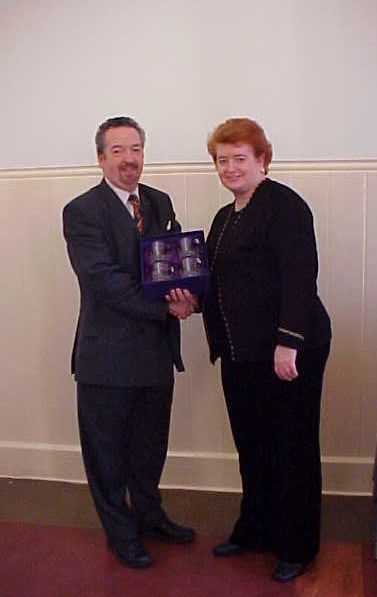 Marion Johnston introduced the speaker as Aileen Stewart from the semi-conductor organisation NEC, where she is employed as the Occupational Health Manager, to speak to the group on one of the activities which she undertakes for NEC – Workplace Rehabilitation.
Aileen then indicated that she intended during her presentation to cover four aspects = the basis of rehabilitation where it comes from and why, What are the major barriers to undertaking workplace rehabilitation, What they do at NEC, and what does the future hold for rehabilitation.
Workplace rehabilitation
This tends to be a catch all phrase covering a wide variety of initiatives, policies and procedures all of which are aimed at getting workers back to work in a shorter time than would otherwise be taken absent from the workplace.
It can include part-time working, phased return to work where the individual may initially do 2 hours rather than the normal 8 or 12 hours shift and then increase in stages the period at work until full time working is resumed. It may entail changing the duties either on a full or temporary basis such that the individual is called to undertake "light duties" where possible.
A change of location may be involved, where perhaps the individual may be able to work from home for a period during recovery. - An example being where PC work at home may be a better option than trying to get the injured worker into an office whilst wearing a full leg cast.
Where a permanent limitation of abilities is involved it could include provision of special equipment of work aids as advised by disability advisers and could also include retraining – not just of the individual but also their line manager and someone to act as mentor.
Rehabilitation includes
Any rehabilitation programme should involve all of the disciplines involved in workplace health. Occupational Health; HR; the individual’s GP; Line managers, etc. and it must include some form of regular monitoring.
One of the biggest worries for individuals returning to work after an extended absence is "what if I can’t cope?" and for this reason any programme must considered to be flexible and not "cast in stone". Aileen’s approach is to tell the individual that it is like driving a bus = YOU are in control of the speed and if you want it to slow down you can do something about it.
TUC Approach
The TUC are currently calling for Government to establish a legal duty on employers to undertake workplace rehabilitation. Currently the emphasis is on preventing injury, rather than treating it and finding ways of getting back to work. The TUC would like to see a similar approach to rehabilitation taken in the USA and Australia where there are Occupational Rehabilitation Laws on the statute books.
Studies undertaken in the USA have shown that by providing workplace rehabilitation the amount of time lost from work has dropped by half and that often a return to work under such programmes makes it more than twice as likely to happen. It has been found in the UK that of persons away from work for 4-12 weeks, 10% to 40% have the chance of still being off work after 1 year. Also those with 1 – 2 years off work with a back injury are unlikely to ever return to work and it is likely that the bulk of these individuals will be suffering some form of loss of confidence that they could ever work again.
The TUC would like to see an extension of the Health & Safety Policy to include some form of "Back to work" strategy and believe there should be "case managers" identified to manage the correct return to work plans, these being trained to a defined minimum standard
The part played by Insurance & Lawyers
These two often work against the effective introduction of workplace rehabilitation programmes quite unwittingly due to the adversarial system under which the UK operates.
Following a lost time injury and/or disability the lawyer will do everything in their power to maximize the level of compensation paid. The Insurers will often delay settlement to ensure the individual is not gong to recover sot hey are not paying for a long-term disability when it is only suffered in the short term.
The barriers
- The lack of co-ordinated effort from Government agencies, employers, the Trade Unions and the workplace Insurers is one of the major issues here. If they could all pull in the same direction at the same time to the benefit of the injured/sick person, life and getting back to work would be so much more effective.
- Rehabilitation is not an easy task, it is often a lot easier to dismiss the individual and pay off some form of compensation.
- The form and type of rehabilitation offered is as variable as it is possible to be. It tends to vary from area to area and Company to Company.
- Few Companies have and OH department or offer the facility, and those, which do it, are often done in isolation from HR etc.
- The legal profession does not encourage any form of rehabilitation until after the legal case has been finalised and agreed.
- The NHS is not equipped to deal with rehabilitation – they are more geared to provide treatment to the acute cases.
Case study
Aileen then related the case of an employee of NEC who had suffered a Road Traffic Accident. He was 44 years of age and had sustained injures to his neck, arm and hand such that he could not grip anything; this was obviously devastating to a skilled engineer.
He was initially off work from September 1999 till January 2000. He then had a variety of absences between January and June 2000, at which stage he went in for surgery on his hand. This however did not solve his problem and in fact made it worse.
When the Consultant surgeon was asked when (if) his abilities would improve, he was non-committal and did later indicate that he had done all he could.
At this stage OH requested a "Full Functional Capacity Evaluation" to be undertaken to determine what he could/could not do and what it would take to get him back to normal working ability.
Blankenship undertook the evaluation and indicated that by undertaking intensive rehabilitation programme he could be brought up to 95% capability. His own GP however indicated that he could not provide active rehabilitation course, but it was found that Blankenship were able to provide such. It would be a residential 3 week course costing £4,000 which would work not just on the physical ability but also provide psychological assistance to enable him to regain some of his former confidence etc.
The solicitor working for the injured man indicate he did not want to seek an interim settlement as this may affect the final settlement figure, so NEC made an agreement with the individual and loaned him the money to take the course.
The system would have failed this individual, but by taking the course he had now returned to work fully fit and well motivated. The system itself is not geared to rehabilitation.
NEC Results
Considering the number of absentees with greater than 3 months absence from work a reduction of 25% has been achieved in the last 5 years and often by very simple techniques.
Lost time accidents which result in 3 weeks absence now leads to contact being made by OH.
Managers have now been converted to accept that the return to work of an individual who is not 100% is a gain rather than being a burden. Aileen’s description being "Half a loaf is better than no bread at all" has eventually got through a severe reluctance exhibited by the Managers.
They have gained acceptance by the individual’s clinicians and their GP’s that a phased return to work is suitable.
They have installed a programme of getting long term absence suffers to pay visits to the plant – OH will not except under very special circumstance visit the individual at their home – they have to come into the plant. This gets them over one of the hurdles.
Return to work plans will often include use of a work mate acting in a "buddy" position who the individual can relay of to assist them through some of the difficult times. Aileen likens it to the first day at school, or returning to school after the long summer holiday break.
Once the plan is in place, OH will review it with the individual after the end of the first shift and then on a weekly basis for the first 3 weeks
Physiotherapy availability
NEC have recently provided their workforce with access to Private Medical treatment and this has greatly increased the chance of getting back to work after injury requiring physiotherapy due to the now easy and quick access to treatment. Previously the wait on the NHS service system could have been weeks if not months, but now the treatment can be in action days later making recovery that much quicker.
NEC also offer know employees who have in the past suffered from back injuries (typically those involved heavily in manual handling activities) a "Back clinic" which is run by visiting trained physiotherapists.
Current estimates are that approximately 2,000 working hours are being saved by keeping people at work and getting them back to work quicker following an injury
The Future
The Government has announced a £12m project to run rehabilitation program pilot schemes. These should kick in after the individual has been on SSP for 6 weeks – this may be a little long but at least it is a start. They intend doing this by provision of Job Retention Advisers at the GPs surgery in defined areas. The pilot scheme areas at the moment being Glasgow and down in Kent.
Depending on the results of these pilots’ schemes we may see further beneficial programmes forthcoming in the future
Summary
Provision of Workplace rehabilitation programmes can –
- reduce the levels of absence suffered by Companies, be these absences from workplace injuries or out of work injuries (sporting activities etc)
- will be cost beneficial in the long term, but the initial investment may be difficult to justify
- the Government are a little slow in providing backing for such activities other than commenting on the benefits
- reduce the amount of time lost from work
- has finical benefits for both the Company and the individual
- the personal well being of the individuals involved has an almost immeasurable knock on effect with the individual’s family and friends
9.0 DATE OF NEXT MEETING
Richard thanked the members for their attendance, encouraged the members to mingle during the tea break and then he set the date for the next meeting as:
Thursday 13 December 2001 at 1.30pm at Donaldson’s College
Clinical Waste Management
Mr D Wightwick, Director – Waste Advisory Service
It is also intended to include a short presentation of the Healthcare Specialist Group and the presentation of a parchment in recognition of achievement of a professional qualification.
Christopher E White MBE, FIOSH, RSP Edinburgh Branch
Secretary Brian W Pill FIOSH, RSP Branch
Chairman
Back to top of this
page