Minute of the 122nd Meeting of the Edinburgh Branch, Donaldson’s College for the Deaf, Edinburgh at 1330 on Thursday 8th February 2001
SEDERUNT
C E White R Lovering R Staines I Craig K Heatley D A Brown R Patus R McLean M Scott-Smith G Dick B Pill T McGowan G Macnab S Young G M Smith A McGowan R Hunter D Sinclair J Curran S Page V Stewart D Morrice N Robertson I Smith I Bruce L Young D P Ward J Smith M Salomon D Devey J Craig I O’Neill P Conway J Clark A Milne S Chisholm G McGeorge N Doherty E Cassidy R Walker I Murray A Whyte R Edward K Lloyd J Conway W Miedzybrodzki M Bancroft J McCraith
APOLOGIES
K Wilson R Reed R Brownlie
1.0 CHAIRMAN Brian Pill
The Chair was taken by B Pill. Welcome was extended to all, particularly new Members and Guests. Again the room had been changed due to refurbishment but adequate facilities were provided and the College thanked. Mention was made of the importance of having some form of identification to hand. Members were reminded that signing the Sederunt assists when claiming CPD points and is the meetings Fire Check sheet.
2 MINUTES
The 121st Minute – January 2001 – was tabled. The Minute was proposed by M Bancroft and seconded by J McCraith as a true and accurate record. It was stated that 110 hard copy are mailed and 25 sent by e-mail. There were no amendments.
3 MATTERS ARISING – There were no matters arising
4 CORRESPONDENCE
4.1 Letters - Redhall. Branch Executive meetings
4.2 Fax or E-mail - Thirty plus e-mail connections made <4.3> Minutes: Scottish Construction Group. Accident and Claim
West of Scotland Branch. J Barrell’s visit
4.4 Membership - 736 Members. 321 Associates 58 TechSP
4.5 The Grange - H Harvey. TechSP up-grades
D Johnson. TechSP up-grades
S Dain. Branch photographs
L Spence. Corporate image
H Harvey. Women and men in professions report
4.6 Adverts - Working at Heights Seminar 17 May – Three Branches
4.7 Job Spot - Construction Safety Advisor in Kazakhstan
Oil related and off shore. Brian Allan contact
Glasgow, Renfrewshire and West Dunbarton
Copies of all the above-mentioned correspondence was made available for the Members present. Further information is available upon request from the Secretary.
5.0 BRANCH EDUCATION OFFICER L Young
Mention was made of the number of Associates that had attended the TechSP workshops was in excess of 200 and that no more workshops are planned.
6 SPECIALIST GROUPS
6.1 MAPS CO-ORDINATOR M Johnstone.
There is a meeting of the Public Services Specialist Group in Leicester at the end of the month. Any points to be taken should be give to Marion as she will be attending. The name of the SG has been changed to Public Services Specialist Group.
6.2 CONSTRUCTION R McLean
The SG had met recently and Roddy attended but as yet there are no minutes available. Points discussed though included: Year plan, Questionnaire to come, NEBOSH not running with Construction Certificate but CITB will, HSE Direct link has much free information., Directors responsibilities regarding Health and Safety.
The Working at Heights seminar is confirmed and details provided. Should be well supported by members and working community – get in early to secure a place.
6.3 ENVIRONMENT J Smith
Information regarding control of explosives to be forwarded for inclusion.
6.4 FIRE RISK MANAGEMENT D Sinclair
Dave has contacted the Chair of the Group and will be attending the next SG meeting in Leicester. Some points mentioned included:
6.5 HEALTH M Scott-Smith
Martin has agreed to look into the requirements and span and will report back at the next meeting.
6.6 OFF SHORE T Boyd
7 MEMBERS ITEMS
7.1 Honours List. Congratulations were extended to A McGowan for his being awarded an MBE in the New Years Honours List. The Chair mentioned the increased recognition that such awards bring to Health and Safety
7.2 Website. M Bancroft indicated that the site had received 320 hits and regular information is being displayed.
7.3 Annual General Meeting. The Chair mentioned that the AGM is fast approaching and that the elections for those wishing to become involved in running the Branch will be soon to hand. Nominations for all Principle Officers and three Executive Members are needed.
J McCraith the Social Secretary then gave a brief outline of the duties and responsibilities undertaken by the Executive Committee. The Secretary reminded members that all nominations have to be proposed and seconded and the nominees in good standing with the Institution. Next meeting being the last date for acceptance.
The Chairman reminded the members that there is always a requirement for new blood within the Executive and that the Branch does not run by accident.
8 GUEST SPEAKER
Traffic Accident Investigations unit – Accident Investigation
| Kevin Lloyd introduced the speaker as Inspector Andy Watt of the Lothian & Borders Police force. Andy had been with the Police force for a total of 28 years and for the bulk of these he had been within the Traffic Section. His position now was heading up the Crash Prevention and Investigation Unit. Andy then indicated that the remit for his unit was to investigate all fatal road crashes plus those that were considered serious and as his team covered all of the Lothian and Borders area and only entailed four officers, they had a very heavy workload. |
|
Introduction
Andy stated he intended to provide a brief history of the topic, some background to the work and formation of the unit and then by use of Case Studies; he would illustrate his talk with factual information relating to past incidents. He enquired of the group if anyone may wish to not see the cases as they would obviously all be from his own area of the Lothian & Borders force and he did not wish to upset anyone by images, which they may be connected with.
The size of the problem
The first fatal road traffic accident took place in England in 1896. The Coroner at the inquest made the statement "This must never happen again", but as we know only too well that was not to be the case.
Around 25 million people worldwide have died from road traffic accidents. Annually (based on 1987 figures), we expect in the UK = 3,298 to die; 36,313 to suffer serious injuries; 200,435 to suffer slight injury; and over 3.6 million damage only incidents.
If these figures were from pure industry based incidents we would be looking to 20 Piper Alpha incidents, or 13 Lockerbie crashes, to happen in one year – Just imagine the public outcry that would raise. But not so for road traffic accidents, they appear to be more acceptable.
Within the Lothian & Border Police force area in 1997 there were 74 fatal accidents; 358 Serious accidents (and by serious the unit considers those where the injuries could later prove to be fatal) and 3,112 slight injury accidents. Within the year 2000 the fatal accidents had dropped to 54 and it is hoped that is to be a continuing downward trend with more cars having airbags and rear seatbelts fitted as standard.
It has been quoted, although Andy could not identify the basis of the calculations, that each fatal accident costs £1,264,672; whilst serious accidents cost £126,610 and slight injury accidents cost £13,630.
What is an accident?
There have been a number of definitions put forward for "An accident" including –
But it was felt they needed something more accurately to define the issue of a road traffic accident and they use the following: -
A rare, random, multi-factor event, in which one or more road users fail to cope with their environment and which results in a collision
However Andy did add that perhaps it was not always that accurate – the event is certainly not rare as can be seen from the figures quoted earlier
History of Road Traffic Accident Investigation
Whilst the Police have always had a duty to investigate incidents it has only been since 1962 that this has been done on a scientific basis and firstly in the USA. It was not until 1972 that the UK started using the same style of investigation systems utilizing Newton’s Laws etc to prove scientifically what had happened.
Andy moved into the role in Lothian & Borders in 1986, but it was not until some 12 years later that the unit was set up in earnest with fully trained officers. The training undertaken at Aberdeen University involved sessions in Mathematics, Dynamics, Detailed examination of the scene of the incident and Drawing detailed scale plans
One of the problems in investigating the incident is that the officers doing the investigation are not usually the first on the scene. Others getting there beforehand, the Police, Fire Brigade, Ambulance etc have their own reasons for being there and often their actions can remove or destroy valuable evidence. The Fire Brigade were originally one of the worst for this, in hosing down the blood and gore to keep the scene acceptable to anyone following on, but this removes vital clues to what happened and how. Training and talks to the various groups has reduced this level of evidence removal making the task less difficult.
What is investigated and what is gained?
The unit will investigate all fatal, or likely to become fatal, accidents.
They will also investigate instance where there is likely to be conflict, or where there is lack of independent witnesses when the accident is serious.
All serious accidents involving Police Officer, or following a vehicle pursuit
Those instances considered to be of significant public interest, such as a double-deck school bus running into a low bridge – even if there were no children on board or no one was hurt.
Evidence gained will be from detailed examination of the vehicles, whilst the officers are qualified vehicle examiners they will often use the DTI Vehicle Inspectors for HGV instances as they are the specialists in those vehicles. The roadway will be examined and this can often include finger-tip search of the surface to find scuffmarks or gouges out of the surface. They will use digital photography and videos as necessary and the detailed plans now utilise a theodolite to gain measurement rather than the old tape measure. This has not only made the records more accurate but has saved virtually half the time involved in making the plans.
They need to consider –
Case study examples – 1 - Mechanical defects
Images of a link pin in an Army Articulated lorry were shown. This pin should be removed prior to the vehicle being driven around the roads, but in this case it had not been withdrawn and when the lorry approached a bend, the cab went round the bend but the trailer tried to continue in a straight line. The consequence was the truck overturned and killed the passenger who had his head out of the window.
Case study examples – 2 - Mechanical defects
In this case a recovery vehicle was towing a crane when the towing mechanism broke and the crane on tow slewed into the wrong side of the carriageway straight into the path of a car coming in the opposite direction. The force of the impact pushed the lorry into the back seat of the car but fortunately a baby in a car seat in the rear of the car was no killed in the incident.
Case study examples – 3 – Weather conditions
Normally we tend to think of snow and rain as being the problem, nut in this case it was the sun. A low winter sun prevented a lady seeing adequately when she came to a junction, such that she pulled out in her Volvo into the path of a 120-ton crane lorry. The side impact bars on the Volvo were of little use in such an impact.
Case study examples – 4 – HGV V’s Pedestrian
This incident was at Drum Brea Island and a pedestrian was trying to cross the road right on the island in front of a cement mixer lorry. The lorry driver was looking to see a gap in the traffic and when he moved off he did not see the lady in front of him and knocked her down – driving over her head. Since this incident a recommendation has been made to install railing around the island preventing pedestrians from crossing at the island and instead having to make use of pelican crossings set back from the island itself.
Case study examples – 5 – HGV V’s Pedestrian
In this second instance of an HGV causing a fatality to a pedestrian, it was on a building site, where two children were playing hide and seek. Unfortunately they were also hidden from the view of the driver.
This incident prompted Andy to undertake a detailed survey to define just what size the blind spot is for the drivers of HGVs, which is a lot larger than was imaged. Both this incident and the previous one could be connected with the lack of vision which HGV drivers have of the area surrounding and directly in front of and close to the front of the vehicle. It is understood that legislation making the fitment of special mirrors to provide vision in these areas is being considered.
Case study examples – 6 – PSV Tachograph Analysis
The Tachograph is a system fitted to HGVs and PSVs which records hours, speed and distance traveled plotted against time on a chart recorder. This case was in Costorphine Road approaching Roseburn and involved a bus/coach going straight on and through a wall, fracturing a gas main and only just missing an electrical sub-station. Examination of the chart showed the journey had started at 5.30am and had been traveling at 80 kph (50 mph) at the end of its journey. However some of the previous speed was undefined as the plot had a flat top to the curve – suggesting that the needle was at its maximum travel. A detailed chart was created; plotting where each period of restricted speed had been linked to specific road conditions. E.g. slowing down for traffic lights or islands. The net effect of this was to prove that although the speed at time of impact may have been in the order of 60 mph in a 30-mph area, just previous it had been traveling at 90 mph at it passed the Zoo. They were hence able to show the vehicle had clearly been traveling at inappropriate speeds and the driver was prosecuted. He was also found to be drunk and it was felt fortuitous that he had not managed to get to pick up his passengers and drive them to the continent.
Case study examples – 7 – Excess speed
This case was one at East Fettes Avenue where three people had been burned to death in a car. The image of the damaged Metro showed the driver had probably been killed outright by the force of the impact as the side of the car was pushed into the middle – this may have also proved to be the cause of death for the passenger in the front. The rear passenger however it was felt had probably been burned to death as the petrol tank had ruptured and the sparks from being pushed sideways down the road had set the fuel alight.
The method of calculation was shown – working back from the known condition of vehicle at 0 mph. The distance of tyre and scuffmarks on the ground showed the Metro to be being pushed sideways at 20.3 mph after impact whilst the Cavalier was traveling at 23.1 at the point of impact. Conservation of energy laws, coefficient of friction details etc enable the Cavalier speed at the point where the skid marks started showed it to be moving at a minimum of 42.1 mph. However it is assessed that taking account of braking prior to skidding and the period for the tyre to warm up enough to create skid marks would put the Cavalier sped at 58.8 mph.
The prosecution was for death by dangerous driving and the defense enlisted the assistance of a computer graphics specialist to generate graphics to show the view of the road from several standpoints. – On the pavement opposite the junction. – On the pavement from alongside the junction. – From the speeding Cavalier. – From the target Metro. These demonstrated that the Metro probably had limited view up the road due to parked cars and the Cavalier had late sight of the Metro due to the speed of travel.
However when the graphics were adjusted to show the likely effect if the Cavalier had been traveling at only 40 mph (where it was able to stop adequately) the defense withdrew and the Cavalier driver pled guilty and was imprisoned for 4 years
A lively question session followed with topic as widely ranging as – stress counseling for the investigators, to response times for getting to the scene, the legality of 30-mph repeater signs and what PPE was made available to the investigators
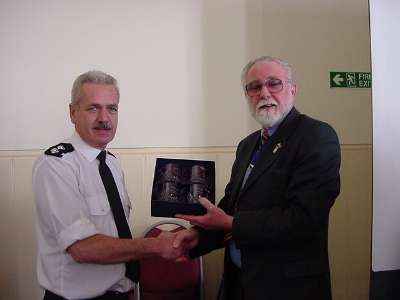
The Chairman voiced a Vote of Thanks and a small token of the Members appreciation was offered – the members responded warmly.
9 DATE OF NEXT MEETING
Members were reminded that the next meeting had been set at:
Thursday 08 March 2001 at 1330, Donaldson’s College, West Coates
With the topic being
Building on Contaminated Land
Doctor Paula Woolmer, SEPA
10.0 CLOSURE
The Chairman thanked all for their attendance and contribution and bade them a safe journey homeward; but before closing reminded the members of the proposed District meeting later that evening then closed the meeting with the invitation to have tea and then mingle.
Christopher E White MBE, FIOSH,RSP Edinburgh Branch Secretary Brian W Pill FIOSH,RSP Branch Chairman