Minute of the 121st Meeting of the Edinburgh Branch
Donaldson’s College for the Deaf, Edinburgh at 1330 on Thursday 11h January 2001
SEDERUNT
C E White R Lovering L Johnson J Steven R W Bertram R Paterson L Young I Wilson A McGowan A Sayer R Edwards D A Brown S Curran M Whitham G McNab I M Murray J McCraith A Whyte C Wilson G Lyall D Devey R Walker B Johnston V Stewart R McLean W Miedzydski D Sinclair R Atkinson J Craig R Thomson K Lloyd G McGeorge I O’Neill J Purdie R Brownlie J Hepburn V B Jagajinni R Davis G Watson N Doherty B Davies L Tring M Bancroft S Page M Johnstone J Adamson T McGowan D Petrie
APOLOGIES
K Wilson R Reed D Forfar B Howden S Young B Pill
1.0 CHAIRMAN Richard Lovering
R Lovering, the Vice Chairman, took the Chair as the Chair had been taken ill and unable to attend. Welcome was extended to all, particularly new Members with an apology for the change of venue to the Dining Room. The college is undergoing extensive maintenance programme but facilities are always found. All attending were wished a Happy New Year and then the format of the meetings explained. Special mention was made of the requirement to carry some form of identification, preferably a Membership Card, as security must be maintained. The importance of signing the Sederunt highlighted as a fire precaution muster checklist and a means for verifying attendance as a CPD point.
2.0 MINUTESThe 120th Minute – December 2000 – was tabled. The Minute was proposed by D Devey and seconded by I Murray as a true and accurate record but only after the word ‘retrial’ was amended to ‘retiral’ when referring to the out going Chief Executive.
3.0 MATTERS ARISING – There were no items mentioned.
4.0 CORRESPONDENCE – Chris White
4.1 Letters
4.2 Fax/E-mail
4.3 Membership
The Secretary also mentioned that 43 members had been suspended for lack of payment of subscriptions
4.4 Adverts
4.5 Minutes
4.6 Job Spot: Ray Edwards from the Yorkshire Branch looking for Company Associates
Copies of all the above-mentioned correspondence were made available for the Members present. Further information is available upon request from the Secretary. Ray stayed behind to chat and mingle.
5.0 BRANCH EDUCATION OFFICER L Young. Nothing to report
6.0 SPECIALIST GROUPS
6.1 MAPS CO-ORDINATOR M Johnstone
It was mentioned that the Group is now being named as ‘Public Services SG’. It is the intention of the SG to produce Guidance Notes on a variety of subjects and details will be posted on the SP Webpage. They are intending to run a national Seminar in the year 2002.
6.2 CONSTRUCTION R McLean
Mention was made of the Seminar ‘Working at Height’ which will be staged in Glasgow 17 May. Full details will be posted but draft copy available now. Nearly all the speakers have confirmed.
6.3 ENVIRONMENT J Smith. Nothing to report
6.4 HEALTH Executive Committee. Nothing to report
6.4 OFFSHORE T Boyd. Although not a regular attendee at meetings due to work commitments Tam has agreed to keep a watching brief and will inform the Branch of interesting items when appropriate.
6.5 FIRE RISK MANAGEMENT D Sinclair. It has been confirmed by the Chairman that D Sinclair will be the Branch Representative to this Specialist Group until the next AGM.
7.1 MEMBERS ITEMS
District Forming. D Devey, the Secretary to the proposed District reported that the next meeting would take place in Kinross on Wednesday 08 February at 7pm with Airport Safety as the Speaker’s topic. All welcome.
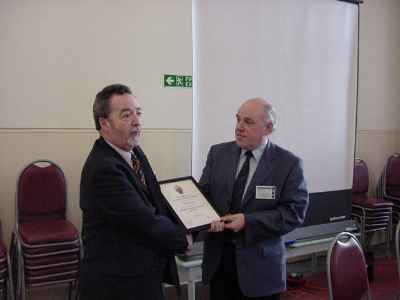
| Certificate Presentation. The Chairman then presented a certificate of up-grade to Technician Safety Practitioner to B Bertram and expressed his pleasure that members are putting the hard work to produce port folio of sufficient quality to achieve this qualification. The members responded warmly at Bob’s presentation. Bob responded and wished it recorded that his special thanks were extended to the BEO Liz Young for all her work and support as Branch Education Officer. | |
| Branch Presentation. The Treasurer, D Brown made a presentation of an engraved wine decanter to the Secretary to commemorate his recent trip to London for Investiture by the Queen of an MBE. Chris thanked the Branch for their generosity. | 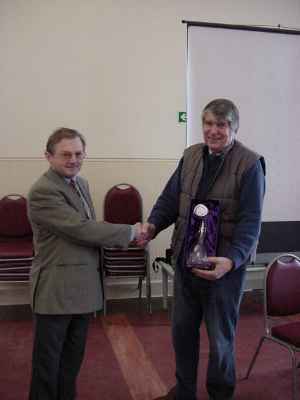 |
Local Construction Company Fined. The members were informed that a local construction company working in Edinburgh had been fined £75,000 for not having a Traffic Supervisor working at the exit from a city centre congested site.
Branch Visitor. Welcome was extended to R Edward from the Yorkshire Branch who is in the area on business. He is looking for Health and Safety Associates for work in the local area and stayed for tea and mingle.
Branch Website. Members were informed that the Branch has gone on the ‘Web’ and have an active site with all sorts of links and connections. Those with Internet access are invited to ‘Surf the Net’ and pay regular visits also please spread the news. The Secretary was informed that the Branch does not have a ‘Call Sign’ or a ‘Handle’ but the site is located at
http://www.geocities.com/ediniosh
8.0 GUEST SPEAKER
|
The Guest Speaker was introduced by R McLean as R Davie from SGB and was invited to address the Members on the subject of Access Equipment and What to Look For.
Mr. Davie indicated that the request to come to the meeting and make a presentation had included comment that he was considered an "Authority" on the subject of scaffolding and access equipment. A comment of this nature he felt was the ultimate in the form of compliment as opposed to the normal comment of being an "expert" hence his presence at the meeting. |
|
Access equipment for working at height could take a wide variety of forms, from ladders, scaffold, trestles, towers, aluminium staging to scissor lift units. However, he did indicate that he would only be able to touch lightly on the subject in a 40 minute presentation as opposed to the normal 4 to 5 hours which he took usually took to explain the NASC Guidance note SG4 which he would be using as a basis for his presentation, by concentrating on independent scaffolding.
Ladders
These must be considered as a system of access rather than a working platform. The HSE will often visit factories reporting accidents involving ladders to get the organisation to explain why the ladder was being used in preference to other systems of gaining access to height.
Alloy Towers
There are hundreds of alloy towers in use on construction sites across the country, but it is well known that large quantities of them are incorrectly erected. Individuals required to assemble this equipment must be trained and competent to do so. Typically the training necessary is of one-day duration, but you need to ensure the individual actually holds a certificate of training. The speaker then gave some details of an incident where a man fell 50 feet from a tower scaffold and is now wheelchair bound from the injuries.
Tube & fitting independent scaffolding (Traditional form scaffold)
SGB did have an entry in the Guinness book of records for the biggest independent scaffold until recently for an assembly in London Docklands, however the entry has been exceeded now by an erection in Wales. The assembly can be complex or very simple. The CDM Regulations do require the assembly to be specifically designed correctly and in particular when they are over 30 foot in height, but mostly they are assembled in accordance with a BS in terms of the frequency of ties etc and do not at that stage require additional design details to be specified.
Powered Access
These forms of systems are varied in their form including scissor lifts, easy lifts, booms and many other styles. The use of this form of gaining access to height has become more popular over the last few years and are frequently now seen in use by steel erectors who previously were used to climbing all over the frames they were erecting like monkeys swinging through the trees. Their use is gradually extending into lots of other areas of construction working where previously employees were at risk of falling due to lack of edge protection an example being roofers, who previously were working at an exposed unprotected edge whilst covering the frame of a roof.
SGB currently have some 400 to 500 of these machines in Scotland, which they hire out, which shows perhaps how popular they are, but the speaker indicated that it is important that you look to see the machine in use is up to the mark. It should be adequately maintained and marked as in accord with IPAC standard.
The training for use of this type of equipment is very specific to the particular model and the users should be trained in the actual machine in use – do not accept a comment that a person has been trained in the use as a general condition, the differences can make them very hazardous to use. An accident in Glasgow demonstrated the need for basic training, as the operator was not aware of the restriction not to use them during high winds and when he raised the platform whilst involved in building a cinema complex, the wind caused the equipment to topple over. In another accident a man was crushed under a soffit when he raised the platform without looking.
Power Lift
Most of these can be recognised by the twin masts supporting the platform erected up the sides of the building. Theses machines need to be correctly designed, adequately anchored to the floor and they are usually anchored every 4 metres, the anchors being proof tested to ensure they are adequate and under the control of trained users.
The remainder of the presentation was specifically aimed at provision of details extracted from the SG4 Guidance Note – The use of fall arrest equipment whilst erecting, altering and dismantling scaffold – issued by NASC – National Access & Scaffolding Confederation.
HSE Campaign
The HSE have recently instigated a campaign aimed at checking out on adequate compliance with of scaffolding erection and use systems. The campaign basically follows the hierarchy of control for working at heights =
A letter was issued by the HSE to all Construction Companies and major scaffolding industry to inform them of the campaign in June 2000, although the guidance booklet was not made generally available until the autumn of the same year.
During 130 site inspections in the London area a total of 30 Prohibition Notices were issued, often scaffolders had harnesses but they were not being used.
Local authorities now include a component in Contract/Tender requests that compliance with SG4 is a requirement
Scaffolding safety
There has always been a general opinion that those involved in building scaffolding cannot use safety harnesses, but SG4 has changed the emphasis such that scaffolders should make use of a safety harness whilst they are in a position, which does not have edge protection. The latest guidance note include a requirement for ladders to be installed during the building of the scaffold, working platforms to be 3 boards wide, fitted with double hand rails and toe boards and each bay should be completed with hand rails as the erection progresses. Single guardrails are only permitted for intermittent platforms and during the building progress. Those Scaffolders working outside of the single guardrail must be attached via a safety harness hooked on to an appropriate anchor point.
The speaker indicated that whilst he was on holiday he read a newspaper report of a fatal scaffolding incident in Inverness – part of his area and he was worried that it may be a tender which SGB had secured. On his return however he found it was a contract that whilst SGB had quoted for it they had been unsuccessful and the contract had been issued to "Joe Bloggs" who had offered to do the job for half the sum SGB had quoted. The reason for the incident was put down to the use of untrained and none certificated Scaffolders.
A meeting between HSE & Scaffold suppliers on 17th June 1998 put forward the basic elements of safe working with scaffolding which HSE would consider in any site inspection this included –
The speaker then showed a slide of a collapsed scaffold in Glasgow and indicated the cause for the collapse which was linked to untrained Scaffolders and not checking for the conditions of the ties prior to starting to dismantle the assembly. A further incident was detailed where SGB had been the Scaffolders but the incident was actually related to site management rather than a fault in the scaffolding arrangement.
Summary
The legislation, which affects scaffolding, falls under –
All of which have been on the statute books for a period of time and whilst most persons are familiar with the newer general legislation some of the differences in the 1996 Construction regulations are not always appreciated.
Notably the requirements on inspection of scaffold in the old regulations required the scaffold to be inspected after 7 days, whereas the later regulations place a duty to inspect before use and this may be immediately after being handed over by the installers. A competent person must carry out these inspections and HSE view this as being someone who has completed the CITB 2 day inspection course. The inspection requirements themselves were also an extension to the original requirement quoted in the old F91 register and now included =
The session then finished with a series of observations and questions from the members present
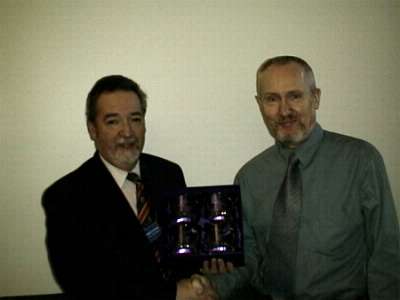
The Chairman voiced a Vote of Thanks and a small token of the Members appreciation was offered – the members responded warmly.
9.0 DATE OF NEXT MEETING
Members were reminded that the next meeting for the Branch had been set at:
Thursday 08 February 2001 at 1330, Donaldson’s College, West Coates
With the topic being
Rules of Evidence
Lothian and Borders Police
And also reminded that the next meeting for the Proposed District had been set at:
Thursday 08 February 2001 at 7pm, Windlestree Hotel, Kinross
With the topic being
Airport Safety
Ms Jennifer Gibson, Edinburgh Airport Authority
10 CLOSURE
The Chairman thanked all for their attendance and contribution and bade them a safe journey homeward; then closed the meting with the invitation to have tea and then mingle.
Christopher E White MBE, FIOSH,RSP Branch Secretary Brian W Pill FIOSH,RSP Branch Chairman