This page has been opened as a new window.
Please close it to return to the main meeting page
Minute of the 120th Meeting of the Edinburgh Branch
Donaldson’s College for the Deaf, Edinburgh at 1330 on Thursday 14th December 2000
SEDERUNT
C E White R Lovering K Lloyd I Smith R McLean B Pill B Howden D Devey C McGlade A Milne G McGeorge S Chisholm A Davies N Robertson G Dick R Brownlie S Smith D Forfar G T Millar D Cawkwell P Johnston V Stewart A Sharman S Deans R Reed M Galloway D Morrice C MacLeod W Witherspoon R Walker
G Macnab M Bancroft H Fraser Wood D Sinclair M Batho
I Murray J Craig A Owen R Edward N Doherty L Tring J Purdie D A Brown J C Steven A McGowan A Sefton J Barrell
APOLOGIES
K Wilson B Bertram J McCraith L Young
1.0 CHAIRMAN Brian Pill
B Pill took the Chair. Welcome was extended to all, particularly new Members and Guests. The importance of carrying identification whilst in the school building was stressed and paring to the front of the building explained.
2.0 MINUTES
The 119th Minute – November 2000 – was tabled. The Minute was proposed by R Lovering and seconded by M Bancroft as a true and accurate record.
3.0 MATTERS ARISING – There were no matters raised.
4.0 CORRESPONDENCE
Letters
- I Waldran. Corporate Plan
- J. Cowan. Information about Noise meters – would like help
- L Allan. Cannot make the meeting but thanks – Tech SP
- L Spencer. Jane Grist leaving IOSH
- I Murray. Additional information
- H.Harvey. Tech SP details
Fax
- R Craig. Apologies District meeting
- J Goddard. Apologies District meeting
- B Bertram. Apologies
Minutes
- West of Scotland – October
- SRLG – December
- Tech SP Group – October
- Fife Chamber of Safety – November
- Scottish Construction Group - November
Membership There are now 728 members of the Edinburgh Branch
240 Corporate Members, 322 Associates and 57 Tech SP. Unfortunately 43 members have been suspended
Copies of all the above mentioned correspondence were made available for the Members present. Further information is available upon request from the Secretary.
5.0 BRANCH EDUCATION OFFICER L Young
Mention was made of the successful workshop held for encouragement to up-grade from Associate to Tech SP. Over fifty members attended and were supported by the majority of the Branch Executive. The Chairman expressed his thanks.
6.0 SPECIALIST GROUPS
6.1 MAPS CO-ORDINATOR M Johnstone
There were no items mentioned apart from the fact that the Branch Representative will be visiting HQ during February.
6.2 CONSTRUCTION R McLean
A number of items were mentioned including the Construction Certificate being back on course with NEBOSH; the revised CDM and its Code of Practice, which is available on the web.
6.3 ENVIRONMENT J Smith
6.4 HEALTH Executive watching brief
6.5 FIRE RISK MANAGEMENT The Executive has selected a member to represent the Branch.
7.0 MEMBERS ITEMS
Certificate Presentation. The Chief Executive was invited to make presentation to Peter Johnson of the Certificate of Technician Safety Practitioner on his recent up grading. The members offered warm congratulations.
District Forming. D Devey gave a short report on the success of the recent meeting of the proposed District. 23 members attended and a new working group elected. Another meeting programmed for 08 February – Airport Safety.
Scottish Branches Seminar. The Working at Heights seminar being organized by the Scottish Branches will go ahead on 17 May at the Conference Centre of Glasgow University. Full details will be circulated later.
| 8.0 GUEST SPEAKER
The Guest Speaker was introduced by D A Brown as Dr Allan Sefton from the HSE and invited to address the Members on the subject of Re-vitalising Health and in Scotland
Dr. Sefton indicated that his presentation would be presenting details of the recently issued Revitalising Health & Safety Strategy Statement by HSE, which contained details of the Targets, the 10-point strategy and 44 actions points. However he wished to use his time to bring it down from the heights into the practical conditions, with particular emphasis on those pertinent to Scotland
|
|
Introduction & Background
Whilst there had been a major changes in the working arrangements for health & safety some 25 years ago when the Health & Safety at Work Act came onto the statute books, however there is now a belief that progress has slowed down or stopped and has hit a plateau such that the arrangements need to be reconsidered. This had been primed initially by issuing a Strategic Approach in March 1999, which was followed by the publication of a Revitalising Health & Safety Consultation document in July 1999. This in turn had led to the publication of the Revitalising health & safety strategy document in June 2000 – copies being made available through the normal publication means as well as being available on the HSE web pages.
Since the introduction of the HASAW Act the number of serious accidents had reduced, but in much the same way there had also been a number of changes, which had occurred in terms of the hazards encountered in the world of work. Public pressures have increased of late in the control of hazards – the latest being related to rail safety and all of this has been generating a need to consider new ways of working and hence restart the accident control and reduction process.
There is no intention to dismantle the HSE/HSC and the speaker confirmed that those, whose activities kill the most at work, can expect to be in for a rough ride. Activities, which created acceptable risks some 25 years ago, are no longer considered to be acceptable and whilst some of the control was through enforcement, a number of other bodies have come to the fore in creating acceptable standards and currently there is a drive towards proportionate enforcement and penalties.
Revitalising health & safety - Why now?
The rate at which the accident rate has been reducing has slowed down and has in fact reversed for some industries of late, such that there is an immediate need for improvement.
The changing world of work, where so much now is undertaken by contractors, or part-time workers, etc. means the format may need to change to deal with the modern requirements.
There is a need to consider what "levers for change" are most likely to be effective – can we get the Board of Directors to drive it? What benefits could be gained by use of the employees through consultation systems etc? Can clear targets for improvement be set, possibly through other agencies such as the Insurance bodies?
Ten point strategy
There is a need to create a culture of self-regulation. This would not result in throwing out regulations, as these would still be necessary, but involve a greater degree of industry setting its own standards by following business case rather than bureaucracy and red tape.
Effective partnerships including workforce involvement and influences should be embodied into the normal operational working – ensuring health & safety becomes integral rather than just a bolt on extra. The achievement of better working environment is likely to stem from a motivated workforce of competent employees.
Local, national and central government departments should ensure they lead by example. It is a sad fact that included amongst the worst employers for making employees sick are the health service trusts. Occupational health is one of the major issues of current working, where Monday is one of the greatest stressers to a large percentage of the workforce, there is consequently a need to move toward "best practice" not just "legal compliance" but OH is still too low on the priority scale.
The long-term effects of occupational health issues can easily affect the countries economic efficiency. It was quoted that of those who stay off work for 6 months or longer with bad backs and similar problems, less than 1% return to work at all, with the bulk being forced into early retirement. This in turn leads directly towards the problems of skill shortages, particularly in the tradition skill areas.
SMEs (the small to medium enterprises) represent something in the order of employers of 40% of workers – each have less than 50 employees on their payroll. Of the 1.4 million employing organisations only 25,000 have more than 50 employees and as such we need to engage more of them in health & safety process and activities. The Public sector in Scotland represents one of the major employers where close on 50% of employees are within this category.
Too complacent over the numbers?
The targets currently being tabled for improvement, looking towards: -
- a reduction of 30% in the number of days lost due to accidents per year to be achieved by 2010:
- a reduction of 20% in the number of days lost in work related ill health per year to be achieved by 2010:
- a reduction of 10% in the number of fatal and major accidents per year to be achieved by 2010:
- Each of these targets to be halfway achieved by the year 2004.
These targets become even more pertinent when considering the actual number of days involved: -
- 18 million days lost per year due to ill health = 97,000 days per 100,000 employees currently which must reduce to 68,000 days per 100,000 employees by the year 2010
- 6 million days lost per year from injuries sustained at work
- Work related ill health accounts for 2 million new cases per year
- The rate for fatal/major accidents is required to fall from 260 per 100,000 employees to 230 per 100,000 employees by 2010
Scotland specific =
- In 1997 the cost of absence was put at £539 million per year
- 2.2 million days were lost per year
- 170,000 people have taken time off work due to ill health issues connected to their work
- The decline in accident rates has not been fast enough and has gone up in some sectors – notably in Construction where the fatal rate has increased 60% and the major injury rate has increased by some 83%.
- The number of fatal and major injuries up to November 2000 is the same as the whole of the previous accident year despite being only 7 months into it.
- The apparent higher headline rates for Scotland has been linked into the nature of the industries within Scotland, but needs very careful consideration of the details within an in depth undertaken for HSE
A seminar is planned for the end of January 2001 and interested parties should register with the HSE if they are interested in attending.
Priorities
Priorities set by HSE aimed at controlling the major areas of concern are: -
- Working at height activities
- Workplace transport
- Musculoskeletal disorders
- Stress
Similarly particular sectors of industry are being considered for attention: -
- Construction – due to the high incident levels of last year
- Agriculture – last years incident rate was even higher, particularly for children and elderly men
- Health Services
- Plus any others as and when necessary
The effect on HSE in Scotland will be more projects and programmes by relocating Inspectors efforts, changing the spread from an even coverage to an emphasized number of visits etc within the selected sectors. This does not mean they will be ignoring the non-priority areas, but they will see less focus on them
There needs to be a GB wide strategic action plan so that all HSE is going in a consistent direction, but some targets set for Scotland may be more stretching to meet the specific needs in Scotland, these could be aimed at pockets of bad performance. Radical ideas for change may need to be examined more closely rather than just repeating the activities and approach followed for the last 25 years and this could make greater use of allays and ensuring the HSE are not seen as the pace setters in quite the way they have been seen in the past. There is a belief that we are "over the hump" in terms of EU directives, but perhaps more is needed in terms of guidance, but this is only of any use if it gets through to the necessary areas of action.
Scotland’s challenge & future
Whilst there may be similarity in basic activities with the rest of the UK, we have in Scotland a different legal system, a different education system and a different health service system, all of which could demand something different to prompt the necessary actions in Scotland.
We have the Scottish Executive and a different nature of industry and expertise within Scotland, each of these show a need for Scotland specific actions and not just "re-badging" of other UK systems. A number of Scotland specific issues have been addressed in the past and this is likely to be continued in the future. £3 million is up for grabs from the Scottish Executive over the next 3 years for Occupational Health support – initially to improve the National Health Trusts, but later it is hoped the benefits can be extended to assist in particular the SMEs.
Specific priority and actions for Scotland: -
- Construction safety – re-enliven Site Safe Scotland committee
- Link in to best practice groups and develop Scotland Best Practice standards
- Set up a Government group in Scotland involving all the stakeholders
- Setting specific Scotland targets – we can do it better than the rest of the UK
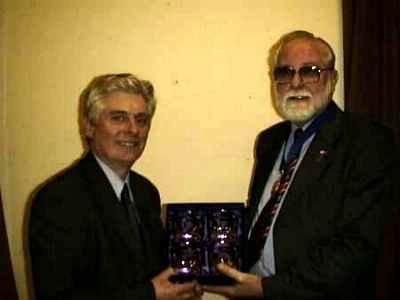
The Chairman voiced a Vote of Thanks and a small token of the Members appreciation was offered – the members responded warmly.
| 9.0 INVITED GUEST
The Chairman invited the Chief Executive, John Barrell OBE, to address the members, as this would be his last visit to the Branch due to his retrial at the end of the year.
John thanked the Branch for the invitation and opportunity to say Good-bye to Edinburgh. He outlined his time with the Institution from start as the Assistant Secretary through to being its Chief Executive.
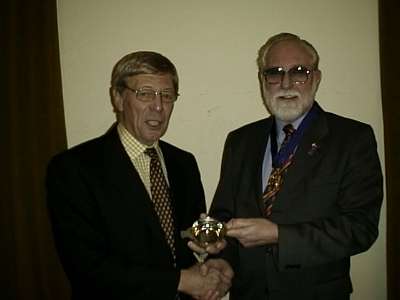
The Chairman wished John a long and happy retirement and presented him with an engraved quaich on behalf of the entire branch membership. The members echoed their support.
|
|
10.0 DATE OF NEXT MEETING
Members were reminded that the next meeting had been set at:
Thursday 11 January 2001 at 1330, Donaldson’s College, West Coates
Access Equipment and What to Look for.
Mr R Davie, Operations Manager,
Christopher E White MBE, FIOSH,RSP Branch Secretary
: Brian W Pill FIOSH,RSP
Branch Chairman
Back to top of this page