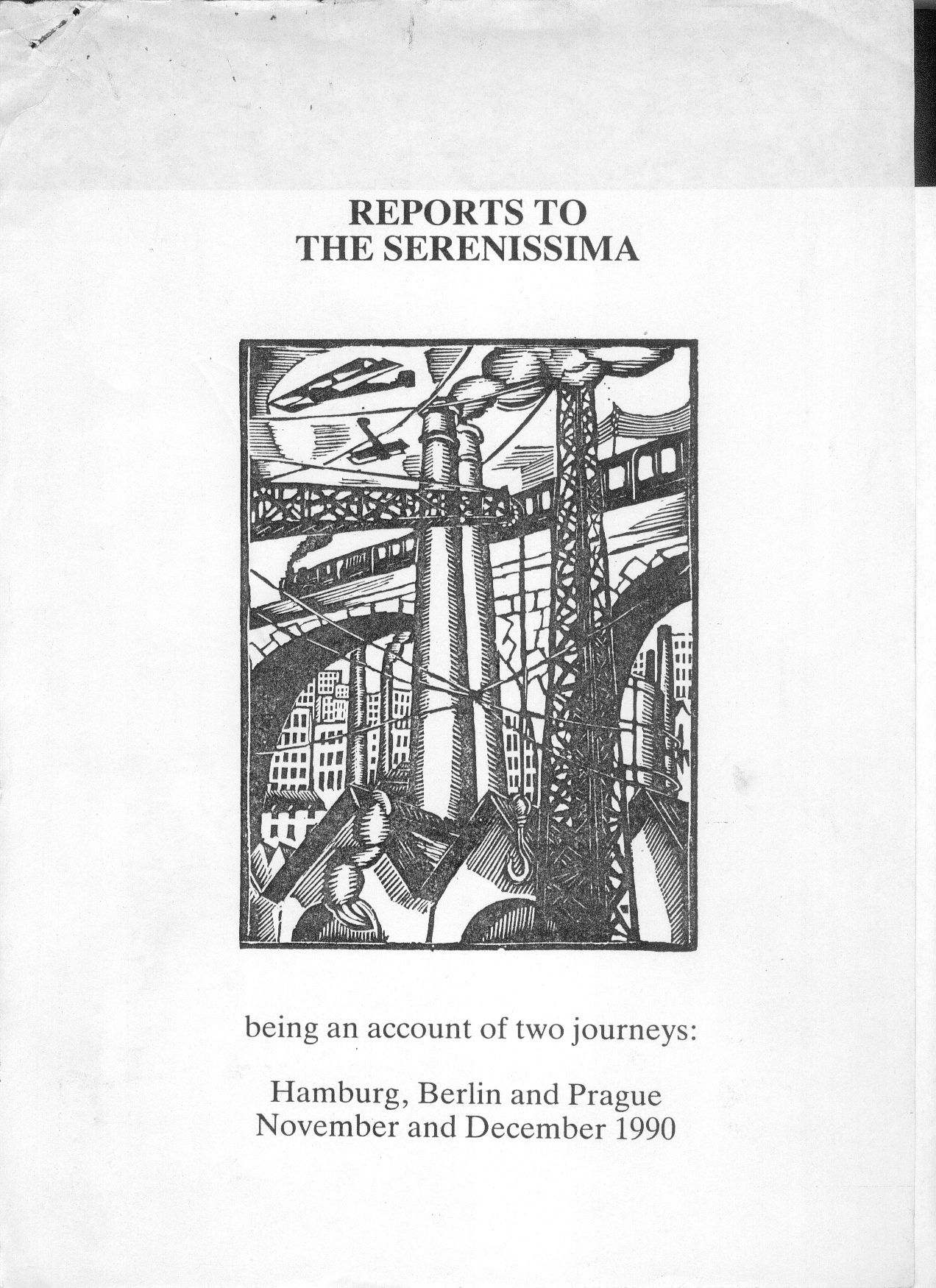
REPORTS TO
THE SERENISSIMA
A travel journal by Ed Emery - November-December 1990
 |
[1] The first circuit:
Hamburg, Berlin and Prague: November 1990
[2] The second circuit
Hamburg, Berlin and Prague: December 1990
The Serenissima is our future Republic, as yet unconstituted.
The process of its constitution requires an accurate understanding and annotation of the condition of the world.
So that we know what has to be built on, and what has to be destroyed.
In two separate journeys, often days apiece, we have spent time gathering intelligence, to that end.
______________________________________________________
Hamburg
7 November 1990
I arrive at the Hauptbahnhof at 3.30 this morning, on the Moscow-bound train from the Hook of Holland. The station, and the city, is shrouded in fog. A handful of indeterminate East Europeans, homeless, seek warmth where it can be found. Sleeping, standing on their feet, next to the radiators in the gentlemen’s toilet.
This solid, worthy Hanseatic free city state provides no benches on the concourse of its railway station (or, for that matter, elsewhere, as far as I can see). It has failed the first test of civilization.
I walk the city. All day, from the earliest fog-bound hours of morning.
I chanced upon the Elbetunnel – the tunnel under the Elbe. Built in 1820s. Four lifts, going permanently up and down, taking two cars apiece, and a quantity of pedestrians and bicycles. A free ride. Quite the most wonderful piece of engineering. A kinetic symphony of point and counterpoint, and all for the transportation of human capital. Dockers, and such.
I also chanced by St Michael’s Church. I heard a trumpet, or so I thought. I searched round the block to find the trumpeter, but to no avail. Concluded that the noise was a freak effect of the constantly wailing police and fire sirens. But then it began again. A man, at the top of this church that dominates Hamburg. Totally concealed in the fog that shrouds the upper part of the spire. Playing a carefully phrased melody on a trumpet. Out over the river, over the docks, out into the countryside. I envy him. He is old, they tell me. Has been doing this for years. And now is becoming too old. And has nobody to succeed him. He plays for the glory of God. C.P.E. Bach, Telemann and Brahms are buried here.
My business here is historiography. My phone calls with KHR have been less than discursive. I wonder whether to attribute his manner to paranoia, but then conclude that the man is under pressure.
Ten o’clock, and the Hamburg History Museum opened. Good material on the historic development of this totally amazing port. All framed in a distinctly social-democratic perspective. There is a large portrait of Kaiser Wilhelm, in admiral’s costume, with a footnote to the effect that the portrait was justifiably relegated to the cellars in 1935. Much talk of emigration, of workers, of proletarian organisation, u.s.w. One’s impression, conveyed by the exhibits, is that the honest proletarians of Hamburg wanted neither WWI nor WWII, with the great loss of life, loss of property through bombing, and loss of ships through destruction and post-war confiscations that both wars entailed. How far was this true? The verdict on the concentration camps, by the way, puts socialists and trade unionists as the first line of priority for extermination, followed by Jews, gypsies, homosexuals, and so on.
The verdict on whether a resurgent, unified Germany will do such things again lies outside the remit of this solidly decent museum. An anarchist slogan down on the harbour wall, however, expresses people’s fears succinctly: “Kein 4 Reich” (“No Fourth Reich”).
The business opportunities opened by the newly-unified Germany were summed up by a row of handbills on a wall down at the Reeperbahn, the red light district. “Hallo DDR-Burger...” (“Hello ex-citizens of East Germany...”) Offering them the dream holiday of a lifetime. In Brazil. Copacabana and all that. Except, of course, that unemployment in East Germany is now running into millions, and the people have no money.
The seeds of resistance in this city are seen in the row of squatted, semiderelict houses along the harbour frontage (just where the Harwich ferry pulls in). The street is Hafenstrasse (Harbour Street), and it is a symbol of political resistance in Germany. A wall painting up the side of one building proclaims resistance to the principles of neo-Hamburger urbanism, and particularly to “yet more concrete”. (The half-unhinged door of the collective, squatted cafe has a poster pasted across it, proclaiming it to be a centre of heroin use.)
But the major horror story of reunified Germany is told in this morning’s Bild. As a prelude to the final historic match between the two national football teams on 21st November, East and West German fans rioted in Leipzig at the weekend. The police stepped in, used live ammunition, and killed a young man. Today, masked representatives of a group calling itself (in English) the “Hooligans” promised that the historic match will be invaded by 5-6,000 football fans and hooligans bent on revenge, unless the policemen who did the shooting are brought to justice.
The currents of racism that underpin West German relations with their newly “liberated” neighbours are very strong, so they say. Poles, Czechs, East Germans, Russians, and so on.
______________________________________________________
Hamburg
7 November 1990
Met with KHR.
His situation and that of the Hamburger Stiftung fur Sozialgeschichte (Hamburg Foundation for Social History) is terrible. He despairs of it. His odd manner, which puzzled me, is a result of a desperate pressure of work, to find solutions, outcomes, a future.
The organisation produces a thoroughly worthy journal entitled “1999For a Social History of the 20th and 21st Centuries”. Last year they lost a useful patron who had provided them with political cover. A political minicoup cut the ground from under them. Therefore they are presently resident in an odd array of upstairs rooms at the University Hospital. An unlikely venue, which is unlikely to last.
Personally, he continues to do good work (including a piece on the new class composition of the united Germany and the crucial role of money in this, which I intend to translate). But he is isolated. He finds that his articles raise no debate. Like shouting into the wind. A lone voice. Nobody wants to know the history that he is historicising. As a result, he (and his close comrades) are thinking of dramatic solutions. He mentioned beginning to write in English rather than German (in the same way that SB writes in German and not Italian) as one possible solution (to reach another audience). He also mentions emigrating. That is how desperate things are.
He maintains political activity. Focussed on the Hafenstrasse squatted autonomous houses (the squats at the dockside). There is a new generation of young, autonomous militants. Proletarians and sub-proletarians. But they have neither the same experience nor the same language as the 45year-old cadres of yesteryear. Thus, another cause for despair – the historical culture gap.
He is convinced that Germany is heading for a terrible experience now. Possibly the old scenarios all over again. He keeps using the words “horrible, horrible”. He states clearly that the German class elites will use East Germany to impose a horrible defeat on the West German working class. They will do it by imposing a form of advanced Thatcherism in the East which they have not been able to impose in the West – and then reimport the results into West Germany.
He was depressed that Tim Mason (who, in his view, had written good material on the German working class under Nazism) committed suicide this March, having moved from Oxford to Italy. He wrote an obituary on Mason in the journal “1999”.
He gave me the fully edited (important, this) text of Bologna on the “Historiography of the Mass Worker”. I can now begin the translation of it. I also told him that I am working on a translation of Die Andere Arbeiterbewegung, which I think should be published in some form, so that people can judge this more or less seminal work for themselves. He said, and he is possibly right, that it is not of major historical importance. It is, however, a job well done.
______________________________________________________
Hamburg
8 November 1990
I have walked this town for sixteen hours. My preferred way of seeing a city, from the earliest hours. At last, though, I was tired. And with no place to sleep. Good luck and a phone call to Berlin got me a bed. By chance I find myself in a bedroom which has the same books as mine, the same computers, the same dictionaries, the same all sorts of things. A member of the editorial collective, in short, of a revolutionary Marxist journal. This is curious. Because the feel, spirit, layout, range of concerns, sense of humour u.s.w. of that magazine is identical to what our group was producing over a decade ago, in the late 1970s. A strong Italian autonomist flavour, a concern for researching class composition, an eager internationalism, and a focus on workers as “workers”. The latest issue has an article on “Class Composition in the in the DDR”, which sets out (a touch too abstractly) the questions I am seeking to ask.
The man himself is not here. So I discuss with other comrades. We drove each other hard on questions of class composition and prospects of class autonomy in Germany and Britain respectively. They were interested in the autonomous organisation behind the London Underground workers’ strike last year, in the cultural autonomy of London’s black Afro-Caribbean population, and in the Poll Tax movement as an expression of independent working-class organisation.
A few bits:
Turks. Large presence of Turks in Hamburg. Kebab shops, video shops, cafes. All political viewpoints, ranging from fascists through to Marxist Leninists, all interwoven with the Islamic element. Since the Hamburg autonomists claim to be inserted at the point where the classic working class meets the marginalised migrants meets the disaffected middle classes, I asked whether their political, cultural and life activities bring them close to Turks. Answer: no. The Hamburg alternative political scene is German and is white and in part middle class. They have centres, cafes, squats, bookshops, film and video groups, and they live more or less communally with more or less destructured family structures. This is at odds with the Turks. Turkish Left political groups have a strong Marxist-Leninist texture, not to say Stalinist. Family structures tend to be patriarchal (note, by the way, the slogan in the Reeperbahn red light district: “Feuer and Fiamme als die Patriarchat”) And they are predominantly interested in the politics of exile -combating fascism back home.
East Germany. The lads described the 18-year-old football fan shot dead in Leipzig as a neo-fascist. In culture, if not in actual party membership. There is a strong connection between the football hooligans and neo-fascist groups. After the World Cup final, gangs of youths in national football shirts rioted in the Reeperbahn, throwing rocks at police and attacking immigrants and chanting terrifyingly, “Deutschland, Deutschland!” A unity of violence seems to bring together both the East and West German fans, transcending “national” differences.
The squatted political houses on Hamburg’s Hafenstrasse have come under attack from football fans after matches in the city. As regards the reactions of East Germans to unification (or Anschluss – “annexation” – as Roth calls it), this has been overwhelmingly conservative. Voting for the Christian Democrats and Kohl. In East Germany you see the German flag all over the place, as you never would in the West. This, at the level of ideology. At the level of everyday life and political practice, there has been a host of strikes. In the public sector and services, for higher wages; in the factory sector, against job losses (which have been enormous) and for unemployment pay.
East German industry is being closed down. It is condemned as “unproductive” – but the comrades praise its non-productivity as a manifestation of a resistance to work and exploitation. That resistance-towork must now be broken. Money is the means that will be used to break it. The East German ports, for instance, will be run down, and the trade will tend to be concentrated in the booming Hamburg docks, as an entrepot to serve the Central European hinterland (by road, because rail transport in the “East” is relatively underdeveloped).
Poland. Two viewpoints on this. Two of the comrades are learning Polish. For political reasons. Partly because they want to learn from the Polish experience, and partly because there are many Poles coming to Hamburg looking for work. But there is an alternative and racist reaction. I had beer and a fish soup at a truckers’ restaurant on the Fish Quay. A notice caught my eye as I came out. It said, more or less, “The toilets in this building are not for general public use. Please use the public toilets...” The notice was in Polish.
The comrades have drawn much political nourishment from Negri, Classe Operaia, Panzieri and so on (didn’t we all...). They also have links with Midnight Notes (remarkable – I know few people in Britain who have even heard of it), and are translating Caffentzis on Africa, for their magazine. They, like me, are likely to lapse into Italian political terminology when their native political terminology is insufficiently expressive (although “class composition” translates very neatly as Klassenzusammensetzung).
I had to confess my unease, though, with the level of their discourse. They speak the language of class struggle, and it is wonderful to hear it. I know of few people with whom I could have had such a detailed and purposeful, class-analytical discussion in Britain. But, at the same time, the feel of this magazine is the same feel that we had, an entire (preThatcherite) decade ago. If, as they say, the central German working class has been less than revolutionary for something over sixty years, and if, as they say, they have little or no contact with the migrants making up the marginalised sectors of the class struggle, then their internationalism and their enthusiasm for other people’s strikes and their determined counterculturalism seems a touch.... seeking of identity... something of that sort. They find it hard to relate their enthusiasm for the class struggle to their own country, where they describe the ground (apart from the wildcat strikes of the early 1970s) as barren.
The magazine, by the way, has its roots in Autonomie and the Autonomie-Neue Folge, and in the Karlsruhe Stadtzeitung. The break in Autonomie was partly a break with Roth’s position, which apparently envisaged the mass diffusion of presently centralised production structures, and the creation of the New Poor in the metropolises (a bit of a USA “Regulating the Poor” scenario, here), which would then become the sector with which to develop political work. The magazine has just published its fifty-second edition.
______________________________________________________
Hamburg
8 November 1990
A few things more, I discover.
I should have brought my camera. I suggest to the comrades that one reason why they can maintain the “class struggle” terminology with such ease is because the whole prospect of the city looks out over acres and acres of docks and shipyards and huge great boats, hoisted high out of the water in vast floating dry docks (Blohm & Voss Dock No. 11, housing the Canadian Explorer, for example). Every sort of crane and gantry imaginable, towering into the sky. Tugs and barges chugging and puffing their way upstream. Police boats, customs boats, survey boats, fishing boats, all kinds of boats, large and small. Huge lumps of fixed capital, vast accumulated tonnages of steel stuff, along with the workers who service them. A fixed labour-force of dockers, 8,000 strong, in a central pool. And the whole dock area chugs and hums and the cranes move majestically this way and that, and lorries, and railway marshalling yards, and all that sort of thing (celebrated in the Hamburg History Museum, with numerous models of the Port, and a working models of its railways). It is exhilarating to see – and within it (unlike within the tertiary and finance sectors, for example, in London’s restructured Docklands) the relations of class struggle are easy to unpick.
I had the extraordinary good fortune to view all this in the grey, damp, dark of an all-enveloping fog in the early hours before dawn. From the cityside of the river I saw nothing, except the dim navigation lights of passing vessels. Then, when I returned, in broad sunshine, many hours later, it was as if a curtain had been raised at a theatre. The wondrous spectacle unfolded.
The political murals on the squatted riverside houses of Hafenstrasse are a delight to see. Hugely public, and hugely confrontational.- High on a gable, five or six storeys off the ground (requiring some dexterity and physical courage to paint it, I would say) is a slogan picked out in large capital letters: STAAT = SCHEISSE (“State = Shit”). And a range of multicoloured images ranging from Donald Duck to a hammer and sickle on a red star background, crossed with a submachine gun. Then, on a disused fish warehouse further down the road, a gigantic wall mural celebrating the history of women, and their struggles, in the port. The images: women confronting mountains of fish; hacking their way through bleeding fishheads; sacks of pepper and spices; coffee beans; a fifty-foot-high pile of washing-up waiting to be done; women sweeping, welding, steering barges, and waiting in lighted doorways as prostitutes. And all these images interspersed with words – hope, luck, chance, work, layoffs, sexism, tears, rent, youth, children...
My impression of food and other prices in Hamburg is that they are 3040% above similar prices in Britain. Hamburg makes me feel poor. My money vanishes in an instant. I imagine what a poor Pole or East German must feel like, wandering these streets. And when my conversation with the comrades turns to the fact that Britain has now entered the European Exchange Mechanism, they correct me: “You mean that sterling has now come under the domination of the Deutschmark.”
Before I left London, I was browsing through old papers. I found my mother’s wartime wedding certificate. The marriage was witnessed by a Greek. I remembered that when I was a child my “aunt”, also Greek, used to visit us. From Hamburg. So I looked up the Greeks in the phone directory at the Hauptbahnhof, and there they were, large as life, a little cluster of them, in a pre-War diaspora. I phoned, to exchange greetings.
The central phone office, by the way, a thronging international hangout of displaced proletarians from all around the world, phoning home, shouting down the phone to be heard in remote cities of Africa, Asia and Latin America, and the hall thick with cigarette smoke and muttered curses as nation fights with nation to get to the first free cubicle.
______________________________________________________
Wittenberge
8 November 1990
I told myself that the transition from West to East Germany would not be apparent from the window of a train, at forty miles an hour, in the darkest dark of the middle of the night.
I was wrong. The stars are yellow. They are yellow because a pall of smoke hangs over the town. Coal smoke. From chimneys. Chimneys big and small. Including the chimney of the railway signal box.
You smell coal smoke on the wind.
______________________________________________________
Berlin
9 November 1990
It took me two hours to go, by subway, from Berlin Central Station (in the eastern sector) to Kreuzberg (in the western sector) where I was to sleep. Were it not for the fact that the city is still, somehow, psychically divided, I would have done the journey in ten minutes. I do not know what took me so long. The city is fundamentally disturbing.
I finally emerged at Warsaw Street station, with instructions to cross a bridge. The road to that bridge took me, late at night, past a long riverside wall. “Ah,” I thought, “a wall. Must be a dock wall.” Then I realised: “Merde, it’s The Wall.” It was indeed the Wall that once divided communist East Berlin from the capitalist West (excuse the imprecision of terminology). In years gone by people have been shot dead for crossing it, and now I just walk through the hole that the bulldozers have made.
On this day, 9th November, in 1938, the Nazis had their Kristallnacht. Synagogues smashed and destroyed. Jewish communities invaded. A pogrom. It seemed fitting to mark the day by attending the memorial service at the central synagogue in the eastern sector, in Rykerstrasse, and so I did. Various luminaries of the Jewish community, and an ageing congregation. The speeches, so far as I could make them out, welcomed East Germany’s entry into Europe, but harboured fears for a revival of German nationalism and racism. These fears are well founded. The ninth of November was also the day, last year, when the democracy movement in East Germany finally triumphed and the Berlin Wall was broken down. But with that breakthrough has come the new nationalism.
The activity of the New Right is represented emblematically by the football fans who regularly set out to smash up the occupied houses, particularly in East Berlin. The occupied houses are fortified, armoured against attack. Their inhabitants live in constant fear.
I cannot begin to describe the paradoxes that face a socialist at the Berlin Wall. At the Brandenburg Gate are possibly fifty stalls, selling mementos, souvenirs of the Durchbruch (breakthrough). Many of the stalls -possibly most – are run by Turks. They are selling: uniforms of the ex-frontier police, police hats, coats, gloves, badges, Stasi notepaper, passports, medals, truncheons, flashlights, vehicle instruction manuals, no-entry signs, belts, gas masks, steel helmets, red flags, solidarity medallions, fur hats, rank insignia, pictures of Lenin, Marx, Engels, Thalman, Honecker, tapes of Honecker saying, in a speech, “The Wall will last for a hundred years”, and, above all, multicoloured, spraypainted fragments of concrete from the wall itself, smashed into small fragments. To see this apparatus of the police state plundered, looted and sold as mementos of the “liberation” is wonderful. To see a portrait of Lenin with a sticker on his nose saying “Peter Stuyvesant – Come Together” is not. It is also strange that the Hero of Labour medal, which would have cost your average Stakhanovist half a lifetime of committed socialist labour to get, can now be bought for a shilling or two on a souvenir stall. The comrades here say that they do not regret the passing of the East German state; what they regret is the terrible, total and crushing victory of capitalism. I for my part feel like crying when I stand on the platform of Rosa Luxemburg Station and look at the subway wall paintings that represent Rosa, and women in struggle. How long will it be before these are covered over with posters for Yankee cigarettes – the ubiquitous Marlboro cowboy with the macho fag in the corner of his mouth’?
From Rosa Luxemburg Square, you look around. Advertisements have begun to appear on shop fronts down the street. Capitalism invades East Berlin. The adverts stand out from the surrounding drabness – Marlboro... Camel... Coca-Cola. The cigarette manufacturers are in the vanguard of colonisation here, as in the Third World. Two Filipino men and a woman sell Marlboro by the pack outside a subway station in the eastern part of the city.
East Berliners have gone bananas for bananas. In every fruitseller’s they are piled high, next to the cash checkout. Housewives carry them off by the kilo. Banana-mania rules – and has resulted in a mountain of empty banana boxes. What to do with them all? Answer – the sellers of secondhand books on the streets put them to good use. They now pack all their wares in banana boxes. Costa Rica. Marx. Guatemala. Engels. Panama. Lenin. Colombia. But curiously no Stalin.
Appear to be no boats in Berlin. Plenty of river, but no boats. I wonder whether this is because of the proximity of sections of the river to the Wall, and hence the likelihood of being machine-gunned to death if you go splashing about in boats. People assure me that this is not the case – that there are thousands of pleasure boats in Berlin. More than in Venice, they boast. Well, I never saw any.
No seagulls worth speaking of, either. But at the point where Karl Liebknecht Street enters Marx-Engels Square, three wooden piles are driven into the riverbed. On top of them sit two white seagulls. Plastic seagulls. There fixed for all eternity. Courtesy of state socialism.
The statue of Marx and Engels has two slogans painted on it. On the back: “It’ll all be better next time.” And on the front: “We plead not guilty.” In other words, don’t blame us!
A cartoon in a Berlin paper has a picture of a wrecked car in a heap. The car is labelled “socialism”. In the foreground, an inane-looking 1968 Leftist proceeds down the road, clutching the steering wheel which is all that is left of the car, and making car-like Brrm Brrm noises. The cartoon highlights the problem of all of us: how the values of socialism can still he asserted when the corruption of official state socialism is collapsing all around.
There is a nostalgia that some people retain for the values of socialism. Chancellor Kohl has declared that “Socialism is dead”. On 3 November there was a leftwing march which declared “Death Rules Over Germany”, and called for the anniversary celebrations for the destruction of the Wall to be boycotted. They called for resistance to the expunging of the socialist heritage of East Germany in this phase of what Roth calls the “Anschluss” – the annexation of East Germany by West Germany.
[The march began at the Brandenburg Gate, and went to Alexanderplatz, the showpiece heart of the Eastern part of the city. At a certain point it came under attack from the police – the West Berlin riot police, in their green and white wagons. The square was full of East Berliners, promenading, as they do at the weekend. They were appalled by the behaviour of the police – and joined in when the riot began to develop. They were telling the police, “Go back to where you came from.” East Berliners, it appears, are not prepared to tolerate the sort of police behaviour that is normal in the West.]
Anyway, speaking of statues, the statue of Brecht in front of the Berliner Ensemble is wonderful. He is portrayed, life-size, in bronze, sitting on a bench. You suddenly realise that the sculptor has left room on the bench for another person to sit. So you sit next to Uncle Bert, where the bronze has been worn shiny by others doing likewise, and. you put your arm round him and whisper in his ear, “Thanks for everything, old son...”
And he needs it. Because scant thanks he will get now. I discussed with the writer-in-residence at the Berliner Ensemble. He confirmed my analysis. The theatres (along with the churches) provided spaces where the democracy movement could express itself, throughout 1989. The Berliner Ensemble in particular. For two reasons: first because they still maintained the tradition of political discussion after their shows (which soon grew and spilled out into the streets in 1989); and second because they were putting on politically challenging plays. Then the old communist regime fell. The new interim government voted to cut the state subsidies for cultural workers. No more jobs for life. Actors’ livelihoods under threat. And, what is more, their audiences deserted them. In part the institutional audiences (school trips, apparatchiks and such, or so I imagine), and in part that great swathe of the East German population that has swung to the Right. Who wants Bertolt Brecht, these days?
Good question – who does want Brecht these days? Why, the tourists, and the West Berliners, that’s who. And they want their Brecht played classic-style, which means a gross risk that the company’s repertoire will become ossified. For more recently-written pieces, the audiences are minimal – fifty or a hundred people in a theatre that seats 700. The actors are shocked, because up until now they have had a cosy, cushioned life. So now the theatre is threatened with... what? Their contracts run out in December. They do not know whether they will get state funding, or Berlin city funding, or simply be forced to go bust. They are looking around for original ways to break out of the trap. A mighty bomb is about to drop on the “Berliner”. Incidentally, Fo’s Elizabeth played to small audiences here, despite the fact that the director (in 1989) interpreted it as Power besieged by the conspiracy of the Writer – a paradigm of the democracy movement in Germany. Fo’s Open Couple, on the other hand, plays to full houses at the Kammerspiel Theatre next door, because its antique sexual politics chimes well with the relatively backward sexual politics of the DDR. In the end, I have to admit, I quailed at the prospect of three hours of Mother Courage in German, tonight. Even as an act of solidarity.
Some photographs I was not able to take. My abiding images of a day in East Berlin are:
• At the Brandenburg Gate, an elderly Turkish grandmother squats on the ground next to a stall of German State Police paraphernalia, which she is selling. She is chewing on a chicken bone. On her head she wears a fur hat of the Russian Red Army, with the hammer and sickle insignia boldly displayed in red and gold.
* Also at the Brandenburg, enterprising souls are doing death-defying leaps from a crane platform some hundred feet up in the air. They attach rubber cords to their ankles, and nose-dive to the ground until the elastic tightens, and they bounce back up again. Bunjy-diving.
• Down from the Hauptbahnhof, a long section of the Wall has become the “East Side Gallery”, where ninety artists (under an initiative started by a woman from Scotland) have taken a slab apiece and decorated it with paintings representing peace, love, and the future of the world. To see it, you walk the central reservation of the rush-hour highway, among the choking fumes of cars in a traffic jam (the ubiquitous Trabant, chugging away). But for all that, it is wonderful to see. Artists from all over the world.
• Coal heavers, in the East, and firewood sellers, and wartime shrapnel marks still showing on buildings, and the lady with the old cart and two horses in hand, and peeling facades of buildings all around the Synagogue, and the rose window of that Synagogue, recomposed from fragments shattered by the anti-semites.
* A slogan on a high building. Referring to next months elections for the Chancellorate, it reads: “Wer wahlt CDU hatt Scheisse im Kopf” (“Anyone who votes for the Christian Democrats has shit in their head”.) This made an old lady on the metro laugh out loud when she saw it.
* Two passers-by stop in their tracks, on Unter den Linden. They walk back to where an armed policeman stands in a doorway (the only one I have seen in Berlin, East or West). Quizzically, they ask why he is armed. With the implication that they thought that armed police were a thing of the staterepressive past. His answer, which seemed to satisfy them, was that this was the British Embassy (and Mrs Thatcher, as we know from the Gulf, chooses to live by the gun).
______________________________________________________
Berlin
10 November 1990
One of the comrades here has been compiling an index for a book. File boxes, pens, yellow markers, slow and painful process. I tried to crack the German-language instructions on her version of Microsoft’s “Word” program so as to index the book automatically for her. In the end I had to give up. The colour-marked entries on her page proofs stood out, though. “SS... concentration camps... Poland... Hungary... Economic policy.” I inquired what was the book she had written.
Five hundred pages on the economic and productivist logic that underpinned the Nazi programme of extermination of Jews, Poles, the Left, the gypsies, the homosexuals and the handicapped. It is a superb piece of work. Clear control of its sources, and lucidly argued. Its importance is that it shifts the argument from “Holocaust” discourse (which Zionism has used in order to highlight Jews as the principal victims of a planned ethnogenocide), and onto the terrain of planned economic/industrial policy.
The lucidity of the approach recommends itself. Basically, East Europe was full of “useless mouths” which had to be fed, and which would be incapable of being used as workers. They were terminally unproductive. A terminal drain on resources. It was not considered worth investing capital to put them to work. Therefore it was more logical to invest in trains and gas chambers to transport them to their death.
What is truly chilling about this analysis-method is that it suggests itself for analysis of Israel’s policies in the Occupied Territories. A similar, systematic research, illumined by the same critical “scientific” detachment, is needed (hence a critique of the sub-nationalist and “victimist” kinds of pro-Palestinian positions). What is also chilling is that the analysis applies itself readily (probably too readily) to the situation of the non-productive “useless hungry mouths” in Eastern Europe today. It is a real question whether the newly united Germany will adopt a Keynesian attitude towards them, or whether it will pursue a similar Final Solution in the East (albeit by economic means).
In my opinion, this text is important. An outline was published by the Simon Wiesenthal Centre, Los Angeles, 1988, under the title “The Economics of the Final Solution – A Case Study from the General Government”. Not accidentally, the conceptual framework is close to that developed by Roth and presented by him in his speech to the “Death Rules Over Germany” demonstration last Sunday. [See Appendix 2].
And it happened that, as we discussed all this, it fast approached midnight, and drinks and narcotics did the round of the table, and mine host arrived with two bottles of champagne, perhaps as his way of celebrating the anniversary of the Durchbruch (Breakthrough). I suddenly remembered something – that at the top of the hour I would be turning forty-four. So the comrades toasted me, in English, in Italian and in German,and we drank on into the night (compiling, as we went, the German-language entries for my class-struggle dictionary).
Travel Note. Mine host has not paid for an underground ticket for four years now. He has only been caught twice, which cost him an on-the-spot 60 Dmark fine each time. He had other close shaves, but was able to run for it. Ticket-controllers no longer dare to travel singly, because they have regularly been attacked by non-paying travellers, and sometimes hospitalised. Now they tend to pick on people travelling singly. The standard single-trip fare in the Western sector is 2.7 D-marks, somewhat higher than London’s already expensive eighty pence. The degree of control is based, more or less, on trust, in both East and West -without the hard-to-evade computerised turnstiles which now control central London. In the Eastern sector you buy a ticket and stamp it at a manual punch at the platform entrance. East-Berlin travellers with monthly passes were in the habit of waving their passes to fellow-travellers to indicate that they were not cheating their fares. West Berliners find this behaviour odd.
______________________________________________________
Berlin
10 November 1990
Eight of us, sitting round a table. Something in the conversation signals a change of gear. As smoothly as a well-oiled machine the comrades’ discourse slips into the English language. A while later it takes another turn. Into Italian. And then back into German. Everybody is able to contribute, and to understand, in these and in other languages. Remarkable. This level of multilinguality derives partly from Berlin’s locus as an internationally strategic hotspot, and partly from our friends’ political commitment.
One of the comrades works in a telephone factory (Berlin, centre of telephone technology). With the exception of a handful of Vietnamese, the working class there, as in other factories, is Turkish. Turkish foremen too. The social and political life of the factory is conducted in Turkish. As a result, our friends are learning Turkish.
This, however, raises a challenge at the level of computer technology. In one house, three computers, plus laser printer, plus modern photocopier. Very advanced technology. And an advanced knowledge of computer working. Handshaking protocols, patching, micro-programming, that sort of thing. The intellectual challenge of factory-intervention leaflets lies partly in understanding the current class realities and politicising them, and partly in forcing the computer to print the special letters of the Turkish (and Vietnamese) language, which lie outside the scope of the basic ASCII set. The comrades produce multilingual leaflets, when they can.
No sooner have they begun to master Turkish, however, than a new challenge arises. The relaxation of the borders means that the Poles are arriving. Driven by economic necessity, they will tend to fill the same positions as the Turks, as an economic sub-class. And behind them – with civil disintegration and the disaster of this year’s potato crop acting as a stimulus to migration – the prospect of a couple of million Russians arriving too (this is the number who, it appears, have already applied for visas). Therefore some comrades here are learning Polish, and others look at Russian.
Borders are becoming hard to hold. West Berliners are full of fear. They did not want this opening to the East. It was forced on them. A weekly magazine suggests that some Berliners want the Wall built back up again. And yesterday the borders were forced in another direction. One thousand gypsies, with lorries, buses and caravans, blockaded the German-Swiss border at Weil am Rhein. Being stateless, they have no passports or papers. They were demanding recognition of their right to live in Germany. They wanted to go to petition the United Nations Commissioner in Geneva, Switzerland. The German police refused (and are still refusing) to let them pass.
The issue of residence rights for foreigners is a burning one. As regards the Turks, for instance, the position is that, if they are found in breach of even minor regulations, they can be deported summarily from Germany. For instance, for a traffic offence. Summary penalties – no court, no appeal. Another example: breach of housing occupant standards. For breaking the regulations (eg overcrowding accommodation) a family could be deported. So if a Turkish woman in crowded accommodation becomes pregnant, there is strong pressure to have an abortion. Watch the Turkish souvenir sellers at the Wall: the moment a police van appears in the distance, the fear comes on them. Their heads move this way and that, sniffing the wind, like rabbits when a fox is about, and some of them begin hastily packing their wares.
______________________________________________________
Berlin
11 November 1990
He said: “My grandfather works for the publishing house that did a German edition of Toni Negri’s book on Spinoza. He knew that I liked Italian things – films, plays, and so on. So he brought me the book as a present. Then a friend of mine came from Spain. She asked if I wanted anything from the West. I asked her to see if she could find any more Negri material, translated into German. She asked a friend of hers in West Berlin. He turned out to have translated “Domination and Sabotage”. We have set up a little discussion group, with some friends. Two weeks ago we discussed Karl-Heinz Roth’s article in Konkret, about the FDR’s annexation of the GDR. We thought it was very good. At the moment the people of our group are just getting to know each other. Obviously, they want to talk a lot about what is happening to Berlin, and Germany, with the unification. But I am hoping that after a little while we will be able to discuss texts by French, Spanish, Italian writers, and so on...”
And so it was that I met possibly the only person in ex-communist East Berlin who has read Negri. He, and the woman he lives with, and we talked. He said:
“On the day when the Wall was broken down, some friends phoned us from Italy. We had not gone to see the Wall. We stayed at home and just watched it on television. Our friends asked us, were we happy? No, we were not. We were sad. Something is going to be lost now, we know it...”
I asked them what sort of things. She said: “The Sandman, for example. The Sandman is a little children’s programme. It’s only ten minutes long. It is on television just before the children go to bed. All children in the GDR love to watch it. And it is very imaginative, very creative. In East Germany they put a lot of money into children’s things. A lot of people worked on that programme. But now they will say that there are too many people, that they are unproductive. So it looks as if we will lose the Sandman. And that makes us very sad...”
He said: “Of course, in a way we were glad when the Wall went. But we did not have illusions. Many people think that there will be a great future now, but what are we getting? We used to have censorship – which meant that we could not see good films from the rest of the world. Now the censorship has gone, but the only kind of films we get are horrible sex and violence films...”
I mentioned the flood of Marlboro ads, and Camel, and Peter Stuyvesant, all down Rosa Luxemburg Street and Karl Liebknecht Street. Our friend replied: “Yes. I know. It’s horrible. Horrible.” The tone in which she said it was as if they and their city, were being violated, raped, by some indistinct and unstoppable force, which they had no means to control.
The Italians have a word for it. “Stravincere”. Not only has capitalism won, but it has carried its victory to excess. An overweening power.
So – control. They are accustomed to having some sort of control in society. They have been reared from childhood to believe that social processes can (and should) be controlled. Now they have to confront a new, irrational and seemingly uncontrollable set of social relations. They do not like it. They hate what is happening.
I said: In my opinion you will not be allowed that sort of control. In order to have control, you have to have power over everyday life. The project of capitalist development is to remove every moment of autonomy from the working class. The Ford assembly-line style of management times human movements in micro-seconds, and seeks to make every second productive. Bell-to-bell working. The rigidity, demarcations and free-time space which the East European working class has imposed within the workplace is going to have to be blown sky-high. Ford and FIAT have already signed their deals. The new productivity is on its way, with thousands of unemployed, and plants closing, and thousands more on short-time. There is absolutely no way that shop-floor control – let alone an accompanying ideology of socialism – is going to be entertained.
We went on to look at the irreducible parts of socialist theory that still hold, and which can be built upon. For instance, the idea that somebody – working class, or whatever – will continue to do the work, and somebody else – capitalist class, or whatever- will continue to get rich at the expense of others. By scientifically planned exploitation. And that there has, inevitably, to be a struggle between those classes. Which we can call “class struggle”. Also, it is humanly desirable that we try to make the world a better place – and help fellow humans who are worse off than ourselves. And internationalism represents this sentiment at a wider level. It is good to be an internationalist.
So, roughly, ended our discussion. I was left with two powerful impressions:
First, of a gentle sadness, and a fear for the future, on their part. And they have good reason to be fearful. A ticket to travel on the underground from East Berlin to West costs 20 pfennig. A ticket to travel vice-versa costs 2 marks 70 pfennig (more than ten times as much). The higher fare is about to be imposed throughout the system. Also, at present our friends pay 65 Dmarks per month for a two-bedroom flat. About $10 per week. A normal West Berlin rent would be ten times this amount – and rents in the East are going to be raised to “market” levels. Our friends would like to travel, perhaps because they see their troubles as nothing, compared with other parts of the world. But they cannot travel, because they face great poverty over the coming years.
And second, that Eastern Europe is absolutely ready for the theory and practice of class autonomy and independent class organization. It is the only viable practice that is going to enable people to regain control of their lives. The ground could not be more ready. So it seems to me.
______________________________________________________
Under way with the
Deutsche Reichsbahn
12 November 1990
One of the most telling slogans (because of its Nazi associations) has been “Freiheit macht Arbeit”, a reversal of the Auschwitz motto “Arbeit macht Frei”. They say to the Easterners: “You wanted freedom. But freedom means you will have to work”. The certainty is that the “liberation” of the East is going to entail a massive drive to impose productivity on a notably anti-productivist workforce. Workers beware! They want to make you work. An autonomous class perspective would seek to strengthen this antiproductivist practice. Mass propagandising of the refusal to work would be one way of consolidating instances of really-existing class power in these countries. The sad comrade from Ost-Berlin, by the way, tells me that I share the problem of the German Left: too many nouns in what I write. Not enough verbs and adjectives. He is a poet at heart.
Note on racism: I heard today, from the lips of an East German gentleman, the word Neger. Raised in a normal conversation about young black children at school. They tell me that the term, which translates as “negro”, but also as “nigger”, is quite normal terminology among East Germans (including among Party members), while it would be unacceptable usage among West German liberals. And yesterday, at the Fairground installed in front of the East Berlin Parliament buildings, a sort of automated coconut shy. Instead of coconuts it had men’s heads going up and down. You get three balls to knock their hats off. And the men were: an Arab, a Turk, a Chinaman, and two black men. Lustige Kopfe, indeed! A film about racism in a united Germany could well use this as its opening image.
Note on Film: Jeanne Meerapfel’s film “Im Glanze dieses Glucks” (In the Bright Light of this Stroke of Luck) features footage of the Wall being destroyed, and interviews with factory workers, a school teacher, an exmember of the Stasi secret police, a policeman responsible for transporting political prisoners, a group of school children, and small-town fascists. A worthy film. Notable for a shot of the back of Chancellor Kohl’s head as he addresses one of the mass democracy rallies in Leipzig last year. He said, roughly, “Es gibt kein mehr Klassenkampf” – There is no more class struggle. But the walls of the square echoed his words back to him, mockingly: “Kampf... kampf... kampf...”
Another film recommended to me was “Leipzig im Herbst” (Leipzig in the Autumn), made by students from the film school, who documented the mass rising in Leipzig closely, with the aid of extensive interviews.
Note on Keeping Up With the Times:
One of the revolutionary Left organisations in West Germany has an effectively integrated national communications network, operating via computers between seven or eight German cities. In the past they have found that the post is unreliable – the police have seized letters and computer discs at will. So now they use computers and electronic mail. For security reasons they have a secret code password, changed each week and known only to their comrades. This network (and here we are talking of hardware and software which is several degrees more sophisticated than my own) enables a degree of democracy in the publishing process of their newspaper. It is realistic for editorial responsibility for each edition to be rotated round the cities; each city sends its articles to the others via electronic mail; critical comments are received back via the same mode; urgent national leaflets can be circulated to all group, instantly, at the touch of a button.
When the police raided one of their offices a few years ago, the group’s computer contained politically sensitive translated materials from the Italian movement. On that occasion the comrades denied the police access simply by switching off the computer. Then, the next time the police raided, they brought a computer specialist with them. For the whole six-hour duration of the raid, he seated himself at the computer terminal and worked his way systematically through their files. This fact has necessitated the comrades moving to new levels of password security.
______________________________________________________
Prague
13 November 1990
Something of a state of shock. I have overtired myself. I had two things I was looking for. A hotel on a boat moored on the Vltava (I found it – it was full) and a Czech philosopher (I found him – he was out). And to find all this, I walked hugely.
A conversation with a Czech at the Central Station. Ten minutes. I understood not a single word, except “you”, “me” and “cigarette”. To such an extent does the semiology of the city (signs, posters, warnings) exclude English-speakers (Russians and Germans are better catered for). However, this is changing. Coca-Cola culture is taking over.
My second meeting was with an American missionary. Of the Assembly of God. White, from Seattle, Washington. Going to take up a post in Czechoslovakia, near the Russian border. He knows nothing about anything. “Do you think Czechoslovakia is what they call a ‘second world’ country. I know that the US is ‘first world’, and India is ‘third world’, so I suppose this must be the `second world’.” And then, to the waiter who had served his beefsteak: “Excuse me sir... Sir... could you tell me... what percentage of the bill should I leave as a tip...?” The waiter, of course, spoke no English, and was not accessible via a raising of the American’s voice, either. And it was possible, just possible, that “tip” was an alien concept in this ex-state socialist country. The Assembly of God, by the way, are evil little bastards. Brazil, for instance, is crawling with them. Some ten per cent of the Brazilian population has turned to them. Their evangelistic concept is: “You are poor because you have evil in you, and because you do not work. Redemption comes through work.” I spared the man my opinion that priests should be hanged with the guts of the bureaucrats, and was curiously caught by his description of his surgical operation for two intestinal tumours a couple of weeks ago. “I was awake all through it, you know. The anaesthetic didn’t work. So I was screaming and writhing about the place, In the end they told me I’d best come back next Tuesday and they’d have another try.”
My third meeting was with my landlady, a grandmother alone in a private house. She tells me:
“America is good. Bush comes to Prague next week. Bush is a good man. But I do not want to live in America. My son lives in America. Too many cars. I like Prague. Old Prague, not new Prague. Very beautiful. And people everywhere, walking, walking. People not walking in America. People go everywhere with cars. But communism no good, no good. Quality of life no good. Quality of water no good. Air no good. No ecology. Many, many children sick in Czechoslovakia. Skin diseases, and so on. Sick, sick. But air and water is worse in Russia. If I go to Russia, I cough, cough. I was in Odessa. Sea, poisoned. Many Czech people like to go abroad to work. Maybe in Germany. An engineer likes to wash dishes in Germany, because he earns more money than working as an engineer in Czechoslovakia. And in Czechoslovakia we have many, many problems. We have drug addicts (she used the word “narcomania”), many young people. Before our Revolution, government say `no problem, no problem’, and never appear in newspapers, but big problem. And people break into houses and steal. I do not like too much communism, or too much capitalism. I think we need socialism like in Switzerland, Swiss socialism is good.”
The most total shock of this city is that (with the prevailing exchange rates) everything is shockingly cheap for a West European. Unbelievably cheap. There are 60 crowns to one pound sterling. A set of woodworking tools for my children cost 53 crowns; a beer costs 6 crowns; a subway fare (valid for 90 minutes), 1 crown, and the best seat at the opera, less than 60 crowns. The prevailing exchange rate, however, is unlikely to prevail for long.
As regards class relations, I have nothing to say. The symbology of communism was nowhere in evidence – signs, flags and badges having been removed from everywhere they could be removed from (except the coinage, which still bears signs of stars, hammers, sickles, and suchlike, reduced to a more than usual bas relief). The contours of the city feel solidly bourgeois, in a psychosocial as well as an architectural sense. Prague is big, and beautiful, and clean, and cultured, and civilised, and its population likewise shares these attributes, as far as I could see.
On arrival at Prague Central Station, by the way, you see three things that you do not by any means see at East Berlin’s Central Station. You see a mass of newspaper sellers, with every kind of newspaper, political tract and so on; you see a “anti-Aids” condom machine mounted on a pillar right slap in the middle of the central concourse; and when you enter the tourist accommodation office, the first thing that pokes you in the eye (apart from a mass of multinational pro-democracy graffiti) is a door-sized poster of Frank Zappa sitting on a toilet pan with his trousers about his knees.
______________________________________________________
Under way with the
Deutsche Reichsbahn
14 November 1990
In Berlin, as I come out of the front door each evening, the sight of the “Cafe Anal” greets me. Anal, as in anal. Noted haunt of Berlin’s homosexuals. All red lights and languid couples.
This morning, the large front window of the cafe was smashed. A visit by the fascists in the night. And a notice hung there, calling people out to the demonstration this afternoon.
And what is the demonstration? As I came back through Warsaw Street last night, I passed within blocks of a major street confrontation – 1,500 police, riot wagons, teargas, water cannons and all. They were there to evict the squatted houses on Mainzerstrasse, in ex-East Berlin, behind the Wall. I missed the fun, all because I hadn’t understood the word Strassenschlacht in the evening papers’ headlines (“street riot”). The squatters fought back, ferociously. They hurled Molotov cocktails and erected barricades; they pelted the police with the two-inch cobblestones which are characteristic of this part of the world (I like to think of them as “pro-democracy” cobblestones; eminently throwable); they even brought a bulldozer and dug a ditch across the street to stop the cops. For a short while, into the night, the squatters won. The police withdrew. The squatters established a barricaded no-go area, controlling access themselves. The teargas hung so heavy in the street that the area was unapproachable for a while. Then, in the early hours of the morning, the police moved again, and succeeded in taking the terrain. So a demonstration has been called for this afternoon, in solidarity with the squatters.
The birth of the re-united Germany is attended by such scenes of violence. The counter-cultural youth are full of loathing for the police (Bullen... Scheisse...) and the feeling is reciprocally returned. Kreuzberg (the “riot capital of Europe”) is a welter of communist, anarchist, and feminist slogans on every available piece of wall. In this city, political posters are over-postered with others within three or four days of appearing. Turkish movements. Gay movements. Green movements. A high level of political turnover. And all this has spilled through the holes in the Wall now, and spread along the network of streets that have marked the course of the recent protest demonstrations in the eastern sector. And meantime other huge posters have appeared in East Berlin, urging its residents to vote Christian Democrat in the forthcoming elections for the Chancellorate.
I can see no reason why the police operation against the occupied houses (and the predictable armed response of the squatters) was not pre-planned and intended to drive Berliners into the arms of the conservative parties in the elections in two weeks’ time. The eviction was decided by the Social Democrat authorities of Berlin, without consulting their Red-Green coalition allies. As a result the coalition has broken up. The Social Democrats are aiming to capture the votes of the ex-East German Communist Party; they need to establish a “law and order” image.
Housing note: There are no longer occupied, squatted houses in West Berlin. The last few were evicted about 3 weeks ago. The effect of this is that the squatters have moved to the eastern sector of the city. One hundred and thirty houses have been squatted there (which means blocks of apartments, not just houses). The authorities have been eager to move against them. These houses are notable for having their lower doors and windows barricaded against fascist attacks (neo-Nazi football hooligans and skinheads). The squatters are in the precarious position of depending on a more or less non-existent police protection. One of the more bizarre aspects of these squats is that their facades are often decorated with the symbols of the ex-communist state regime. The old national flag, for example. And one in particular has a red one-storey-high sculpted hammer and sickle sign propped up against its front windows. It is said that the squatters liberated it from the Red Army. (This house has just won a fierce battle with the city council, forcing them to instal Berlin’s first speed ramps in the road). High on the gables of one occupied house next to the ex-Wall is a slogan which reads: “The dividing line is not between countries, but between those on top and those underneath”. In other words, class – not race, colour or nationality – is the issue.
______________________________________________________
Rotterdam
15 November 1990
Boats again. Big beautiful harbour. The Rhine barges. Names like Minerva, Taunus, Pax, Liberte, Deo luvante, Gazelle. It is as if these bargees labour under the inspiration of the French Revolution. Very principled. Very neo-classical. And all this at Rijnhavn, under the overhead chute that pours ton after ton of Quakers Porridge Oats into the gaping holds of these selfsame barges.
An Englishman is in permanent exile in Holland. In his old workplace in England they treated you like a dog. These Dutch are more sensible. They know what’s what. Anyway, if he were to go back to England, he would lose almost half of his present wages, because English wages are shit. And there is also the Poll Tax to consider, which he has no intention of paying.
And, at the last, a leisurely and dignified progress on the passenger ferry from Hook of Holland to Harwich. All this – railways, ships, harbours – has something fundamentally civilised about it. That, at least, is what a man at the bar remarked to me, and I had to agree. And the red Trinity House lightships moored line astern in the harbour mouth at Harwich came into view.
REPORTS TO
THE SERENISSIMA
[2] The second circuit
Hamburg, Berlin and Prague
December 1990
______________________________________________________
Aboard ship
9 December 1990
I meet a fellow translator. The Dutch coordinator of the World Association of Christian Radio Operators, no less. He is, by the way, an Engine Driver on the Dutch Railways. His whole being, life and leisure, is dedicated to human discourse and communication. A remarkable fact of class composition. WACRO (a lot of capitals going on here) produces a world bulletin of Christian radio news, in English. Printed, A5 format, 24 pages, photocopied down from A4. Copies are sent to the Engine Driver. He translates it into Dutch. On his computer/wordprocessor. He then sends the computer text-disc to a fellow Christian radio operator. He, in turn, cuts the pictures out of the English edition, does the layout, and prints it. When the Dutch Engine Driver has difficulties with translating slang from the English, he calls his opposite number in England, via short-wave radio (or he may use the Christians’ bi-weekly world-wide radio network link-up) in order to resolve translational problems.
I am amazed... the world is full of wonderful people! Why is there not a World International of Revolutionary Radio Operators? (I would happily join.) Answer: because International Conventions for the control of the airwaves forbid radio operators from talking Politics over the airwaves. Even in Morse code. So: Christians are free to spread their reactionary drivel, but communists are barred.
A fat pig of a Special Branch man clocks my name as I check through Passport Control (compulsory seat reservations, cross-checked with your passport... Europe is tightening its borders, perceptibly). He calls me over, asks to see my passport, asks how long I will be away, and casually uses my surname in the rest of the conversation that follows. Unpleasant habit they have. Just to say: “We’ve a handle on you, son.”
______________________________________________________
Rotterdam
9 December 1990
Our man hissed and snarled, he did. “Fuck off, you cunt! What do you take me for?!” The object of his derision was the hapless Asian seaman who was distributing sick bags around the tables of the second class bar as our ship began to pitch and, mildly, toss. He was incensed when one of these sick bags landed on his own table, next to a couple of cans of Guinness. “I’m a professional seaman, you cunt,” he expostulated.
My determined decision to work for the duration of this passage was instantly undermined. I betook myself to his side, and this is the tale he told.
The Falklands War. The St Tristan. Or was it the Sir Galahad? Anyway, went down, she did. The paratroopers had gone in and sorted the Argies out. There was a shortage of hospital space. The paras had cleared out a school, and we were going to use it for the wounded. (The first elements of his discourse were lost, a bit, in the thickness of his Canado-Dutch dialect and the thump of Tina Turner grinding away on the jukebox. Please excuse any imprecision.)
“Well, like in any war, there’s always some bastard who won’t lie down and accept defeat. There was this one hard-liner – a sniper – who had his eyes on glory. I was on-shore, and we were doing what we could for the poor bastards of the Welsh Guards who had copped it. And all of a sudden I felt something like a punch in the belly. Well, it was pretty fucking cold, and I had a few layers of clothes on. I looked down and saw fucking blood. Well, I didn’t know what it was – you don’t, you see. So I pulled up my shirt (so saying he pulls up his shirt) and I found that I had a couple of ninemillimetre bullet holes through me. They’d pierced my stomach (he shows the large, stitched-up holes next to his belly-button), and there was half of me intestine hanging out. I thought, `What do I do now?’ I thought I’d best try to stuff it back inside. But it wouldn’t go back through the hole. The hole was too small, you see. So I turned to me mate, and said, `I’ve been fucking shot.’ He said: `Oh fuck off,’ like he didn’t believe it. But then he turned round and saw me with me guts in me hand, and hleacghhh! he threw up, vomited all over, at the sight. So anyway, they had to operate, because one of the bullets had lodged in the hack of my stomach. They had to open my stomach up. I never realised this, but your stomach’s full of hydrochloric acid, and when they open it up, the acid attacks the other tissues in your belly. When I came out from the anaesthetic, I was screaming. The pain was so bad. They put me on morphine – but they would only give me so much morphine – every four hours, and then every six. I had tubes into my lungs to stop me getting pneumonia, a tube up me prick so’s I could piss, a tube feeding me on an IV drip, and the pain was so fucking terrible that at one point I was trying to rip out the life support systems, and they ended up having to strap me down onto the bed.”
Our man is from a military family. Canucks, and proud of it. His father was in Korea, fighting the commies. And himself was up the Mekong Delta, in the Vietnam War, at the age of fifteen, running aviation fuel for the Yankee war machine. A ship’s mate is what he is. Together we sang Country Joe’s “Fixin’ to Die Rag”, word for word and verse for verse, as the night-time population of the bar began to thin and bodies slumped in heaps on the pink plush sofas and our ship throbbed its way across the North Sea.
I am speaking to the first man to bring in a load of scab coal into Perthshire, Scotland, during the 1985 Miners’ Strike, as first mate on a ship whose name was lost somewhere between his whiskers and a deep draught of his Guinness. Polish scab coal, it was. At least, that’s what it said on the ship’s papers. In fact it came from fucking South Africa. And he did that run even though he supported the miners (and would unhesitatingly vote Labour, now, if he had the vote) because, he said, the coal was destined for hospitals and old people’s homes. In Perthshire the ship ran straightway foul of the Flying Pickets. The miners came aboard ship. “If you open those hatches,” they said, “don’t bother going ashore.” The implication being that the miners would mash him up something horrid, and quite right too. So there was a mighty ding-dong, and it was at that point – or so he claims – that the NUM agreed to let imported coal through the picket lines, for humanitarian purposes.
I am also speaking to the man who blew up a bar in Rotterdam. A huge great fucking explosion. He was in Rotterdam, once again, as first mate on a ship, and a couple of his crew had gone to the bar. The bar was called, perhaps, the White on White. It was run by a Moroccan, anyway. The bar staff had the habit of slipping things into your drink, and then, when you were well drugged, they’d beat you up outside and rob your money. Robbing seamen, the dirty bastards. Well anyway, that night they robbed his crewmen, and they staggered back to the ship in a hell of a state.
“Well, I patched them up as well as I could, and told them to stay on board. Then I went to the nightclub opposite the bar. I needed a few drinks, you know... to get up courage for what I was going to do. I watched and watched, until the owner locked the place up. Then I went over and broke in. I spread lighter fuel around the place. And I got two Dutch 5-cent pieces, put a very thin strip of chewing-gum between them (I invented that myself), and jammed them into the fuse box. Then I went round and turned on all the gas taps, and opened one of the windows about the right amount, to let in oxygen to make the explosion. I reckoned it would take about half an hour to blow. In the end it took four hours. I was waiting and waiting, till in the end I went over to have a look. I was going to look inside, but I couldn’t get in for the gas. And just then the whole fucking place blew. Amazing, it was – doors and windows blown right out, and the whole place went up in smoke and flames. Anyway, the fire brigade turned out, and the police, and I was well-drunk, so I decided just to walk off. And I tripped over a fire hose, and the cops just waved me on... another drunken sailor...”
Well, he was arrested finally, after the residents of the seamen’s hostel were taken in for interrogation. He went to trial, and copped a six-year jail sentence. Plus the Moroccan was suing him for damages. In the event, though, the Moroccan committed suicide, now there’s a laugh, because the place hadn’t been insured, and he knew that our man would rather rot in jail than pay him a single penny compensation. And the case went to appeal, and the judge appreciated several things: first, the bar had been robbing seamen of their wages; second, our man had checked to make sure there was nobody in the building before firing it; third, he had used the skills he had as a man trained in the art of containing fires aboard ship. Therefore, at appeal, his sentence was reduced to eight months, with two of them suspended.
I am also speaking to the only Canadian seaman serving in the North Sea. There used to be two of them, but his mate, Coghlan, was killed on a tanker in the Tanker War in the Gulf.
It happened that, somehow or other, the funeral of Tommy Schofield popped up in our conversation. I thought you would like to hear about it. Tommy Schofield was a Scouser; and a man who could drink. “When the beer lorries did their delivery rounds to the bars in Rotterdam, they’d do a special drop at Tommy’s house. Ten crates a week. A crate a day, he’d do, easy... Heineken, that is. And then down to the bar in the evening. One day we sat down and worked out how much beer he must have drunk in his lifetime. It was enough to fill a 2,000 tonne tanker!” Well, Tommy was a drinking man. He died when he was 43. Ten years earlier the Dutch government had given up on him. They called him in and told him that he’d have to give up the drink. He said: “No way.” So they gave him a life pension. And a house, too. The Dutch do that sort of thing. Well, anyway, Tommy blew up. The alcohol destroys the vitamin B in your body, which is supposed to control the enzymes in your pancreas, which in is what controls the sugar level in your body, and that was what did him. A sugar explosion.
“The funeral was a sight to see. There were eight people on the religious side – from the Seamen’s Mission, and so on. And three old girls who were nothing to do with anything – professional funeral goers. And ten of us seamen, and let me tell you, we were all drunk. Well, for a start, the vicar was struggling to get his gear on. He asked me mate if he’d hold the Bible for a moment. Me mate said: ‘I wouldn’t touch that thing with a bloody barge pole!’ Then they lowered Tommy into the grave. I picked up the shovel and started to shovel the earth in, but they stopped me. They said they had machines to do that. Well, it’s the least a bloke can do for a fellow seaman... Anyway, I dropped a Heineken medallion onto his coffin, as a memento.”
Our man also waved a variety of falsified train tickets under my nose, and, best of all, a forged Dutch permanent residency stamp in his passport. He challenged me to work out how he’d done it. I could not. He then explained that he’d wrecked two photocopiers in the process. He’d fed his fucking passport through the feed rollers of a fucking photocopier – and the effect was superb. Not quite superb enough, though, malheureusement. He got nicked. Spent three weeks inside. Thereupon worked out a line of attack, took the case to appeal at the High Court, and won, on a technicality. His special pride and joy is the Dutch police charge-sheet, from when he was arrested, which asserts that he was found in possession of a “legion” (“legio”) of falsified papers.
Well, his story draws to a close, He’s not a union man-he tried to join once, in Liverpool, I think, but they fucked him off. Now he’s a lone operator, doing anything – animal feed coasters (Rotterdam, Cork, Exmouth); munitions ships (he signs aboard a ship bound for the Gulf War, today); and standby boats for the North Sea oil rigs. He connives at all sorts of dodgy dealings, but is a man of principle. He runs a clean, well-ordered ship, and has this as a matter of pride. He sees himself as a one-man Union. He has, incidentally, studied paleontology, and argues at length a scientific basis for the racial inferiority of the black man. To only one question did he not have an answer. “Tell me,” I asked, “What is the process by which work comes to you? Is it like my job, in the print, where you have a Call Office which keeps a list of the jobs available? How do you get your work?”
“That is the one question I cannot answer. I do not know why I cannot tell you the answer. It is a difficult question to answer to an outsider. You see, we are not in the Union... We have our ways of getting work, but I cannot tell you what they are... Because it might make... well... trouble...” The answer, of course, is that, in union terms, our man is part of an international network of scab labour that operates outside the control of the unions.
But he is a jovial cove, for all that. A sweet man. He has a thousand more tales to tell, and will be happy to tell them. Shall we meet again? One day, maybe. On a quayside at some little scab port somewhere. Or at the Cafe Metro, at Parkade, Rotterdam. On a Sunday afternoon. Because that is where the seamen like to be, when the week’s work is done...
______________________________________________________
Hamburg
10 December 1990
I meet the peanut merchant. And his wife. German. Very. Green loden coats. Trim hats. Fur collar. Ageing. Stooping.
The peanut trade, you see, began over a hundred years ago. The peanut was mainly used for its oil. It’s not a nut, really- it’s a bean. It grows most strangely – when the flower grows, it goes down into the earth, and there the nuts grow. In the earth. Like potatoes. Hence “erd nuss” – “ground nut”. It is a good plant for poor countries. It likes a light soil, and sunshine, and it does not need much rain.
“I was a merchant in China. Thirty years in China. Around Shantung. And ours was a very progressive company. In the firm there were only two of us Germans. We trained Chinese into all the positions. We had a very good relationship with the Chinese.
“When the Second World War came, we had a very international community in China, with tennis clubs, and dinners, and music. Germans, English, Russians, Japanese, and we all got on very well together. It took about a year before we started to behave like we were in a war, and split into various camps. It was strange.
“After the War, when the communists came, my wife and I were interned for two years. But then the communists came to see us. They said: `We have examined your firm. We see what you have done. You have done good things for our people. You have brought them money. You have trained them. And so we would like you to become our official advisor for foreign trade.’
“It was true, you see... We used to pay the best prices for the peanuts, because we thought that if we paid well, then the farmers would be able to invest, and produce even better peanuts next year, and that would be good for our business too. And so I accepted to become their Secretary for Trade.
“But then the Russians came, as advisors. They told the Chinese: `You must be crazy. You cannot have a German in charge of your foreign trade. He is a spy.’ Of course, we were not spies, but they decided that we were. They put us into prison. For re-education.”
At this he fell silent. I wanted to know what it involved, to be “re-educated” by the Chinese communists. So I pressed him to tell. But he would not. Could not:
“It was horrible. So horrible that I cannot tell it in words. We were lucky, very lucky to escape with our sanity. Many people did not. Many people went crazy and died. We wanted to die too. Every day we wanted to kill ourselves. Commit suicide. But we could not, because the Chinese watched us so closely...”
And the both of them love the Chinese, still. And their daughter is a German sinologist. And their heart bleeds at the thought that, in the Third World, 40,000 children die of starvation every day. They spoke of Germany, too – and of the waves of political and economic refugees that are set to engulf the country:
“Our country is small. We cannot take all these people. There is no room for them here. Germany worked hard to build itself up after the War. Now we have a good economy. But all these people come here, and they live off our social security, and our health system, and it is not right. They should go back to their home countries, and we should give them money to build industries in their own countries. The money which it costs to maintain one immigrant in Germany, in social security or in prison, would perhaps feed fifty people in their home countries.”
In short, a charming and liberal exposition of what is basically the racist position – send the foreigners home. It does, however, explain the readiness with which, this Christmas, the Germans are supplying economic aid and food parcels to Russia and Poland. The motivation is fear that the Hordes from the East will come flooding in, to settle on German soil.
______________________________________________________
Hamburg
10 December 1990
I finally catch up with Nuncle in a flat that “used to be owned by Jews”, in a reasonably select part of town. We spend the day fishing through old family photos and trawling the inner reaches of his memory for who of the family did what, and when and where. Tobacco factories. In Hamburg, Berlin (Alexanderplatz), Moscow, Sukhum and St Petersburg. Greeks. Propelled across Europe by the twin forces of revolution in Russia and pogroms in Turkey. Strong, beautiful women, tra l’altro.
Periodically members of the family would come to Hamburg on visits, from Greece. All duly photographed, duly holding babies, walking in goodquality shopping streets, posing before national monuments, posing next to the new car, and such.
In one such photograph, two of my great-aunts pose. In front of a building site. In 1962. The building was the Polizeipràsidium.
Uncle, it appears, built the central police headquarters in Hamburg. Not with his bare hands, you understand, but with the power of professional knowledge. Uncle is a systematisch sort of man. And, the police headquarters, he built.
Now, when I told this to the comrades, a moment’s chill fell on the proceedings. “We have,” they observed, “spent time in that building.” As unwilling guests, they added. “In that case,” I observed, you might have opinions as to its architectural merit.” “For certain,” they said. “For example, when it was built, half the roof fell apart. Har, har...! Ask uncle about that! And what about the cells...? Well, you could tell your uncle to give more attention to the design of the cells next time... We suggest that they should have no bars on the windows, and no doors either... Har, har...”
I agree to pass on their proposals. The police headquarters, incidentally, was the first high-rise block to be built in Hamburg after the War. Twentytwo floors of it. And two deep floors built underground, in the sense of a top-security, atomic-bomb-proof, self-enclosed, very-Cold-War, counterinsurgency thing, to house the “Bullen” which, in the words of the familiar street slogan, are “Scheisse”.
It happened that I also spent an hour photographing the squatted houses on Hafenstrasse. Our chum in the corner asked: “Did you see the painting of the black cat at the top of the house?” I replied that I had indeed seen it, and that I had admired the boldness of whoever had got up there to paint it. “I painted that,” he said.
Thereupon the comrades proceeded to tell me the story of Hafenstrasse and, for good measure, the story of the Hamburg prison riots:
________________________________
THE STORY OF HAFENSTRASSE, HAMBURG
The Hafenstrasse occupations began in 1981. Not as political occupations, though. There were still people living in those houses, but some apartments were also empty. In Hamburg there were people who had nowhere to live, so they occupied the Hafenstrasse houses, on the quiet. Then the movement began to spread. At that time there was a squatting movement in the whole of Germany, which had begun in Berlin in 1980. By 1981 there were upwards of 300 squatted houses in West Berlin alone, and Hafenstrasse in Hamburg was one of the outcomes of this movement. More of the houses in.. Hafenstrasse were occupied. After a year the squatters began to hang out posters, and they had a demonstration to the city Council.
Most of the original squatters were not so interested in politics. It was a cultural centre, with punks and all kinds of people. Then more political peope started living there, and 1983 saw the first attempt on the part of the Council to evict them. There was a very big political campaign, with some demonstrations, for the houses to stay. In the end, the Council decided to sign contracts with the squatters, permitting them to stay for another four years.
The struggles around Hafenstrasse have always played a big role in the politics of Hamburg. For example, the first time the Council tried to evict them, it was just before the elections for the government of Hamburg. The CDU always insisted that the squatters should be evicted, and the SPD had to balance the question whether this would damage the credibility of their liberal position. The SPD depended on the parliamentary support of the Greens in this period, and this was important for the squatters.
It was part of Hamburg’s political scene that there were always clashes with the police, all kinds of conflicts, because there was not a political group or movement, as such. Hafenstrasse was one of the representations of the sub-proletarian scene here. For example, the squatters were getting money from the Council for renovating the houses, and when they got the first money they made a very big party, and when they were all drunk they started building barricades just for the fun of it, and the police came, and there was a riot, and people got arrested. Things like that happened very often. The movement was not open to control either by the Council or by the political groups. This was a very important fact.
Many of the squatters were unemployed, and had no money to live on.
Some of them began stealing from cars in the area, and things like that. This gave fuel to the right-wing, calling the squatters robbers and criminals, and there was an incredible mass-media campaign against the Hafenstrasse.
Then, at a certain point, after 1984, more political people became involved, living at Hafenstrasse. There were two events that we remember. On one occasion a US Navy destroyer was sailing into Hamburg Harbour after a world tour, and they had to pass the occupied houses on the river front. The squatters put a big Vietcong banner on the roof, and played Jimi Hendrix’s version of the American national anthem. Very loud. Then, another time, Prince Charles and Lady Diana arrived to visit Hamburg, by ship. The squatters put up an IRA banner and played Irish music and punk music through loudspeakers, and they had slogans on the walls, like Victory to the IRA and Smash the H-Blocks.
There was a continual turnover of people living there, people going and new people coming. Very few people were there since the beginning. And downstairs they have a cafe, a bar, and a film project which made some very interesting films.
In 1986 the Council started taking people to court, saying that they had broken the terms of their contracts, and were not paying rent. (They were contracts for each individual apartment, not collective contracts.) What had happened was that, in the case of people on unemployment benefit, the Welfare had not been paying their rent. It was a case of the city not paying the city, and then trying to throw the people out. After the trials, the City went in with the police, and they evicted some of the people. Maybe ten or fifteen. And there was resistance from the other houses. People were throwing cobble stones, and water, and paint onto the police. And the police were destroying apartments. And it was a situation of very hard conflict. Many people were thinking that this was the end for Hafenstrasse.
However, they started a public campaign, and they got the support of part of the reformist Left... some well-known people... And they reoccupied these evicted apartments. This was 1987, when their original contracts ran out, and they were supposed to renew their contracts.
But they decided that they didn’t want these contracts (anyway they had already been pressing for collective rather than individual contracts). They said: “We’ve occupied these houses, so we’ll just live here. We don’t want contracts with the council.” They decided not to accept the draft contracts offered by the Council.
It was clear that the police were going to move against the houses. So the squatters began to barricade them. Putting barbed wire on the roof (because last time they had sent in special police units, onto the roofs, with helicopters). They put steel doors on the houses, so as to defend them, and steel-concrete bollards in the street in front of their doors, so as to obstruct police bulldozers. The Council reacted by giving them one week to take all this down – otherwise they would evict them.
In the end the squatters agreed to remove the bollard fortifications, on condition they were allowed to stay. The Council agreed to this, and the fortifications were removed.
There were heavy discussions about what to do. Some people wanted to stay and fight, and others didn’t. Two national demonstrations were called, in Hamburg, to support the Hafenstrasse. On the demo there were a lot of people. A lot of them with black masks, and so on.
During that week when there was the total ban on demonstrations, the whole area was saturated with police. So little groups began spontaneously coming together, and somehow it formed up into a demonstration, and we succeeded in getting through to the houses. It was great, a really great feeling.
There was now a political battle raging between the left wing and the right wing inside the SPD. The right wing of the SPD, embodied in the Senator for Public Building, Wagner, decided to send the police to evict Hafenstrasse, without informing their left-wing partners (just as happened within the “Red-Green” coalition in Berlin, when Mainzerstrasse was evicted this year). It is said that even the Mayor didn’t know it was going to happen.
Police were already in Hamburg, ready to act (there were rumours that special squads had been trained by the Israelis). And by this time the City was threatening to revoke the draft of Dohnanyi’s contract.
However, the squatters got wind of the coming attack, 3-400 people mobilised, and they spent the night building barricades all round the houses. In fact the police attack did not come that night, and the newspapers claimed that the violence was being started by the squatters. The barricades were up for a week, right across Hafenstrasse, which is the main road down by the riverside. The Council was giving ultimatums that the barricades must be removed.
After two or three days, the squatters removed the barricades from the street itself (they had used container tugs from the lorry park across the road, and tractors, and pallets, and so on). At this point we believed that they would move in to evict. But they didn’t. There were five thousand police, brought there a week previously from all over Germany, including special units. San Pauli (the surrounding area) was occupied by police. There was a total ban on demonstrations.
After a week the Mayor, a social democrat, Dohnanyi, gave his word (and staked his political future) that he would sign the contract. But the condition for signing was that the barricades were removed.
One of the best things about this period of the barricades was the appearance of Radio Hafenstrasse. It was a pirate station, and all day they were transmitting music and political information and political speeches.
Their call sign began with the Internationale, then the sound of shooting, then `Here is Radio Hafenstrasse’. They called on the police to throw down their guns and join us (needless to say, they didn’t). This was the end of November 1987, and there was a very special feeling about the thing, as if it was in a revolutionary period.
The organisation of the movement was important, too. There were big meetings, of people who never went to meetings before, maybe several hundred people, and the meetings would go on half the night, as new people kept coming. Between the houses a big tent was pitched, and that was the meeting room, because there was no other big room in the houses. All kinds of people came there – Leftwing social democrats, people who had never been to the houses before, and they said their opinion, and decisions were taken there. It was a kind of a council movement. We never had anything like that before.
And in order to defend the barricades, there was a system of round-theclock picketing, which meant that a lot of people took part in the organisation of things. Some hundreds, probably. With radio tranceivers, connected with the other people. A high quality of organisation. And Radio Hafenstrasse was able to relay information about the movements of the police. The radio also provided a democratic possibility, because if you had something to say, you could either go to the radio, or talk into a cassette tape at home, and it would be broadcast.
There were solidarity telegrams coming from other cities in Germany, and abroad. From Padova, for example, and from the autonomous radio stations in Italy. The Hamburg students occupied the University. And some individuals in the trade unions in Hamburg – teachers and service sector, mainly – expressed their solidarity.
Hafenstrasse represents something important, not just for Hamburg, but for the whole of Germany. It is a symbol of resistance. Of course, there are other squatted houses in other German cities, like Diisseldorf, for example, and now Berlin, but the conflicts have not been so sharp, and not right in the middle of the city, either. In Hamburg, the Hafenstrasse has blocked the development of this riverside area on a “Docklands” model. The land here is worth a fortune, but the squatters are holding on to it.
In a way the movement created its own myth. People with masks on their faces, wearing workers’ overalls, standing high up on the roofs and waving red flags, it was really something! A lot of young people got into this kind of pre-revolutionary feeling. They could go there, and just live it. Go with their friends, to make barricades.
Obviously, this account has told only a part of the story. Anyone who wants to know more could write or go to No. 116, Hafenstrasse, Hamburg. Or perhaps write to the anarchist bookshop for literature:
Schwarzmarkt Bookshop, Paulinenstrasse 9, 2000 Hamburg 36.
________________________________
THE PRISON MOVEMENT IN GERMANY – 1990
In May 1990 there was a prison riot in Hamburg, which lasted for one week. More than 200 involved in one prison, and then, two days later, about 60 prisoners in another prison nearby, acting in solidarity with the others. After a week this was ended by special units of the police, who got the prisoners off the roof.
This year there have been prison riots all over Europe, all over the world. It is a cycle. Obviously, the British prison riots shortly beforehand provided something of an inspiration here. Prisoners here will have seen these events on television. It was very striking – one week, the pictures of prisoners on the roof at Strangeways, and the next week they were on the roof in Hamburg. And the day after, in another prison in southern Germany, prisoners also got on the roof, in solidarity with the Hamburg prisoners.
While the riot was in progress in Hamburg, every day there were little demonstrations outside the prison. Between thirty and eighty people each day. People were managing to talk to the prisoners, and they were also throwing food over. Oranges, bananas, sandwiches. And tobacco too. There was an active support movement outside the prison. The demonstrators even succeeded in throwing a megaphone over the wall to the prisoners. And a red and black flag, which the prisoners put up on the roof. And all this was very important for the prisoners. They wrote letters afterwards, saying how much they had appreciated the support. And out of this a small support group for prisoners was formed.
Then in October 1990 there were prison riots in Germany, because there had been demands for a general amnesty, to mark the unification of Germany. Originally it was the East German prisoners who had called for the amnesty, because they didn’t see why their sentences should be carried over from one state to another when everything else was changing. Then an amnesty campaign was started in the West, which activists of the movement earlier in the year saw as diversive, but which turned out to be useful.
In the event, the government would not agree to an amnesty, so on the day of unification there were riots in more than 20 prisons all over Germany.
During this period, the small prisoners’ support group has produced leaflets which have been sent all over Germany. One of them was reprinted in the East Berlin magazine Telegraph, and this brought a letter from a prisoner in East Germany. What has happened is that the prisoners from the original May riots have been dispersed all over Germany, and they have taken the lessons of the struggle to those other prisons. The prison support groups have maintained contact with them. And now some of those dispersed prisoners have started legal proceedings, for the right to return to Hamburg.
______________________________________________________
Berlin
11 December 1990
Four and a half hours out of Hamburg, on the eastbound Schnellzug bound for Berlin, and the twin-track railway suddenly expands to six tracks, eight tracks, maybe ten.
It is night. On board the train, all is quiet. Fellow passengers snooze, or read, in darkened cabins, by the intimate light of reading lamps. A pair of newly-weds bill and coo by the window. The fields are deep with snow, but we are roasty-toasty warm. An intimacy, in the night, as we speed on our way.
And suddenly we are passing through a railway marshalling yard. Something alerts my senses to something special. What? Strings of tankertrains for transporting liquids – black in the night, and snowcapped. Footprints in the snow between the rails, on the wooden sleepers, where a passing railworker sought a sure footing. Solitary lamp standards, yellow light, illuminating the black bulk of coal piled high in coal wagons. And again, between the tracks, rising clouds of vapour from the steamgeneration points. Lighted panels with a yellow-illuminated W at the points.
A wheel-tapper, with his bag over his shoulder, himself hunched against the icy chill. And a water tank – that’s it! – a water tank, with its hose hanging like an elephant’s trunk. Steam – somewhere here there must he a steam engine!
And then we come upon it. A great radial arrangement of engines, facing out from in front of the engine sheds. Great mammoth diesels, in yellow and red... and over at the back, a great black beast of a steam engine, sitting quietly, sitting with all its power concentrated and waiting, and a thick curtain of steam hanging between its funnel and the dim ochre of the yard light overhead.
And so on, to the brick-built signal box, and the solitary signalman lit in the frame of a solitary window by the pale light of a solitary desk-lamp. And so on, again, into the night.
For this small moment I am deeply grateful.
______________________________________________________
Berlin
14 December 1990
At the third attempt in two months my travelling companion and I achieve a successful rendezvous.
Twenty-four hours ago (and by now we are, by the way, more or less married) it seemed he would not he able to come. No money. However, by a move of inspired genius, he contrived to multiply his scanty funds. As per follows: he took an acid trip and went to play the roulette wheel at a Casino near the London Hilton. The scanty funds did indeed multiply. If the croupier had not been momentarily deaf to his instructions, he’d now be rich to the tune of £25,000. As it was, he settled for rather less, but a tidy pot nonetheless. The acid-trip, he assures me, enabled him to establish a direct contact with the reality of the wheel – to exclude the paraphernalia and circumstantial trimmings, to get to the core of the matter. Such a thing is acid.
And so we settled to, and talked into the night. And our conversation went more or less as follows:
MORE OR LESS AS FOLLOWS
Are we going to write a book?
Oh yes. Some material is arriving. I asked them to send some things. I want a title for this book. I can’t make a book unless I’ve got a title.
Amazingly difficult, that. How about “Enjoy”? I always use the subscription cards out of Newsweek magazine to make filters for my joints. I always use the particular bit where it says “Enjoy Newsweek”. I cut out the “Enjoy”. Seems poetic, somehow.
I was thinking about it. I was trying to imagine the front cover. For me the beginning, the middle and the end of the story that we are enjoying is the fact that you are a Jew.
For sure.
And I think that the book is called “The Jew”. There’s the front cover. The words “The Jew” appear in the middle in English, and from top to bottom the words “The Jew” appear in Lithuanian, in Russian, in Hebrew, in Greek, in Polish, in Dutch, in Arabic, in Italian, in German, and all the other places where your life has taken you. And at the bottom, in English, in a cursive script, lower case, “and the revolutionary”. And people will say that there is the Jew and there is the revolutionary, but the fact of the matter is that here the Jew is the revolutionary and the revolutionary is the Jew. Will that do?
I’m going to give you a kiss in a moment. I’m glad.
I was thinking about this two days ago. I was thinking that you are a man who can understand, because you have these two children, as well, who have all the Jewish business. You are involved.
I see it as a work of fiction.
The problem is, what do we do with the photographs?
We don’t need photographs. Words describe better than photographs. By the way, at some point you’ll have to explain your antipathy to dolls.
Dolls. I hate dolls. It’s the school of necrophilia. You don’t find dolls among Arabs, among Jews. They don’t go for dolls. Of course, in Israel there are dolls, don’t get me wrong... Barbie dolls and all that, because we are already in mass culture. But in a Jewish home you don’t see dolls. Not in an Arab house either. Also the Muslims don’t have an image of God. The image of man is not to be reproduced in statues or... I have this problem with my daughters at home. Me, when I see a doll, I kick it. Blam! “Fuck that,” I say, “it’s only a doll, it’s not people.” I argue with my daughters all the time, and when I pass they get angry with me. I say, “This is shit.” I make my opinion known. And they continue playing. I never respected dolls. I kick them and throw them out of the window, and my daughters say: “There he goes again, throwing our dolls away, this lunatic...!”
You never had dolls? I suppose you didn’t need them. You had the Russian Army to play with, instead.
I had a sword once. But only for a day or two, and then I gave it away to someone.
What toys did you have? Any?
None. And I hate games, as well. Chess is one of my most hated games, even though I can play it, and I can enjoy it, because I enjoy having the mind mirrored even for an instant. That’s why I like the Go game. The game has such rules that there are no rules, really. It’s squares and buttons, and you make out of it what you want. I think it’s a game in which two people really can make some incredible moments. Chess is too enclosed.
In Vilna, after the War, we came back to our own flat, and there was a backyard. It was a beautiful house, with wide wooden stairs and big doors and a big fireplace, a well-built house. And there was this son of a Russian general or something living there. Playing in the yard. He was a cripple. And there was another guy. Polish. They were about twelve, and I was about six. I was all over town with those guys, and they were making these Russian submachine guns, like a tommy gun with air ventilation holes, they used it in World War II, a very popular gun, like the AK47 nowadays. This Polish guy was very handy at that – he used to cut them out of wood. So I used to supply him with wood, and I supplied enough would so that he could also make one for me. And we went up to the hill, what they called the Deer Hill, and there was the King’s ancient castle, and we played wargames with these machine guns. And at the foot of this hill there were actually Russian soldiers, training with their machine guns, that looked like a cannon, with a protective shield... on wheels... I remember these things. I was six and a half.
I remember Vilna from that moment when we arrived, from where we had been hiding in the country. In Lithuania. We were hiding in a place owned by some farmers. A bathhouse it was. A log cabin. I don’t remember how their bathing arrangements were... they probably heated the water and poured it over themselves... anyway, several families used it. And our hiding place was in between the walls. A few logs were taken out, and that was the entrance to our space. Less than six feet wide. And we were hiding there for over a year. I remember things in the room. When there were arguments between me and my mother, at a certain time there was another man there. Apparently he moved somewhere else, and was later killed. But I was there with my mother and grandmother. And my mother used to come and go. At night she used to sneak out, either to Vilna, or with the partisans. And she used to bring us food. We were on the edge of the forest.
You have to understand that, for me... the Red Army, communism... for me and all the people round me... was good news. We loved Stalin. An officer of the Red Army turned up one day. Took me up in his arms. I was five and a half then. And there he was, with his helmet and his cape. I remember that my mother asked him if he could find where the entrance to our hiding place was. And he couldn’t. And he was so nice. The Russians, you know... I was very impressed. And my mother was telling me all the time that the Red Army were going to liberate us.
A few nights before, we used to go out to take the air, and on this occasion we came out a bit too early. The sun was just behind the forest, so there was still this metallic blue colour to the sky. On the edge of the forest we saw some military passing, with horses, and rifles and things. You saw that they were soldiers. My grandmother was sure that they’d seen us. “That’s it,” she said. “They’ve discovered us, and that’s it.” She thought they were Germans. My grandmother was in total fear. It was my mother who was the courageous one.
How was it that you knew these farmers in the village?
My mother knows. I know that she paid them with diamonds. We had a nanny, and my mother went to Vilna to sort out about the diamonds... and this brings us to the story of how my mother came up, twice, for execution.
One of these is still so clear in my mind... My mother is still amazed that I remember it... She was caught trying either to smuggle something, or for some other reason, she was caught in the ghetto of Riga. We were transferred... But let me start the story at the beginning.
We were taken out from the ghetto of Vilna. Part of the people were shot in the Ponare forest. (We visited it after the War, and there was a memorial put up there, by the Russians, and we stumbled across human hones in the ground... some 70,000 people were killed there... My father was murdered there...)
The Germans had this thing which they called “Action”. They had “Action” days. They told us that we should run to that forest, or to the town. They conveyed this message to the ghetto by loudspeakers. People should move either to the forest or to the town... it was their choice. The Germans wanted to split them up. And at the same time there was some idea of a game in it. The Germans were driving with their motorbikes, with the Spandau machine guns on the front, and they were shooting those, the weak and the invalids, who couldn’t run the distance and who fell behind. I guess the Germans were doing it for logistical reasons, because they wanted to sort out the ones who were fit for labour. Logistical, and sadistical, and objectively reducing the number of Jews.
My mother told me (although I remember it clearly myself) that I was then coming up to four years old. Probably around the middle of 1943. My mother and my grandmother took me by my head and by my feet, and that was how they carried me. One of them alone couldn’t have carried me, I was too heavy. It was snowing. And my grandmother dropped me. A woman was passing by, and she caught me, and picked me up, and continued carrying me, with my mother.
We reached the forest. Then there was the problem that women who were not married, who did not have a man, were to go for liquidation. So there was a panic, of the women choosing a man. And some children were left abandoned, because their mothers panicked and left them. My grandmother grabbed a man and said: “You are with me.” And my mother took someone by force too. My mother tells this story very well...
One of the Germans kicked her away, and wouldn’t let her take that man. And she was saying in German that he was her man. Somehow it worked, but it was a close shave.
Now, from there we went to ghetto Riga. There was a German sergeant, Fritz, appropriately enough, (who was mentioned in the Eichmann trial) and he was the one who took me in his arms and helped us escape from that ghetto. And he was later executed. He was the guy that was in charge of the the big store of coats for the German army, and they had to sort them out and repair them. Now, if all the coats were ever finished, the people would be got rid of. So this guy used to mess up the whole operation in an attempt to buy time. But he was informed on by somebody, and shot.
It was from this point that I remember about the lady and the chicken. This was my first deed. A philosophical moment. A situation in which I have found myself repeatedly – like in Belfast in the riot. In a position of trying to prevent violence. Trying to prevent a catastrophe.
So anyway, I was sitting there in the window, in the Riga ghetto. And I told my mother, years afterwards, that I remembered that I was sitting in a window and a lady was cleaning a chicken. My mother explained that I used to like to sit in the window to watch the soldiers in the big square, with its cobblestones. Now the soldiers used to come searching where we lived, looking for food, all the time. I saw a search party coming near. Wehrmacht soldiers, with their helmets and their Mausers, like you see in the movies, marching in threes, with their big boots... My mother tells me that I warned this lady. I said: “Salaleh, Salaleh, go, piff-paff-cockale.” In other words” “Sarah, be careful, the Germans are coming, they’ll shoot you for the chicken.” Because it was not allowed to have meat, then. Anyway, the Germans came in, and searched, but they didn’t find the chicken, and I was rewarded with the leg and the wing! You see – that’s what you get. If you do these sorts of things, you get the leg and the wing!
Sometimes I wonder, how can you he humble when you feel that this planet is your property, your house. Such a house! It’s mine. I know it’s mine. If you don’t know it’s yours, habibi, what a pity! Ha, ha.
And as regards the execution, this was in Kovna. My mother was caught, smuggling or something, and she was put, with some other people, up for the firing squad. This officer, the commander or whatever, was there, giving the orders, and he was inspecting the thing, and he came up to her and said: “You have too beautiful eyes to die. Come.” He got her out of the line. Now I remember for sure that I was sitting with her at his house, in the salon. It was evening, and I ate a chocolate, and there was a model of a lit aeroplane, with a light inside, a yellow light, and a very cultural atmosphere. I felt suddenly like at home. Which means that some spark of humanity passed there. If my mother paid a price for that, I wouldn’t blame her, but I don’t know.
Now, we were in a few hiding places. We were in one hiding place inside a straw heap, and I remember one night they came to search and there was shooting going on, and two people were shot, and I remember the mice in the heap. One friend of my mother went insane. Started shouting, “I’m here, I’m here,” and went running out. A few people got shot but we managed to slip through. We were having to change hiding places. The farmers were informing on each other. And I remember as well crossing the river, with all our luggage at night, when we changed hiding places. The boat was only an inch or two above the water. We had to go very, very carefully as we crossed so as not to upset the boat and sink.
There was one hiding place I remember, where we lived with the farmer’s family and we were involved in all their internal affairs. They made a big meal and all their family came, and there was a danger in us being seen by all the family, and some guests from that family weren’t allowed to come in. This is where we were going to our hiding place through the oven. There was a big oven, that they sleep on top of during the winter. Sometimes at night we used to come to sleep on top of it. But during the day, when the fire was out, we would move through it to get to the other place without being seen.
[By the way, in the “Action” in the forest, my mother and my grandmother took me, and my grandfather and grandmother took their daughter, my father’s sister, who was a professor for languages... she knew some eight languages, actually teaching them... Latin, Greek, French, English, Spanish, a genius... She was crippled in her leg, because she had fallen off her bed when she was a child. She was their dear daughter, she was beautiful... So they were running with her. And people told us that they were shot on the way. And so they never arrived in the forest. But it was clear. My mother and grandmother took me... I was a child, and she was a cripple... ]
My father they took right at the start. Among the first eighty people.. When the Russians had been there, he was the official photographer of the headquarters of the Russian Army, and was a friend of the chief of staff there. They were friends. When the Army was parading, my father was with the general, and because he was wearing this leather coat, they used to think that he was the real commander. He was an impressive guy, my father. When the Russians were moving out of Vilna, this general offered my father a lorry. With petrol. Unheard of. We had three cars standing in our yard. Because my father and my grandfather were representing the car companies... Mercedes, Citroen, and Pontiac. And my father was a lawyer as well. He had his own train carriage. My mother and my father travelled to Monaco for their honeymoon in their own carriage.
Anyway, this general pleaded with my father: “Please, come, they’re killing the Jews.” They were great friends, eating together and drinking together. My father was a very good shot. My mother tells me that he used to stand behind a door, aim his gun at the eye of a picture, and they’d close the door, and he used to shoot right through the door and hit the eye. He was from that class of Jews that were trying to assimilate. So he comes to his mother, whom he adored and respected, a powerful woman, and she said: “I don’t believe the German intelligentsia is going to touch the Jewish intelligentsia. This is all communist stories.” Then, afterwards, when it was too late, we realised what was happening... and we had these three cars standing in the yard, and no petrol. My father had no petrol to be able to run away, and the Germans came in to my mother, and said that they wanted him for work. She was to take soap and a towel... and they saluted her, and were very very polite, and told her that she shouldn’t worry... Then a witness came and told us... About eighty of the leading members of Vilna were taken, and the Germans made a game out of it. They tied them up with these towels, and they made soapy water and put soap in their eyes. And they put them on planks of wood, sandwiched, and poured petrol over them and burned them.
______________________________________________________
Prague
15 December 1990
There is, in Prague, between the cathedral at Malostranksa and the presidential Palace, a large rambling Baroque sort of building. In a previous incarnation it was the seat of the Czech Assembly. Then the headquarters of the German SS. Than the headquarters of the Czech secret police. And now it is empty.
When we arrived, an art exhibition was in progress. In the cell-like rooms giving off the central courtyard. One of the installations has small candles lit, as at a shrine. It takes little to imagine the tortures, the beatings, which have taken place in this building. The candles are appropriate. In memory of the maimed, the brutalised, and those who “wrote letters, went crazy, and died”.
On the ground floor an impromptu bar had been opened. People from the University and from the artistic milieu were gathered around, looking artistic, drinking, smoking, and listening to the music of a Czech bluegrass band. A year ago, before the Revolution, this would have been impossible. Not least because this ex-police headquarters has now been squatted, as an alternative venue for the arts.
We were conducted to an upstairs room. An iron stove in the corner was throwing out a fierce heat to combat the bitter cold of the night. Homegrown grass. An iron bedstead, an old table and chairs, and basic cooking equipment. We discussed briefly with the prime movers of this occupation.
They have an immediate and pressing problem. The Czech government, which is prepared to sell everything and anything to foreigners, on Havel’s own admission, has offered this splendid building to the Austrians for a cultural centre. If the artists are to retain it, and beat the Austrians, they have been required to make up a “viable economic project” to present to the government. This they are doing, at this moment.
It is an important moment. These are the people who drove the Czech revolution forward. They are the people who propelled Havel into power, carried his papers for him, nurtured the spirit of the thing, and suffered police persecution in the years preceding. They are also prepared to resist the mass sell-out of their country, and to demand space for individual artistic expression.
As to the politics of it all, well... A member of the bluegrass band carries a wax candle in the shape of the head of Lenin. Periodically he pulls it out of his pocket and spits at it. Not very nice. And one of the prime movers (who remains anonymous at his own request) describes himself assertively as a Conservative. We are advised not to listen what he says but to look at what he does – they say that he always chooses the right tactic. But he certainly hates communists. And a conservative is a fucking conservative, whatever way you look at it. And Havel did, after all, come creeping before Mrs Thatcher. Their collective faces lit up at the mention of “autonomy”, but I suspect that their notion of autonomy has more to do with “bourgeois individualism”, to coin a phrase from a previous era.
In another part of the city, the artists have also occupied a large underground space under what used to be a mammoth monumental statue of Stalin. They have an alternative arts centre there. The Stalin statue was pulled down some many years ago. For a while, all that remained standing was his boots. Somehow fitting that the city’s dissidents should he drinking the night away under Stalin’s boots.
______________________________________________________
Prague
17 December 1990
We eat at the restaurant of the National Theatre in Prague. Only the current exchange rate permits us to do this. The manager will be a happy man when the Czech krone is revalued and he no longer has to tolerate unkempt subversives in his restaurant. Our East German comrade (the wrong word for him, but it’ll have to do) contrives to fall fast asleep at table. Unwakeable, but sitting quite upright. A remarkable achievement. It is, he said, a trick that he learned in the army. During ideology training. You sit with your pencil in your hand, and go to sleep. I was curious about the content of an infantryman’s ideological training. “What did you ideological training consist of?” I asked. “I don’t know,” he replied. “I was always asleep.”
In such a way was popular resistance to state socialist oppression constructed. He added, further, that the young people of East Berlin have a very particular mind-construct that contributes to their real political independence. Over the years they have taken in the ideology provided by their teachers, and the ideology peddled by West German television (which was receivable in the East), and they have been able to choose for themselves the valid elements of both. He tells that under the old regime it was forbidden to watch West German television -so schoolchildren would watch it, and then lie to their teachers. At the Rudolf Steiner school, now, it is also frowned upon to watch television – so once again, schoolchildren watch it, and then lie to their teachers.
There is, in East Berlin, a solid grounding of political independence, which is shown in the way that not only right-wing, but also “progressive” ideologies are subjected to critical examination. Progressive young people in East Berlin are grossly resentful of the “one-way traffic” of ideas that happens when the West German Greens, Leftists and Autonomists arrive in the East behaving as colonialists. They value their own experiences, and expect outsiders to be willing to learn from them, reciprocally. So it was that the leftwing Tageszeitung newspaper committed a political error: against the well-founded advice of comrades in East Berlin, they published the addresses of known Stasi personnel in the East. This was like a slap in the face to the East Berliners, who, from that day to this, no longer buy the newspaper. Or so I was told.
______________________________________________________
Berlin
18 December 1990
The old East German regime had given permission for Soviet Jews – some hundreds in number – to settle in the GDR. They would be settled in Berlin, where a Jewish community exists, together with its synagogues. Now, with the unification, the Western authorities are saying that they have quotas. A percentage of these Jews are to be sent to Saxony, where there are few Jews, a strong nationalist sentiment, and a resentment of foreigners.
In Berlin this has provoked a movement of resistance. Progressives are organising to find empty houses where the Soviet Jews could be housed. This is not so easy, because the ex-communist officials in charge of housing are now acting like petty businessmen who know the value of their properties. So perhaps this housing will have to be squatted.
And by then, who knows how the West German police will react... with their tanks... and their riot gear... and their water cannons. “We have never seen such big water cannons. We had water cannons before, yes, but they were small, and old, and they did not squirt very far... And when the West German police came in to throw out the occupied houses, they sent 3,0(10 police against 300 people at Mainzerstrasse, and the East German people were saying that all the money they spent on arms and police weapons, they could spend on housing people instead.”
________________________________
Appendix 1: Karl-Heinz Roth
Speech to the Rally at the End of the
“Death Rules Over Germany” Demonstration, Berlin, 3 November 1990
Friends, comrades
Our demonstration today takes place in Berlin, the capital city where, just over 50 years ago, the elites of the Nazi dictatorship embarked on the social and physical annihilation of entire sectors of the population, which was to be the core of their programme for the conquest of power. The so-called Reichs Kristall Nacht [the “Night of the Broken Glass”, in which Jewish shops and synagogues were attacked] of 9 November 1938 marked a decisive turning point in this regard.
In this early period, the political and racist persecution of the Jews and the Left of the workers’ movement took systematic shape, alongside the persecution of the mentally and physically handicapped. Preparations for war were already far advanced, and within that framework priorities were established, the mechanisms for the seizure and isolation of the victims were standardised, and, under the management of the Gestapo, the official seal of approval was given to acts of the most utter depravity. The experts of the big banks in charge of the “Aryanisation” project were well aware, as were the SA commanders around the corner, that it was now becoming possible not only to humiliate still further the people who were the targets of their greed and aggression, but also to have them disappear silently from history.
As from 9th November 1938, clearsighted observers could already sense that the annihilation of German and European Jews was on its way. One year later they observed that the mechanisms of deportation and mass murder were also likely to be directed against the so-called “social outcasts” (Gemeinschaftsfremden) – the gypsies, the population of Poland, and the population of Eastern Europe as a whole.
Immediately after the outbreak of the War, the official murderers of the “Aktion T 4” set about killing the inmates of mental hospitals in the occupied Polish territory, and then within Germany itself. As of January 1940, the upper echelons of the SS and the Police put into effect their “next step” – the deportation of Jews and Poles from the annexed territory of West Poland. New concentration camps, among them Auschwitz, originated as transitional stations between the “extermination through work” project and genocide.
Then, after the invasion of the Soviet Union on 22 June 1941, the Germans began the massacres of the operational groups in areas behind the operational lines. This was accompanied by the Wehrmacht’s intentional starving to death of Soviet prisoners of war in the Autumn and Winter of 1941-2. This same period saw the beginning of the mass deportations of German and European Jews. They were taken, by means of a thoroughly rationalised system of human collection and transportation, to extermination camps in occupied Poland. There they were liquidated with the assistance of technical procedures that the Fascists’ doctors had developed during the extermination of the inmates of the mental hospitals.
The extension of the mass murder of the Jews to the population of Eastern Europe was not put into effect at once, since the course of the war during 1942-3 had altered the Germans’ priorities regarding their occupation and extermination policies. So it was that Nazi Germany, in 1939-40, became the organisers of an officially planned and enacted process of mass murder. The war served as a backdrop. When it ended six years later, with the Liberation, the perpetrators were only confined, in order to blot out the tracks. The facts and the outcome of this genocide were to become widely known. However, as regards the background and the motives for it, our understandings are still hazy. Any attempt to identify the perspectives and motives of the people who perpetrated all this has been regarded as taboo, since it obviously raises the question as to whether Auschwitz could happen again, and, if so, how. There has been a massive resistance by establishment historians, mass media and politicians to any attempt to look at these questions. But a few worthwhile understandings are beginning to emerge.
1] The basis of the Nazis’ extermination planning was anti-semitism and racism, combined with aggression and a chauvinistic intention to achieve world power. All the elites of the dictatorship were united around the notion of a Volksgenteinschaft, a national ethnic community – this notion united the economic sector, the military, the ministerial burocracies, and the Nazi party. Their common aim was war, and war was to be the vehicle for a social-racist New Order of exploitation and domination in Europe.
2] In the course of the pre-War armaments boom, a number of economic and sociopolitical bottlenecks had arisen, which prompted Germany’s elite to take the racism and anti- semitism that had already been embraced as a national philosophy, and translate it into comprehensive bureaucratically planned techniques of domination. The “Aryanisation” of companies and of capital assets speeded up the rationalisation of the arms industry. But it also made more housing space available: the first deportations of 1938-9 were designed to case the shortage of housing in the big cities, while the expulsion of gypsies and the “work-shy” was aimed at disciplining Germany’s waged workers and reducing social welfare costs.
3] The learning process based on the economic and socio-political exploitation of racist and anti-semitic exclusion policies advanced more vigorously once the War began. In two ways: first, the War, with its attendant military atrocities, provided a useful social and economic safety valve for the “final solution of the Jewish question” and the solution of “social questions” within the Reich. Second, in the newly occupied territories, the war created an available mass of people for the establishment of a “New Order” in social, economic and demographic policy. The deportation and extermination of the Jews, and subsequently of the Slavic population of Eastern Europe, was seen by its perpetrators as a precondition for the sociologist “ideas people” to be able to elaborate the model of an occupation regime that could be translated into long-term development plans. The planned “extermination” policies of the Reich security organisations went hand-in-hand with a “General Plan for the East” (Generalplan Osa’), which incorporated models of territorial organisation, agrarian policy, and social and demographic policy designed to create a system of development which would be dependent on the Nazi metropolis.
4] The carrying-out of these two mutually interlocking programmes – of mass extermination on the one hand, and an imperialist “New Order” on the other-was a complex process, in which all the economic, state-security, scientific and administrative bodies of the Nazi dictatorship played active parts. Extermination and economic development fused into a single, unified planning concept, which was shared by all the various German elites. The Auschwitz concentration camp provides a telling example of this. From the SS point of view, Auschwitz represented a decisive step towards setting up a forced-labour supply for their own industrial combine, which could also be hired as contract labour to the arms industry; at the same time, Auschwitz was also seen as an intermediary station in the long-term plan of mass extermination. Add to this that the policy makers dealing with the territorial organisation of Upper Silesia treated Auschwitz as an instrument for a demographic “segmentation” of agricultural and industrial planning. Despite shortages of materials and labour-power, the top management at I.G. Farben invested in Auschwitz with a view to creating a central location for the development of an internationally competitive factory for the post-war manufacture of profitable future synthetic materials.
Auschwitz represents precisely that mutual inter-relationship of genocide, regional planning and economic development which the economic bosses, the intellectuals and the SS High Command had been elaborating. It is perfectly possible for Auschwitz to repeat itself, for as long as this background remains concealed from public view; for as long as the abuse of knowledge in our society is not checked; and for as long as we fail to draw the existential and political conclusions from what this analysis shows us. For as long as that is the case, the lessons of the victims of Auschwitz will remain unlearned.
Comrades, Berlin, the former capital of the state planning of mass murder is now, once again, about to become the capital of Germany. This is the result of the annexation of East Germany by West Germany, as it has happened in the course of this past year. The ideologues of the ruling class and their historians have triumphed. They proclaim that with the abolition and incorporation of the GDR (a state whose anti-Fascist break with the continuity of German history had been congealed into a really-existing socialist state), Auschwitz had been overcome as an “identification barrier” to the development of a positive German national consciousness. In view of the fortunate outcome of the particular path of Naziimperialism, they recommend to the subjects of the newly-restored Greater Germany a new form of conscious disposal of the past. And in so doing they insult the memory of the victims of Auschwitz, and of the Jews who were exterminated in Europe.
Now, what are these people trying to do?
First, they are attempting to outlaw any work, any thinking which attempts to analyse the murderous logic of capitalist expansion and racist nationalism as it was expressed in the case of Auschwitz. They want to eliminate our understanding that the Nazi combination of extermination and economic development, with all its international consequences, can only be answered by a position that is anti-capitalist and at the same time determinedly anti-nationalist. In order to pander to the recently-felt and growing need for national consensus, for national solidarity, Auschwitz is to be allowed to vanish from our memories.
Second, the opinion-makers who create our national consensus want to divert attention from the fact that Auschwitz itself represented only a culminating point of German nationalist thinking. The very foundation of the German state, in 1871, was based on “Blood and Iron”. The Prussian creator of that state, Bismarck, had waged war against the other German states and then against France. What was declared at the time as “belonging together” only in fact “grew together” following the annexation of Elsass-Lothuringen and after indirect participation in the massacre of the 70,000 Paris Communards. Since then, nationalist annexationist chauvinism and capitalist expansion have gone inseparably hand-in-hand in Germany; these were the drives that led to the re-arming of the German fleet, the First World War, and the development of the obscene science of gas warfare. After 1918 the defeated German elites tolerated Weimar only as a temporary transitional phase. They then exploited the political destabilisation resulting from the international economic crisis so as to carry through a second attempt at world domination, on the basis of an alliance conceived in terms of a “national community” (Volksgemeinschaft). After the failure of this second attempt, German history appeared definitively discredited as a national history: internationally by means of Yalta and Potsdam, and within the former Reich by the construction of two antagonistic territorial entities. Now, 41 years later, this is done away with, because in the meantime the state which broke with the continuity of German history has been dismantled.
History does not repeat itself as a linear process. But it reproduces itself and becomes more extreme for as long as the given structures of power and domination continue to prevail. Now the apparent “excess” of Auschwitz is to be excised in order to close up to Bismark, the Iron Chancellor of 1871. But even so, we are still left with the dimension of a “Knuto-German” Reich – remember how both Michael Bakunin and Friedrich Engels, quite independently of each other, studied the process by which the German state had been set up, and concluded that Germany’s officers and industrial magnates carried the seeds of bureaucratised mass murder in their hearts. How far will today’s push for the restoration of a Greater Germany actually go? These days, following the fall of the DDR, anyone who lives between the River Oder and the Rhine has no choice. We have to adopt positions that are not only anti-capitalist, but also anti-nationalist if we want not only to survive a dire catastrophe, but also to prevent it.
Thirdly, what has weighed heaviest has been the method whereby this Greater Germany has been restored, in the course of 1989-90. The West German ruling class has quite cynically exploited the East German democracy movement of Autumn 1989, when the people moved against the dead hand of state-socialist domination. The intention of the West German ruling class is to destroy the DDR by means of an economic blitzkrieg and to incorporate it into its own sovereign territory. The basic outlines of the programme developed by the big banks and by a fraction within the Bundesbank were already laid down in the State Chancellor’s office by the end of November 1989, and by March-April 1990 they were technically perfected. The East German economy was to be split off from its markets by means of currency and fiscal policies, and driven to ruin, in order that it could then be annexed politically on terms that were totally one-sided. This economic blitzkrieg has been an unqualified success for the West German ruling elite. But it was not only (as is now becoming clear) a master stroke of monetary double-dealing; it was also facilitated by the fundamental willingness of the East German reformist intelligentsia to capitulate in the period after the Modrow government. Even before the “Deutschmark elections” on 18th March, any attempt at a democratic socialist renewal of East German society and its economy was paralysed by the slogan “Deutschland einig Vaterland” – “Germany – United Fatherland”. After April the national-reformist and conservative forces of the DDR limited themselves merely to modifying the economic, and later the political, annexation plans.
Comrades,
This part of Berlin in which we are presently standing will find itself under the economic (as of 1st July 1991) and political (as of 2 October) foreign rule of West Germany. The process of destroying the social and economic structures has already resulted in production being halved. It has harnessed all income to the West German national exchequer, has made one third of all wage-earners unemployed, and administration and policy-making has been surrendered to the commissars of the West German “Annexation/Unification” faction.
As the destruction accompanying this annexation process continues, so the social consequences will become increasingly dire. The more the mass of the West German people become socially demoralised by the reaction to wage pressures, immigration, and all-round deregulation, the more the powers-that-be in Greater Germany will fall back on the myth of a national “Volksgemeinschaft” – community of nation. The professorial mer-cenaries of the Deutsche Bank and the Konrad Adenauer Foundation began this campaign a long time ago, in alliance with the barking dogs of social democracy. A disillusioned and psychologically demoralised population are expected to find long-term respite in a self-generated “national solidarity” awakening. That way they’re supposed to feel better.
This is where immigrants and “foreign” workers come to serve a useful purpose, because they provide a safety valve for aggression. In order for popular racism to be given an official dignity, in the last few days the state constitutional court has explicitly declared that there is an internal relation between nation and “German nationality” (deutsche Volkstum). The popular and institutional racism which is once again unfolding today is the logical consequence of an annexation strategy which has just ruined an entire society – not by using guns and bombs, but simply by the crushing weight of its economic power, by its instinctive urge to conquer, and by the prospect of a glittering post-modern culture of fast money – all this in order to expropriate East Germany’s state assets and to subject it as a territorial entity.
Comrades,
The economic offensive of the West German ruling class and the gutless capitulation of the East German reformist elite have unexpectedly thrown us, and our counterculture and our identities, into an existential crisis. Whether we like it or not, we are going to be forced into a radical perspective of resistance. Our chances of survival depend on our capacity to be able to analyse the class relations of the new Germany, the way in which it is deeply split by the contradictions of boom and depression, but also by overweening power and a powerless experience of foreign rule. We shall have to develop a fresh viewpoint on our relation to the exploited and the oppressed, while remaining aware that a promising perspective of mass resistance is not going to be easy to arrive at.
There is, however, one position which is clear, and which could perhaps serve us as a common starting point: the boycott of the national parliamentary elections on 2 December 1990. Quite independently from our reservations about the parliamentary road and its relevance to mass resistance, these elections have to be boycotted:
- because they are an insult to the victims of Fascism, and at the same time represent a rehabilitation of those responsible for Fascism;
-because at this moment they are excluding five million non-German fellowcitizens, and are seeking to turn the German Republic into an apartheid state;
- because we don’t want to become accomplices of this annexation crime perpetrated by the West German ruling class;
- because we want to fight the coup d’etat that Chancellor Kohl has staged, with the economic assistance of finance capital;
- because we can only function as anti-imperialists within the metropolis of Greater Germany if we remain truly anti- nationalist;
- because we are proud, and because we won’t he put down.
3.xi.1990
________________________________
Reports to the Serenissima
Appendix 2:
Dictionary of Class Struggle Terminology
Comrade Genosse
Politics die Politik
Political party die politische Partei
Government die Regierung
Socialist sozialistisch
Imperialism der Imperialismus
Unemployed die Arbeitslosen
The struggle der Kampf
Workers die Arbeiter / die Arheiterinnen
Working class die Arbeiterklasse / Arheiterlnnenklasse
Marxism der Marxismus
Communist kommunistisch
Union die Gewerkschaft
Movement die Bewegung
Revolution die Revolution
Capitalism der Kapitalismus
Prime Minister der Premierminister
Law das Gesetz
Red flag die rote Fahne
International international
Wage der Lohn
Women’s movement die Frauensbewegung
Liberation movement die Befreiungsbewegung
Exploitation die Ausbeutung
Boss der Boss
Ruling class die herrschende Klasse
Oppression die Unterdruckung
Protest der Protest
Strike der Streik
Communism der Kommunismus
And so on and so weiter (u.s.w.)
[Note the attempt to feminise terms, as in ArbeiterInnen. But, as the comrade said, you can’t change the same old politics simply by using a capital `I’.]
________________________________
Appendix 3:
These reports began with Hamburg, and the Elbe Tunnel, and that is how they now end. When I returned home, I noticed a book on my shelf which I have not touched in the thirteen years since it was first published: Hamburg at the Barricades, by the Russian writer and revolutionary Larissa Reissner. She describes Hamburg at the time of the three-day uprising by its workers, in October 1923. The book, by the way, is entirely wonderful.
______________________________________________________
Hamburg
October 1923
Hamburg lies on the shore of the North Sea like a big wet fish lifted still quivering from the water.
Eternal fogs settle down on the pointed scaly roofs of its houses. Not one day remains true to its capricious, pale, windy morning. With the tide’s ebb and flow there follow in succession damp, mildness, sunshine, the grey cold of the open sea and the interminable relentless rain that drenches the glistening asphalt like someone standing on the foreshore picking up from the sea an old ship’s bucket – the kind used for baling out leaky boats that choke with water in a heavy swell – and swilling it out over gay Hamburg; Hamburg, as impermeable as a pilot’s oilskins, steaming with moisture, reeking like a seaman’s pipe, charred with the fires of the dockside bars yet standing firm under the torrential rain with legs set wide apart as if on deck, planted on the right and left banks of the Elbe.
All along the shores of this marvellous industrial inlet, nature has been universally eradicated like some prejudice left out of our life by the eighteenth century. Not an inch of ground left bare. Over a stretch of twenty or so miles are two trees, more resembling masts after a fire at sea than the useless living things they are: the one on the jetty is hunched up like an old woman walking against the wind onto whose thick woollen stockings and shivering legs the wind tosses shreds of angry foam; the other is at the offices of Hamburg’s greatest shipyards, Blohm & Voss.
This one only stays up out of fear; beneath it is a disgusting black canal into which factory waste flows from gaping pipes like inky vomit. A bridge, the guard’s cabin and, on the opposite bank in the pale light of five o’clock in the morning, nothing but the shining windows of invisible blocks without walls or roofs in row after row up above the whole harbour, reaching out with their electricity to touch the very dawn.
But the greatest of all these wonders, and the shapeliest forms in this realm of shapely metal, are the light shadowy jibs of the world’s largest cranes that arch over the harbour. Lying at their feet like toys are transatlantic liners, fully fitted-out with their illuminated rows of portholes and hideous parts below the water line, like swans out of water which have equally ugly underwater parts.
Here they are working three shifts, convulsively and ruthlessly.
Here, by wringing out the workers like wet washing, the German bourgeoisie is making its last futile attempts to surmount the crisis that paralyses it: building, creating new values and populating the oceans with its black- funnelled white ships from whose sterns flutter the old imperial black-white-red banners with scarcely noticeable republican pock-marks on one of their fields.
As they say, Hamburg has everything – the smoke of factory chimneys, the elephant-trunks of the cranes with which the iron mammoths ravage the holds and fill up the stone depositories, the light, gently sloping bridges criss- crossing the new-born ships, wet beds, the howl of the sirens, the coarse yells of the hooters, the ebb and flow of the ocean that makes sport with the jetsam and the seagulls that settle on the water like floats, and the neat cubical dark red brick masses of the warehouses, offices, plants, markets and customs houses all built in straight lines and looking like oblong piles of cargo recently stacked by the dockers.
Armies and legions of workers are employed in these ship yards, on loading and unloading the ships, in the innumerable engineering, oilrefining and chemical plants, the several large scale manufacturing works and the vast industrial installations that cover Hamburg’s rear, that marshy, sandy hinterland, with an unbroken crust of concrete and steel.
The Elbe, this ancient, dirty, warm-watered coaching- yard for sea tramps, is continually extending and building on to its concreted backyards.
Here the sea horses throw down their baggage, gulp down oil and coal and get cleaned and washed while their captains give in their bribes at the customs, touch up the bills and have a shave before going ashore to their families; meanwhile the crews go off and get nabbed en masse in St. Pauli, a quarter for bars, gangs, ready made dresses, pawnshops where the same garish, shoddily-made expensive dress can be lodged for half its price and finally the most astounding brothels. Ever since medieval times the back streets of the St. Pauli neighbourhood have been screened off from the city by strong iron gates open only at night. They are finely wrought with every conceivable device and whimsical detail, proudly decorated with the emblems and insignia of the craft’s guild. In the evenings a lighted window opens up in every door that gives on to a back street and there, on display, smiling into the endless rainy darkness, are the queens of these seamen’s paradises. They wear low-cut dresses, drawn in at the waist and trimmed with spangles and feathers, dresses in which the fashions from the end of the last century have survived to the present, as on sweet-wrappers and in the imagination of woman-starved seamen, and have always been thought to embody the supreme joy of living.
This fine of living meat is sold with the utmost simplicity. Customers pass from window to window, examine the goods on display and disappear inside only to fly out into the road a short while later growling and cursing: St. Pauli’s doorkeepers are renowned for their muscle.
All languages echo and all nations mingle in the little taverns of this district. They are famed for their savage wit, egg grog and a total immunity from police intervention – in short, a wonderful blend of valour, alcohol, revolutionary ardour, tobacco smoke and the latest hopelessly fallen, wilted sinner; she balances on the edge of a table swamped in bitter beer hastily repeating over a piece of bread and butter to some drunken Adam without name or face that most divine lie – about love.
The language spoken here is, as a rule, Hamburg’s language.
It is thoroughly soaked in the sea; as salty as cod; as round and juicy as a Dutch cheese; as rough, pungent and jolly as English gin; as slithery, rich and light as the scales of some large rare deep sea fish slowly panting among the carps and plump eels quivering their wet rainbows in a fishwife’s basket. Only the letter S, sharp as a spindle and as graceful as a mast, testifies to Hamburg’s old gothic and the days of the Hanse and the piracy of the archbishops.
Not only the lumpen-proletariat but the whole city is steeped in the lively, boisterous spirit of the port. It surrounds on all sides in a tight ring the bourgeois quarters situated around the Alster, a tidal lake in which the pulse of that same Baltic ebb and flow can still be felt. Villas hug the shore closely, leaving barely enough space to run through the neat gardens clad in flowers like swimming costumes, and tennis courts down the flight of steps to the shore.
Everywhere the excited, unclean breath of the suburbs blows down the necks of the patricians’ houses. A ring of electric trains firmly binds in the outskirts and squeezes them against the smart quarters like a steel band; along it, filling the coaches with the smell of sweat, tar and winey breath, a turbid stream of workers surges twice daily, bisecting the whole city on its way to the docks.
Consequently all of Hamburg is equally attentive to the lunchtime hooter at the shipyards, the boatswain’s whistle and the morning and evening callover on the bank of the Elbe just as the smallest pool and the tiniest childpacked frog pond heeds the shudders of the distant ocean, the ocean that sends Hamburg its wealth and its winds that are as resilient as sails.
The bourgeois, the worthy burgher, is just as uninsured against contact and proximity with the proletarians as is his home. A lady going to the theatre is squashed between two portworkers who quite naturally put their greasy bags down on the soft seats.
A young thing from St. Pauli sits herself coolly down beside a civil servant’s wife, winks round at her neighbours and gets off at her stop on the arm of one of them, a worker cuddles his wife or girlfriend; a stevedore smokes out those around him with an incredible tobacco, some friends take a seaman home from a binge and the whole coach chuckles with them, thinking, speaking and laughing in the purest Hamburg Platt (dialect) that can turn any place into a jolly seaman’s fo’c’s’le.
All this is not very consequential from our point of view. But after Berlin where a worker with his tools has the right to travel only in a specially dirty old coach; where the superiority of the first and second classes is all but defended by the police; where an unemployed worker, rubbing his cold violet ears dares not seat himself on one of the Tiergarten’s innumerable and always vacant benches; after exultant bourgeois Berlin, the very air of Hamburg with its free and natural spirit smells of revolution.
At four or five o’clock in the morning the lumpen- proletariat is asleep, wherever that might be, or is being forwarded on to the police station.
At a quarter to six, still by the light of electricity, the first high tide of workers begins.
Above the tramlines a railway hangs in the darkness and above that the short gleaming ribbons of the electric trains: all these thrust on to the pavement an army of dockers, hundreds of thousands of workers and hundreds and thousands more unemployed who besiege the wharves in hope of some casual employment. Each unit gathers around its foreman; in the blackness of tarry jackets and from behind backs humped with tool-bags there shines an oil-lamp like a colliery overman’s. After the call-over the regiments of workers split up for the hundreds of steamboats that distribute them around the yards and plants. They pour into the industrial city over four bridges. Troops and police keep a sharp eye to see that not one ‘civvie’ penetrates the industrial islands. But neither the bridges nor the hundreds of steamers that play their lamps and searchlights upon the river in a sort of unique carnival in a black oily Venice, suffice for the dense surge of the morning shift. A bright dry tube that pumps legions of workers across from shore to shore every morning and evening, has been laid deep beneath the Elbe’s waters.
At each end of the tunnel elephantine lifts raise and lower this human torrent to and from the concrete exits.
They move, these two lifts, screeching in their screw-like towers like two shovels unceasingly stoking living fuel into hundreds of furnace-like factories. Out of this forge came the Hamburg Rising.
Ends