



This is our day to visit the WW I battlefields in the Ypres Salient. We walk to the pick-up point for the tour. Sharon of Quasimodo Tours picks us up in a van. She is an interesting person: half Flemish and half Aussie but born in Penang, Malaysia when her father, who had joined the Aussie air force was stationed there. Our tour companions are an Australian couple living in Cambodia, a couple from New Zealand and a very knowledgeable British gentleman. A most interesting group and we are looking forward to the day.
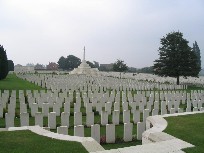
Our first stop is the Tyne Cot Cemetery. It got its name because members of a British regiment from Newcastle thought a cottage in the area reminded them of their homeland on the Tyne River. It is the largest cemetery in the salient and contains a wall with the names of almost 35,000 British Empire troops who were killed after August 16, 1917 and whse bodies were never identified. The cemetery includes two German bunkers, one with the Cross of Sacrifice on it. There are over 30 British Empire cemeteries in this area, consolidated from about four times that number after the war ended. Pictures of this cemetery and all the other places we see on this tour are on my Ypres photo site.
We visit the New Zealand Memorial at Gravenstafel where many New Zealanders died in the Third Battle of Ypres sometimes called Passchendaele. Many Kiwis and Aussies, to say nothing of Canadians, Indians, Pakistanis, Africans, and other soldiers from the far reaches of the empire died in this 10 or 15 square mile area. It was a slaughter house. I have a great deal of trouble understanding how men could have faced the terrors of not only the German guns but also drowning in the swampy bog, they were fighting in. The thought of it reminds me of a scene from The Bridge On the River Kwai, when, after the bridge is blown up, the camp doctor wanders down the river bed uttering the words "Madness, madness, madness." over and over.
We next visit Hellfire Corner which every soldier had to pass on his way to the front and which the Germans had zeroed in on with their artillery. One of the most interesting facts is that approximately 3 tons of unexploded ammunition is dug up by farmers and others every year. There is a Belgian Army unit that does nothing but collect this ammo and dispose of it. There are pick-up points along the roads where the farmers leave the shells to be picked up weekly, I believe. As we drove around the area we could see shells in the cement containers provided for them.
We stop for lunch at the Hooge Crater Museum. It is a small but very well done museum with a small cafeteria: well worth the 30 minutes it takes to browse through it. After lunch we visit Hill 60 where the British spent over 18 months building tunnels in which to place 19 huge mines which would then be detonated just before a planned attack. The mines were indeed exploded and Hill 60 taken in the Battle of Messines. We climb up the hill and see that the craters from the explosion are still there as well as German bunkers and other artifacts from 80 years ago. By this time we are getting confused as to what happened when and so we buy a small study guide to try to fix the chronology in our minds. It's titled simply YPRES 1914-1918 and was written and self published by a British history teacher, Leslie Coate. This helps considerably. I find that Michael Duffy's First World War.com website is also a good source for understanding the chronology of WW I.
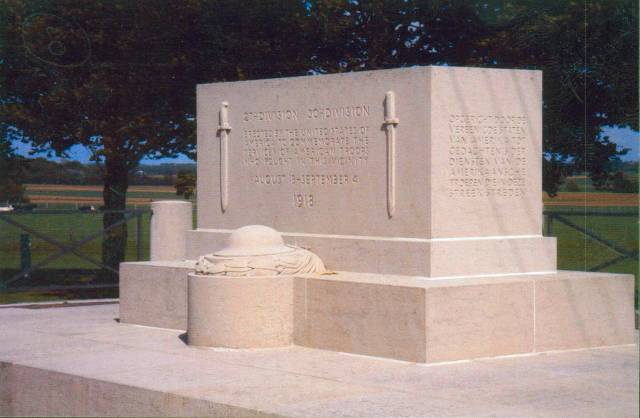
We visit an American Memorial near Mt. Kemmel. Evidently a few American National Guard units were assigned to the Ypres Salient, poor bastards. Calling Mt. Kemmel a mountain is a definite overstatement but in this area it is the only rise that is over 100 meters above sea level hence the title: mountain.
(Continue)
(Return to EJ's Place Home Page)
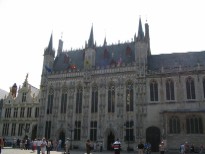
We visit City Hall which dates back to the 15th century when Bruges was a major trading center and seaport. The murals are both beautiful and historically interesting. We next visit the Basilica of the Holy Blood where supposedly Christ�s blood re-liquefies periodically. While we are there, a ceremony is going on to honor �His Sacrifice.� I don�t see the blood liquefy, though. Damn! It is, nevertheless, a fascinating ceremony taking place in a beautiful church.
After a quick stop at the Tourist Center, we walk to the Groeninge Museum . This museum is housed in an old restored palace-type residence and is one of the most efficiently organized museums I've visited. The audio guide is most instructive. It tells you more than you may have ever wanted to know about each of the paintings. The collection is obviously focused on early or "Primitive" Flemish artists particularly Jan Van Eyck, but they have a good selection of more modern paintings. The museum also has a delightful garden. We take a break under the shade trees.
Our next stop is the Church of Our Lady, which contains Michelangelo's Madonna and the tombs of Charles the Bold and his daughter Mary. As you can see from the pictures, it is a beautiful church. Pam has the time and energy to visit the choir but I'm fading fast so we decide to visit the local Half Moon Brewery for a tour.
The tour is fun but a little disappointing because they no longer brew beer at this location. There is, however, a lot of historical information to absorb. It is obvious the Belgians take their beer seriously. At the end of the tour we are having our complimentary beer when we meet a delightful couple, Mike and Brenda, from Colorado, who have taken a year off to travel around the world. They quit their jobs, sold their house and took off. I'm in awe of their adventurous courage. I doubt I would have done what they were doing when I was their age. Doesn't seem to bother them, though. Maybe all the stories of the depression I heard from my parents had more of an effect on me than I'm willing to admit.
Together, the four of us head for the Beguinage. Now a Benedictine convent, it was at one time a place where religiously inclined women who did not want to be nuns, could live away from the rest of society. It is certainly a peaceful spot with a beautiful garden surrounded by living quarters and a small chapel. I am surprised to see a nun wearing a habit. I haven't seen nuns wearing habits, except in the Philippines. We leave Mike and Brenda practicing their French with a couple they meet and we walk to a nearby park that has a canal running through it. I'm exhausted but Pam wants to walk much farther than I do. She takes off and I find a grassy spot next to the canal under a tree where I can contemplate my declining level of fitness.
When Pam returns, we walk back to our hotel. I'm tempted to take a horse drawn carriage but I resist the temptation and instead we hike back. As soon as we arrive, Pam checks her e-mails and I hit the bar for a beer and more discussion about Lance Armstrong and the Tour de France.
An hour later we choose a restaurant on Simon Stevin Square for dinner. I beleve it is actually named the Simon Stevin restaurant. The outdoor venue is across the street from the restaurant proper. The food is great but the service is not so good. I guess if I have to choose between the two, I'll take the food.
We have an after dinner drink at our hotel and even more discussion about Lance Armstrong before I finally, totally run out of steam, ascend to our room and pass out.