 |
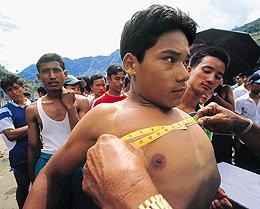 RITES OF PASSAGE: Would-be Gurkhas are scrutinized during a rigorous selection process. |
The cream of Himalayan manhood still leaves the mountains to fight in foreign lands, for foreign flags
By MICHAEL FATHERS Beni
A curious spectacle is taking place near the rapids of the Kaligandaki River in the western foothills of the Himalayas. Roughly 150 men between the ages of 17 and 22 have stripped to their underpants and are lining up for a physical fitness test. It's the first round of a grueling elimination that will end three months later when 230 of the thousands of aspirants are chosen for the world's most successful and perhaps most feared mercenary force--the Gurkhas. Across the mountains of eastern and western Nepal, the annual recruiting season for Britain's 3,700-man Brigade of Gurkhas is in full swing.
because
men in such areas generally aren't considered tough enough. Each
gallahwallah is allocated a fixed number to recruit, usually no more than
80. These go on to the next stage, known as the hill selection, in which
the tests--physical and mental--are more thorough and the elimination more
ruthless. Of some 6,000 boys who attend the hill selection, only 789 make
it to the final week-long examination at the British Gurkha recruiting
center in Pokhara in west Nepal. Of that number, 230 will join the army
while 100 others will be chosen for a select unit in the Singapore police.
Elsewhere in Asia, one of Britain's two battalions of Gurkhas is stationed
permanently in Brunei at the request of the Sultan. The unit rotates with
the one in Britain every three years.
Most of Beni has come out to watch the gallah selection. The women giggle
when the boys fail; they look on in awe when others pass. The easy part is
when aspirants puff their chests out a few centimeters. Half are knocked
out at the next test--25 sit-ups in one minute lying head down on a 35
degree sloping board. This is followed by 12 pull-ups on a bar with the
support stand kicked away. When entrants pass this stage, the "cattle
market" begins. The gallahwallah inspects the men like prize animals:
their mouths are opened, their breathing checked, their teeth examined,
their chests tapped, their muscles poked. Are they flat-footed, can they
stand straight, can they use both eyes? Are they coordinated, can they
read, are they deaf, do they have any diseases, are they calm?
As a precaution, the gallahwallah and his helpers pack up their equipment
in case they need to make a quick getaway: candidates who fail have been
known to throw stones. Pun misses out again. He suspects it may be because
of his slight squint. He is on the verge of tears; others are angry. Those
who passed are beaming, only dimly aware of the greater hurdles
ahead--more grueling than for other recruits to the British army. The
tests include a 1.6-km run in less than 9 minutes; a 4-km mountain race
carrying 35 kg of stones in a doko, or rattan backpack, up 400-m slopes
within 35 minutes; intelligence tests, mathematics quizzes, essay-writing
exercises, X-rays and still more physical exams.
After years of fighting at the margins of empire, the Gurkhas have become
a central part of the 113,500-member British army. They help fill gaps
caused by a shortfall of domestic soldiers that currently totals 6,000 a
year. Recruiting is now open to citizens from Commonwealth countries,
leaving the British army with the curious prospect that it could look more
imperial in the 21st century than it did in the 20th. Gurkha units are
also an integral part of India's 1-million-strong army and are stationed
along all of its borders.
A certain aura surrounds the Gurkhas, owing to their reputation for
bravery and to the kukri--a small machete they carry that can slice off a
human head in one blow. Their motto--"It is better to die than to
live a coward"--also helps. Says India's vice-chief of army staff,
Lieut. General Chandrashekar, an honorary colonel of the 4th Gurkha
regiment: "They are excellent soldiers, physically fit, fearless,
relaxed, hard working and with a natural aptitude for field craft."
Gurkhas have fought in almost every conflict involving Britain or India
over the past 150 years: Afghanistan,
Mesopotamia, Persia, Palestine, Tibet, China, Egypt, North Africa, Malaya,
Burma, Borneo, Bangladesh, Pakistan, the Falkland Islands, Iraq.
Their peacekeeping role within and outside the United Nations has taken
them to Vietnam,
Congo,
Rwanda and Lebanon.
This year they have served in Kosovo,
Kargil and East Timor.
An Indian Gurkha battalion is also on standby to join the new U.N. force
in Sierra
Leone.
Lately, though, some Gurkhas have been asking whether their service is
adequately appreciated. The death in June of Sergeant Balaram Rai of the
British Gurkha Engineers while clearing unexploded bombs in Kosovo focused
attention on a disparity in pay and pensions between British soldiers and
their Gurkha counterparts. Rai's
widow received a
lump sum
of $31,000
and a pension of $1,500 a year, falling to $1,300
after five years--her husband's remaining period of service. The widow of
a British soldier of the same rank would have received a lump sum of
$90,000, a further $16,000 six months later and an annual pension of
$25,000 until she died.
A British media campaign, backed by actress Joanna Lumley, whose father
was a Gurkha officer, has forced the government to review compensation.
When British Gurkhas quit Hong Kong and relocated to Britain in 1997, they
were given "allowances" to bring their take-home pay on a level
with British soldiers of similar rank. This was the first tangible
recognition of equality. But pension levels remained fixed. "We give
them a very shabby deal in retirement," Lumley told the British
press. "It's all very well saying, 'Oh, you can live very cheaply in
Nepal.' But we all know what that means--they walk for seven days to get
to a hospital."
Last week, British Prime Minister Tony Blair announced that payments to
the widows and families of Gurkha soldiers killed in action would match
those of their British counterparts and be backdated to May to cover
Balaram Rai. The pension issue, however, remains unresolved.
At Subathu depot, a Gurkha headquarters and site of the passing-out
parade, the officers' mess is filled with trophies. The skin of a tiger
shot by King George V on his 1911 visit to India and another bagged in
1938 by John Masters, a Gurkha officer, hang on the wall. These days
Gurkha officers are more likely to spend off-duty hours playing hunt the
yeti on their laptops. Not worthy of their reputation? Try telling that to
a Gurkha.
With
reported by Dhruba Adhikary/Katmandu and Michael Brunton/London