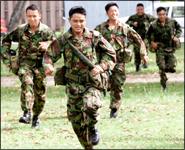
Gurkha soldiers take part in an exercise in Brunei in November 2001. (Vincent Thian/AP Photo)
Bravery Precedes Them
By Leela
Jacinto

But in 1816, the Nepali defense of the hill fortress of Kalunga in the Himalayan foothills so impressed the British that in the terms of a peace treaty signed with Nepali King Prithvi Narayan Shah, the British shrewdly included a clause under which the Gurkhas could serve in the East India Company's army. That was the start of a long, illustrious military alliance between the British and the Gurkhas, a term loosely used to describe men of Nepal who serve as soldiers in the armies of Nepal, India or Britain. Drawn mostly from the Magar, Gurung, Rai, Limbu and Sunwar hill tribes — tribes the British considered fit fighters — the term "Gurkha" is an Anglicization of the Gorkha district, the birthplace of King Prithvi Narayan Shah, who is considered the father of modern Nepal. Ayo Gurkhali! With their battle cry "Ayo Gurkhali!" — "Here come the Gurkhas!" — the hardy Nepali hillsmen gained such a reputation as fighters that stories of enemies fleeing their positions upon hearing rumors of their advance abound. During the Great Indian Mutiny of 1857, when local sepoys revolted against their British officers, a rumor running through the northern Indian town of Simla that the Gurkhas had joined the sepoys so frightened the resident British that they panicked and fled the town, some men even abandoning their wives and children. But the Gurkhas stayed loyal to the British and did not join the mutinying sepoys, passing their first test of loyalty. Many years later, after Argentina's surrender to Britain in the 1982 Falklands War, Argentine troops told reporters that rumors of the Gurkhas slitting the throats of 40 Argentine soldiers in single strokes and of Gurkhas jumping into enemy foxholes with live grenades gave them the jitters and seriously shattered their morale. It's hard to tell where the legends of Gurkha ferocity spring from and how much of it is true. Many of their deeds have been recorded in official military dispatches, but many more have been gleaned from diaries of British officers through the centuries, and historians argue that many of these entries may have been liberally embellished. Blood Thirst of the Blade Certainly the most pervasive myth of Gurkha ferocity fans from their famed wielding of the kukri, or the curved Himalayan knife. Legend has it that once a Gurkha unsheathes his kukri, he must draw blood with it. When a Gurkha unsheathes his weapon in a noncombative situation, he must then nick himself to satisfy the "blood thirst" of the blade. With a motto that says, "Kaphar hunnu bhanda marnu ramro" — "Better dead than live like a coward" — Gurkhas are known to be brutal in battle, but they can also be charming and delightfully childish in peace. During their World War I operations in the Arabian Peninsula, British officers recorded the Gurkhas' delight when they encountered the sea and camels for the first time. When a Mule Kicks a Gurkha Stories of the toughness of Gurkha skulls also do the rounds, with one story going so far as to claim that if a mule kicks a Gurkha's head, the Gurkha may suffer a headache, but the mule will certainly go lame. But among all the legends surrounding the Gurkhas, the ones that have the greatest ring of truth are stories of the Nepali fighters' discipline and literal performance of orders from military superiors. One particular diary entry talks about how an Indian army doctor once went up to a British officer and told him that a wounded Gurkha would surely die unless he displayed some "will to live." The officer, the story goes, stormed into
the hospital room and barked the order: "Live!" The
wounded Gurkha obeyed. |
|||||||||||||||
