Factories use secret dumps to dodge treatment costs
Busrin
Treerapongpichit Yuthana Praiwan
Bangkok Post, September 24, 2001
| Some 400,000 tons of hazardous industrial waste has been dumped secretly in Rayong, especially between Pluak Daeng and Ban Khai districts, and at municipal rubbish dumps and garbage-separation plants, according to local sources. According to the Industrial Works Department, the country produces 13.9 million tons of waste a year, of which 1.24 million tons are hazardous. But of the hazardous and chemical waste, only 800,000 tons are on record as being eliminated by approved treatment and disposal methods. |
 |
 |
|
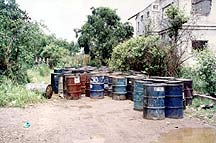
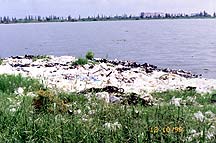
Factory owners dump toxic waste without treatment on vast stretches of bare land in Rayong, where many of them are near farms, waterways and communities. |
|
| A local politician, who declined to be named, said there were vast stretches of bare land in Rayong where factory owners could secretly dump toxic waste without treatment. Many of the dumps are near farms, waterways and communities. The factories concerned, especially in Rayong where 90% of the hazardous waste originates, mask their activities by sending some of the waste to General Environmental Conservation Plc (Genco), the only company with the legal authority to treat toxic waste. The factories then mix the rest of their toxic waste with common garbage. Behind the scenes, the factory owners invite companies, whose charges are much lower than Genco's, to bid for the right to dispose of the mixed waste and turn a blind eye to where it is dumped. This made it hard to trace hazardous substances, a local official said. Officials had to infiltrate the operation to find evidence to bring offenders to court. "Some officials have to disguise themselves and keep watch on suspect factories around the clock. They may follow garbage trucks to see where the waste is dumped." Fifteen officials of the Industrial Works Department have been inspecting waste disposal methods and sites in Rayong for one month and expect to complete their work next week. Pramote Veeraphat, the mayor of Mab Ta Phut, said it was difficult for officials to inspect factories because most plants were in industrial estates and protected by the industrial estate law. No one except directors-generals of the IWD and Pollution Control Department are authorised to inspect the factories but, unlike local officials, they were unable to make timely inspections. Mr Pramote said he had tried to persuade the departments to decentralise power to local officials, but to no avail. "But I can try my best to make the municipality free from toxic waste by sorting garbage prior to disposal. Our area runs a high risk of hazardous-waste dumping because it is located near the industrial factory zone." Mr Pramote said the Industrial Estate Authority of Thailand was best placed to identify the amount of garbage disposed of by factories in the industrial estates since the collection and transfer must be approved by the authority. As an example of the problems, Mr Pramote cited the case of Tuntex Petrochemicals (Thailand). The company hired Ganfong Co as its contractor to manage disposal of coal ash. Although evidence showed that the ash had been dumped beside an irrigation canal in Map Ta Phut, the companies were not found guilty of any offence. Tuntex said Ganfong had been asked to take responsibility for disposing of the waste properly. The authorities asked Ganfong to comply with proper practices in the future. Bundit Thongsricharoen, chief of the Rayong industrial office, said Ganfong was licensed to dispose of common waste and coal ash was not listed among toxic substances by the Pollution Control Department. A source at Ganfong, who asked not to be named, said the incident arose from the personal interests of some of the company's staff who wanted the ash to develop a market garden outside the permitted area. Those responsible had been fired. Issara Shoatburakarn, deputy director-general of the IWD, said factories that called bids for waste disposal were required to tell the office about the type of waste and treatment planned. However, the office lacked the manpower to check whether the 4,000 factories in the province added toxic waste to the garbage. The department had no an authority to check factories in industrial estates, such as Tuntex, as they were the responsibility of the estate authority. "Factories in estates are mostly large ones that discard huge amounts of toxic waste while most factories outside the estates are classified as small and medium scale,"Mr Issara said. Bhichit Rattakul, a former Bangkok governor and current chairman of an environmental protection foundation, said that only two operators-Genco and Siam Cement Industry (Kaeng Koi) Co_ had the capability to provide full treatment of industrial waste. In April, Siam Cement Industry was licensed to use waste as a raw material or fuel substitute by burning it at 1,450 Celsius in cement kilns. A source at the company said it had spent about 25 million baht on modifying its kilns for the purpose. The plant had the capacity to dispose of at least 100,000 tons of liquid waste and two million tons of solid waste a year. The company plans to increase its full capacity for liquid waste disposal to 1.1 million tons a year. Seven more companies have applied for toxic-waste disposal licences: four more Siam Cement plants and Siam City Cement Plc, TPI Polene Plc and Asoke Chemical |
Go back to the Main Page