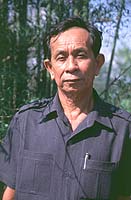
One-time city dweller Kamphan Laowongsri is part of a far-seeing plan to revitalise natural farming methods across the country
When he worked as a welder in Bangkok a few years ago, Kamphan Laowongsri found it difficult to make ends meet. He was earning 12,000 to 15,000 baht a month, but was constantly worried about being able to put enough food on the table for his family of five.
"No matter how much I earned, it was never enough,'' the 44-year-old father recalled. A year after the economic crisis of 1997, Kamphan decided to quit Bangkok and start a new life back home in Kantharawichai district in Maha Sarakham province. His assets were just a six-rai plot of barren land inherited from his parents _ and some valuable memories.
"I couldn't stop thinking about my childhood. My parents were farmers. They weren't rich but they were debt-free, unlike me in Bangkok. Life with them was simple but full of happy times. Our family was together. We had no worries. We were never short of food."
"I reckoned the only way I could survive was to return to my parents' way of life,'' he said.
Working mainly from memories of how his parents had done things, Kamphan starting farming in the natural way which was the norm for centuries before the introduction of pesticides and fertilisers during the "Green Revolution'' here some 40 to 50 years ago. He got some help to start off with from the Sustainable Agriculture Foundation of Thailand, which provided funds for a pond, seedlings, chicken and cattle.
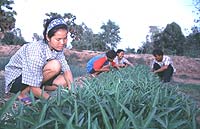
After two years of devoted hard work, his efforts began to pay off. Today Kamphan's small plot has become a green oasis in a region of mainly yellow-brown barren land. In his barn he has enough rice to feed the family for months ahead. His orchard has a wide variety of fruit and vegetables, including bananas, mangoes, papayas, chilies, mint, Kaffir lime leaves, limes, melons, mushrooms, morning glory and lettuce.
"Having no food expenses is actually the same as earning a lot of money,'' said Kamphan. He also benefits from not having to buy items like seedlings, chemical fertilisers and pesticides, and petrol to run machinery. Now he hopes to carry the process even further. "It's great not having to spend money on things. So I'm now having discussions with my fellow villagers on how we can be self-reliant in other aspects of our lives,'' he said.
Villagers are considering growing cotton and reviving weaving so they can make their own clothes, he said. They are also discussing growing herbs for medicine and trees for construction material.
Advocates of sustainable agriculture believe that success stories such as Kamphan's will encourage more farmers to follow suit. "Farmers should be able to provide themselves with the basic necessities of life,'' said SAFT chairman Viboon Khemcharoen, who is also a pioneer of mixed farming. ``Food security should start with the food producers,'' he said.
The foundation was established in 2000 after almost two decades of work by Thailand's grassroots back-to-nature movement. Through persistent public and political campaigns, the movement convinced policy-makers to include natural farming in the 8th National Economic and Social Development Plan (1997-2001). This was the first time natural farming was included in the national development agenda side-by-side with mainstream chemical farming. The plan aims to eventually expand the amount of agricultural land used for ecologically friendly farming from almost zero a few years ago to 20 percent of the total, or about 25 million rai of land.
As a result of the plan, a pilot project was set up in 2000 to encourage more people across the country to take up natural farming It includes 19 regional zones covering a total area of 27,120 rai and involving 7,800 households. Farmers chosen to be in the pilot project have been given funds for necessities such as seedlings, fencing, cattle, chickens, and pond digging. "Sustainable agriculture is a real alternative. It helps farmers to get out of debt gridlock and to stop having to rely on expensive technology that's a product of the capitalist market economy,'' said Viboon.
"Ecologically friendly farming is about more than agricultural methods, it's a way of life. It includes dimensions such as family, culture, community and environment and works towards harmony and peace between all of these.''
Since each region differs, the foundation does not impose uniform rules on farmers or tell them what to do.
"They need a lot of patience _ to watch how nature works, to experiment and even to fail,'' said Viboon. But there is one golden rule. ``No quick-fix chemicals can be used. Sustainable agriculture is about learning to live with nature, not to beat it. Right thinking and efficient management are the keys to making it work.''
Kamphan uses cattle and chicken manure and compost as fertiliser. He positions his plants according to their needs. He doesn't have to buy new seedlings since he harvests his own. For chicken feed he uses vegetable greens chopped and mixed with termites collected from lumps of damp, dead wood on his land.
"Everything on the farm is usable,'' said Kamphan.
"The heart of sustainable agriculture rests on having a diversity of plants to reduce risk and enhance food security,'' said Dr Pearmsak Makarabhirom of the Community Forestry Outreach Programme. Ecologically friendly farming doesn't mean saying no to cash crops. Wanchai Srisongpleuy who farms in the Phupan mountain zone in Sakon Nakhon, for example, grows commercial crops such as cassava and rattan among his vegetables and fruit.
"I couldn't just throw away the cash crops when I reverted to sustainable agriculture. I needed cash to pay for my children's education and medicines, for example,'' he said.
Supha Yaimuang of SAFT said that farmers have other options beside food crops to make cash. For example, at Baan Khok Khao in Sakon Nakhon, farmers grow cotton and kram (indigo) along with rice. The rice is for their own consumption and they get a cash income from selling handicrafts and indigo-dyed hand-woven cloth. "It is difficult for villagers to be wholly self-reliant with just food crops,'' said Supha. "It's good if they also have some other products that help support them and make them less dependent on the marketplace.''
Farmers' networks are important to help people exchange products, knowledge and experience, said Dr Banchorn Kaewsong, an academic who has long worked with grassroots organisations in the Northeast and who is part of the project-assessment team.
At a Grassroots Knowledge Fair held recently in Kalasin province, for example, farmers from different regions exchanged views on rice varieties, new initiatives and new practices in chemical-free pest management. "This learning and sharing process is essential,'' said Dr Banchorn. Since knowledge about natural farming has fallen away since the ``green revolution'' many of the old skills needed to be relearned, he said. Get-togethers also acted to encourage farmers by reminding them that they are not alone, he said.
The toughest thing, said Dr Banchorn, was convincing farmers of the value of switching to natural farming. He cited the example of farmers in the rich, fertile Central Plains who are reluctant to change from chemical farming although they are deeper in debt than farmers elsewhere. They also suffer more from illnesses caused by exposure to the chemicals they use. "They still hang onto the hope that with more investment in chemicals and petrol they'll be able to clear their debts,'' said Decha Siripat, a SAFT committee member and long-standing advocate of sustainable agriculture.
Viboon said such feelings are understandable _ change is hard. So is being faced with severely degraded soil and knowing that to revitalise it naturally needs a lot of patience, devotion and time.
"Many farmers don't have much money now, and it would take a lot of energy and time to get their land working naturally again. They can't succeed unless they're really tough and determined,'' said Dr Banchorn. That's why many natural-farming advocates believe the government should be lending more support. The three main causes of farmers' debt are education, illness and gambling, according to a study by Dr Pearmsak. "Sustainable agriculture may provide farmers with their food and other basic necessities but they still need large sums of cash to pay for their children's education. The government should do something to help.''
Since the government can't subsidise everyone, the future expansion of natural farming may happen through community co-operatives, which could provide loans, Dr Pearmsak added. "The Sustainable Agriculture Foundation is only supporting the natural-farming pilot projects for three years. After that community organisations will take on the task of pushing it forward,'' he said.
There are many challenges ahead. But Kamphan, for one, is not disheartened. "I now have plenty of food. Whatever I want to eat, I grow. I have enough to provide for my family and even to share with my neighbours,'' he said, smiling, obviously content with a life of simplicity, the secret of happiness.
Source: Outlook, Bangkok
Post, April 24, 2002 |