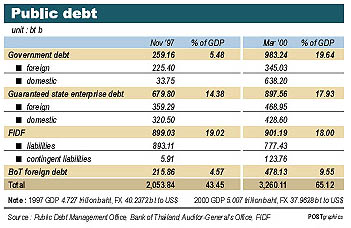

"The budget for debt service alone will increase from 9.5% of the total budget in 2000 to 13.3% to 17.1% in 2003," the report said.
The Finance Ministry said long-term debt management would depend on revising terms for loan projects, overhauling the tax system, accelerating state enterprise privatisation and adjusting borrowing procedures. Akapol Sorasuchart, government spokesman, said budget laws should be amended to increase flexibility for refinancing foreign loans with borrowing on the local front. Tax rates should also be adjusted in line with the economy's growth, he said. No details on how rates would be changed were announced.
Total public debt at the end of March comprised of 983 billion baht in direct government borrowings, including 499 billion baht used to offset losses by the Financial Institutions Development Fund and 48.5 billion baht for the August 1998 financial institutions recapitalisation scheme. Mr Akapol said the government had taken out 105.3 billion baht worth of foreign loans over the past three years to stimulate the economy and strengthen the social safety net.
He said the government also had to incorporate from 800 billion baht to 1.2 trillion in additional losses for the FIDF in the public debt over the next five years. But economic growth remained on track at 4%-4.5% for the year, despite risks such as global oil prices, US interest rates and domestic share prices.
Bad debt within the banking sector and falling commodities prices were other risks to economic growth this year, Mr Akapol said. But economic ministers noted export growth remained strong at 24.6% for the first four months of the year. Private consumption had also shown gains, with inflation and exchange rates both stable.
The Commerce Ministry estimates export value to reach $64 billion this year, equalling growth of 9.5% in dollar terms. According to Staporn Kavitanond, secretary-general of the Board of Investment, new investment projects in the first four months this year rose by 50% from the year before. The BoI was studying ways to restructure investment promotions for the agricultural industry to spur new investment. According to a BoI survey of 740 companies which had received investment promotions in the first quarter, production utilisation stood at 77%, compared with 70% reported in the fourth quarter last year.
State enterprises also reported second quarter net profits of 22.5 billion baht, an increase of 9.5 billion from the year before. Rattana Chongsuthanamanee, deputy government spokeswoman, said the higher profits stemmed from lower production costs and foreign exchange gains. Total net profits this year for state enterprises was expected at 73 billion baht, an increase of 13 billion from original targets. The largest gains were posted by the Electricity Generating Authority of Thailand, the Telephone Organisation of Thailand and the Provincial Electricity Authority.
By
Parista Yuthamanop and Chatrudee Theparat,
Bangkok Post, May 30,
2000
Go back to the Main Page