|
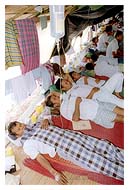
| One hunger striker is given a saline drip as he and other protesters continue their fast in a tent outside Government House. Two of them were sent to hospital yesterday. _ APICHIT JINAKUL |
"I came here because the dam made me poor by flooding my land. It has taken away fish from the river. I had to sell everything, my farmland, my cattle, nothing is left. I have no other choice," she said.
She joined the hunger strike on July 21 to join 500 others in persuading the government to address their grievances. There are now 472 hunger strikers, said attendant Somjit Khongthon, of which 287 are male, 215 are female and 174 are over 60 years old. The oldest is 88 while the youngest is 14.
Only one hunger striker from the first group remains since they began fasting on July 27. Prasert Phopkhunthod, who has been on the strike for 10 days, has become weaker but refused a doctor's order to start taking food.
Alongkorn Polabutr, the PM's secretary, yesterday said Prime Minister Chuan Leekpai was concerned about the villagers' health, particularly the women and the elderly.
Despite admitting that she became weak after two days, Mrs Hai insisted she was unafraid of falling ill since she would have starved if she stayed at home. The spirited grandmother was affected by the heat and the pollution, and frequently came down with a cold or a fever. Lying on the hard concrete also gave her backache.
"I don't sleep well here. Usually I go to sleep at 11pm and wake up at around 1am," she said.
Mrs Hai was not the only elderly villager on hunger strike. Sa-ngiam Polchit, 63, said this was the second time she had to come to protest in Bangkok. The first was during Gen Chavalit Yongchaiyudh's government.
"The Chavalit government promised us a 15-rai plot of land or 500,000 baht. But the Chuan government has done nothing, so we are here to remind them to keep their word," said the native of Ubon Ratchathani.
Mrs Sa-ngiam, who began the hunger strike two days ago, said she took water occasionally and a little honey, but was unable to take glucose from the medical unit. She also suffered from a frequent cold and dizziness, after spending nearly one month in the polluted city.
"Bangkok people might get irritated with us because they don't understand our problems. We would not be here if it were not for our hardship. It's much more pleasant in rice fields at home than here," she said.
Mrs Sa-ngiam said she did not want money from the government, she just wanted the fish and shrimp to return to her river.
Dee Saiboon, 64, also came to protest in Bangkok because he could no longer fish in the Moon river and did not have enough to eat. Mr Dee said he was limited to fishing because he no longer has enough strength for farming. But the supply of fish and shrimp gradually decreased since the construction of the dam, and have all but disappeared now. Mr Dee said he was weak after two days, but could continue because he was used to hunger.
"The government caused us trouble, but they never set eyes on us. They said they've done their best, but still we're poor. We are people of the state. If we're starving, that means the country is starving, and if we cannot survive, the government cannot either," he said.
Sanitsuda Ekachai
 |
| "The government doesn't respect our community
land rights. Neither doees it see us poor people as equal human
beings." RAE MAHACHAI Lang Pu villager |
"Our communities by the Moon river have been living and farming in the Lang Pu forest for generations. My grandfather lived there. My father was born there. And so was I," the mother of three said.
"With some farmland and a river nearby, we never knew hunger. Life was peaceful until 1981 when forestry officials told us we could no longer live there as the area had been declared part of a national park."
Routine harassment followed when the government tried to evict the villagers, who fought back by joining the Assembly of the Poor. Despite bureaucratic red tape and state resistance, years of struggle finally paid off when the authorities admitted the Lang Pu forest communities in Ubon Ratchathani existed long before the boundaries of the Kaeng Tana National Park were decided.
The Chavalit administration, which preceded Mr Chuan's government, agreed the Forestry Department should not include these communities in the national park. The villagers were on the brink of getting the land security they so desired, when the Chuan cabinet's decision broke all past agreements with the Assembly of the Poor. In essence, the resolution gave the department full authority to arrest and evict forest villagers.
"This is really unfair. The government doesn't respect our community land rights. Neither does it see us poor people as equal human beings," she said.
Arrests and constant harassment have devastated many families and forced them to give up and leave. But Mrs Rae stayed, and paid a high price for the struggle. Her husband was not that keen on farming or fishing. He saw no point in fighting a losing battle and pressed her to leave home and find work elsewhere. He left after she refused and now lives with another woman.
"I was shattered," she said. "But I must fight for my family, for my community." She paused to regain her composure. "I'm lucky that my children understand. So do my parents. They said I'm doing the right thing for the children's future."
Mrs Rae is one of many female leaders in the grassroots environmental and land rights movements. Such female prominence does not surprise her.
"Men are more mobile, they like to work elsewhere. Women are more homebound, which increases our attachment to the land.
"It's also the mother's duty to look after the family's well being. When the source of our livelihood is taken away, mothers must act to protect our children."
That is why Mrs Rae insists the 1998 cabinet decision must be reversed.
"We want to have a say in things that affect our lives. At present, forestry officials can evict us anytime they please," she said.
"We don't want much. Only the same old way of life that has been destroyed by the authorities. We don't want any money. Only some security, and the ability for families to stay together.
"Is that too much to ask?"
The government has rejected all these recommendations.
Source: Bangkok Post, August, 8, 2000
Go back to the Main Page