Unemployment/Income gap widens
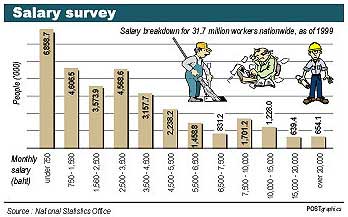
Cholada Ingsrisawang, Bangkok Post, May 29, 2000 What's 750 baht? A bottle
of imported scotch. A dinner for two at one of Bangkok's better hotels. But for
6.8 million people nationwide, 750 baht represents more than a month's wages.
Last year, the number of people below the poverty line totalled 7.9 million, an increase of 1.9 million or 15.9% from 1998. According to the National Economic and Social Development Board, nearly 13% of the population now live below poverty line, defined last year as those with incomes of 886 baht per month or 10,632 baht per year. Most of the poor are farmers, with the highest growth rate in poverty levels recorded in the South, followed by the Northeast region.
According to the National Statistical Office, average wages nationwide totalled 6,602 baht per month, with the lowest salaries reported by the agriculture sector at 3,014 baht and the highest by the public utility sector at 11,369 baht. Wages reached their peak in mid-1998, when average salaries stood at 6,808 baht per month.
Labour economists agree that the increase in those below the poverty line stems largely from the decline in farm product prices over the past two years. Corporate restructuring, resulting in higher unemployment and salary cuts, has reduced incomes. Almost 7,000 firms closed down last year, while tens of thousands shed staff as part of restructuring.
According to the most recent job surveys, unemployment stands at 1.07 million people, or 3.3% of the workforce, down from 5.3% in May 1999. But employment, according to the National Statistical Office, is defined as those working at least one hour per week, a standard which critics say masks the number of part-time or occasional workers compared with those in full-time jobs.
Bangkok residents continue a longstanding trend of being better off than people in other regions. Of 5.6 million people in the city, around 2.2 million have monthly salaries below 7,600 baht. Monthly spending has also declined with wages averaging 6,000 to 6,500 baht compared with 7,500 baht in 1996.
One NESDB economist said that 60% of consumer spending usually went on food. For the poorest, spending on non-essential items, such as liquor, entertainment or cigarettes has fallen to compensate for increases in prices.
Labour advocates have clamoured for an increase in minimum wages, which have remained unchanged at between 130 and 162 baht, depending on location, since 1998. But Pisarn Manohleehakul, managing director of the Thai Farmers Research Centre, said increasing minimum wages would have little impact in reducing poverty, given the sluggishness of the economy. A pay increase would most likely lead to further lay-offs, as companies seek to maintain profit margins.
Even so, it is uncertain whether companies are complying with existing minimum wage laws. "There are no statistics on whether employers are actually paying minimum wages. From informal surveys, many firms are not, and are hiring staff on a daily basis rather than permanent contracts," Mr Pisarn said. A better solution, he said, would be to increase incentives for staff to improve efficiency and productivity.
Overall industrial development policies now focus on increasing value-added content, as Thailand's labour-cost advantages fade in comparison to those of competitors such as Vietnam and China. Most industrial goods, such as electronics and auto parts, are for export, given the low buying power of the domestic market. The poorest people often bought black-market goods imported illegally from China, Mr Pisarn said.
Even the civil service, which offers some of the most secure jobs, has faced budget problems in compensating retiring workers or accepting graduates seeking positions to complete scholarship obligations. Around 2,000 former civil servants who accepted early retirement last year are still awaiting compensation payments of nearly 430 million baht, with delays blamed on the fact that a budget of only 200 million baht was approved for the Labour Ministry.
Go back to the Main Page