Supara Janchitfah
Bangkok Post, June 25, 2000
Where does all the water Bangkok and its surrounding urban areas consume come from? The Chao Phya River Basin is the main source of water for Bangkok, Samut Prakan and Nonthaburi.
|
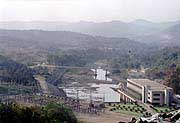
| The Sirikit Dam releases water into the Chao Phya Basin but it is often almost dry. _ SUPARA JANCHITFAH |
The Metropolitan Waterworks Authority (MWA) processes the water at Bang Khen and Samsen stations. Another source, the Tha Chin River, provides raw water for the Mahasawadi processing station. Last year alone, the MWA withdrew about 1,415.2 million cubic metres of raw water from the Chao Phya Basin. At this rate, even the largest dam in Thailand-the Bhumipol Dam-cannot supply enough water for city people to use. In June last year, according to the Royal Irrigation Department (RID), the Bhumipol Dam had only 951 million cubic metres of water stored in the reservoir-just 9.84 percent of its total capacity of 13,462 million cubic metres.
Of the 1,415.2 million cubic metres of raw water the MWA took from the Chao Phya Basin, only 856.6 million cubic metres of tap water was distributed-over 558.6 million cubic metres (39 percent) disappeared during delivery to households due to leakages in the pipelines.
This amount of loss is equal to the combined water from the Mae Ngod, Kiew Lom and Mae Klong dams with about one-third of the water stored in the Sirikit Dam in 1999.
 |
| Children may soon be deprived of water if their parents cannot afford to pay for it. |
The MWA's provincial counterpart is the Provincial Waterworks Authority (PWA).
In 1998, the PWA withdrew about 660.74 million cubic metres from various river basins in Thailand but only 437.44 million cubic metres were actually delivered to consumers.
Where did the other 223.30 million cubic metres-equal to the combined storage loss at Lamthakong, Chulabhorn, Moon Bon and some smaller dams-go to? According to water authorities, the main reason is leakage in transit due to old pipes.
PWA governor Dr Wanchai Gooprasert
admits that, in some places, water loss is as much as 50 percent.
Waterworks leakage is a worldwide phenomenon but the amount of loss varies from country to country, says MWA governor Chuanpit Dhamasiri. Old pipes, such as those in front of the Samsen waterworks station and surrounding areas in Bangkok, were laid in the time of King Rama V. Changing these pipes is not easy, since they are made of old, thick steel and laid in very deep soil. Most leakage is through pipe connections which are normally located every five to six metres.
The problem is exacerbated in Bangkok by soft soil and numerous construction projects. Traffic also aggravates the movement of the soil and pipes, adds Mrs Chuanpit. The quality of pipes in Thailand is low compared to that in Japan and Singapore, where stainless steel pipes are commonly used. The MWA still uses PVC pipes. Moreover, detecting leaks in the underground pipes is a daunting task. Although new technology is available, absolute silence is needed to operate it. "Unfortunately, Bangkok has never been that quiet," said Mrs Chuanpit.
The MWA has tried many different types of leak detector. The latest system to be tried is computer control. However, extensive mapping is required before it can become effective.
Facing the same problem, PWA governor Wanchai reports that 40,000 kilometres of pipes running from 224 PWA waterworks stations are old and decaying. "But we do not have enough money to change them. The price of water at the moment cannot support the investment. "Water currently costs less than a satang per litre for home consumption. (1 cubic metre = 1,000 litres)The PWA is trying to find a solution to water loss by hiring a company to replace the old pipes in the Pathum Thani area.
"We can solve the problems of water loss during delivery, but we have to invest in the pipe system," reports MWA governor Chuanpit. "It isn't easy," she adds.
"Although the MWA has money to invest in some places, it cannot easily install new pipes. Unlike electric power lines, we cannot easily remove old pipes. The roads are busy and putting in more pipes makes traffic problems worse," she says.
One of the Asian Development Bank's conditions for irrigation cost recovery is the imposition of raw water fees. The MWA's Samlae waterworks station is located by the canal that was built when Thailand's waterworks system began on November 14, 1900, since when it has always been accepted that the MWA may draw raw water from the Chao Phya River for free.
"We don't have to pay for that," said Mrs Chuanpit.
"In principle, the RID-whose job it is to allocate water-will charge if we withdraw the water from an irrigation canal. "But extracting water from the river or a natural canal is free," said Mrs Chuanpit. The fee that the MWA collects from consumers is the cost of delivery and services. The burgeoning growth of cities contributes to the MWA's delivery system expenses.
Further, delivering water to households and other users requires the observation of laws of gravity and water pressure.
The water pipe delivery system is different from other utilities, as the pipes must be of the same size from the starting point to the end of the line. They cannot enlarge en route. "The gravity of the water depends upon the first users. Sometimes users further down may have to wait until the first users use less water to have a chance to use the water as well," said Mrs Chuanpit. The MWA governor says it would not worry her to see a tariff imposed on the raw water used to produce tap water.
If the Asian Development Bank's raw water fee plan is implemented, water costs will rise. In that case, the MWA governor washes her hands of the consequences: "It is up to the government. If it thinks we should pay for raw water, the price will be passed on to the consumers," Chuanpit said.
Consumers should understand if they had to pay more because it is not just so the MWA can make more profit. It's because it has to pay for the raw water. "But the voices of people in the cities and of the middle class are loud," she smiled.
Meanwhile, Mr Boonyuen Wongkuang, a farmer and chairman of the Upper Ping River basin users group from Chiang Mai, insists: "We farmers have been paying for water for a long time. We collect money from our members and we maintain our own waterways. "However he doubts if some groups of people pay for water, including golf courses, resorts, hotels, the Provincial Waterworks Authority and many other agencies.
PWA governor Wanchai told Sunday Perspective that the PWA pays 50 satang per cubic metre for raw water. This applies only to some stations. A source from RID reveals that many PWA stations still owe the agency money.
Attempts to find new water sources for the cities are on-going. One plan is for the MWA to draw water from the Mae Klong River, about 106 kilometres from the Mahasawadi processing station. Land has already been purchased, according to MWA governor Chuanpit, and an agreement has been reached with the people in the basin. "We have an agreement with the people in the Mae Klong River Basin: in case of water shortages, the people will have the first right to use the water even before the MWA," said Mrs Chuanpit.
The PWA has also encountered similar problems. The growth of the eastern and northeastern regions are already taxing the waterworks system of the PWA. The search for water will never end as long as the demand cannot be managed. Mrs Chuanpit emphasises that water supply must be allocated and managed so as to guarantee quality and quantity. "Whether the government will impose a water fee or not, water management should come first," she affirms.
"In other countries, water boards allocate water from each river basin and stipulate how to control waste. "Water boards have complete power to manage their water. But Thailand has nothing like that. "However, she notes that successive governments have moved towards creating a water board. "We also tried to push for this but the governments change too often for the idea to materialise," she notes.
Thailand's present water management is in the hands of two groups: the flood and drought committees which are formed to solve the pressing problems of each year but not for long-term water management.
Go back to the Main Page