
Robert
Mundell: 1999 Economics Nobel Laureat
Professor of Economics, Columbia University
| Since 1974, Robert Mundell has been Professor of Economics at Columbia University in New York. After studying at M.I.T. and the London School of Economics, he received his Ph. D. from M.I.T. in 1956, and was the Post-Doctoral Fellow in Political Economy at the University of Chicago in 1956-57. He taught at Stanford University and The Johns Hopkins Bologna Center of Advanced International Studies before joining the staff of the International Monetary Fund in 1961. From 1966 to 1971 he was a Professor of Economics at the University of Chicago and Editor of the Journal of Political Economy; and from 1965 to 1975, he was (summer) Professor of International Economics at the Graduate Institute of International Studies in Geneva, Switzerland. He is currently, for 1997-98, the AGIP Professor of Economics at the Johns Hopkins Bologna Center of the Paul H. Nitze School of Advanced International Studies. Professor Mundell has been an adviser to a number of international agencies and organizations including the United Nations, the IMF, the World Bank, the European Commission, and several governments in Latin America and Europe, the Federal Reserve Board, the US Treasury and the Government of Canada. In 1970, he was a consultant to the Monetary Committee of the European Economic Commission, and in 1972-3 a member of its Study Group on Economic and Monetary Union in Europe. He was a member of the Bellagio-Princeton Study Group on International Monetary Reform from 1964 to 1978, and Chairman of the Santa Colomba Conferences on International Monetary Reform between 1971 and 1987. The author of numerous works and articles on economic theory of international economics, he prepared one of the first plans for a common currency in Europe and is known as the father of the theory of optimum currency areas. He was a pioneer of the theory of the monetary and fiscal policy mix, the theory of inflation and interest and growth, the monetary approach to the balance of payments, and the co-founder of supply-side economics. He has also written extensively on the history of the international monetary system. Mundell's writings include over a hundred articles in the scientific journals and the following books: The International Monetary System: Conflict and Reform 1965); Man and Economics and International Economics 1968); Monetary Theory: Interest, Inflation and Growth in the World Economy 1971; and co-edited A Monetary Agenda for the World Economy (1983); Global Disequilibrium (1990); Debts, Deficits and Economic Performance (1991); Building the New Europe (1992); Inflation and Growth in China (1996). Professor Mundell presented the Frank Graham Memorial Lecture at Princeton University in 1965, the Marshall Lectures at Cambridge University in 1974,and gave the Ohlin Lectures in 1998. He was the first Rockefeller Research Professor of International Economics at the Brookings Institution in 1964-65, the Ford Foundation Research Professor of Economics at the University of Chicago in 1965-66, the Annenberg Professor of Communications at the University of Southern California in 1980, the Repap Professor of Economics at McGill University in 1989-90, the Richard Fox Professor of Economics at the University of Pennsylvania in 1990-91, and is the Agip Professor of Economics at the Bologna Center in 1997-98. He received a Guggenheim Prize in 1971, the Jacques Rueff Medal and Prize in 1983, the Docteur Honoris Causa from the University of Paris in 1992, an Honorary Professorship at Renmin University in China in 1995, the Distinguished Fellow Award from the American Economic Association in 1997, gave the Ohlin Lectures in September 1998 and was made a fellow of the American Academy of Arts and Sciences in October 1998. |
Why Mundell Won the
Nobel
For work that led to the euro,
not for his supply-side theory
By Peter Coy in New York, October 13, 1999
| The core of the Reagan Revolution of the 1980s was the idea that cutting taxes would stimulate the economy by restoring people's incentives to work and invest. Big tax cuts, President Reagan argued, would actually increase government revenues in the long run. Reagan learned his supply-side economics from the likes of Jack Kemp, Jude Wanniski, and Arthur B. Laffer. They, in turn, took their inspiration from a Canadian-born economist at Columbia University named Robert A. Mundell. Naturally, supply-siders were ecstatic on Oct.13 when Mundell was named the winner of the 1999 Nobel prize in economics. Exulted Wanniski, head of Polyconomics Inc. in Morristown, N.J.: ''Mundell is the most important economist of our time.'' Laffer said Mundell's prize is ''absolutely the most deserved prize I've ever seen in my life'' and called Mundell ''the best economist in the world today.'' But it's wrong to conclude that Mundell's prize constitutes an endorsement of supply-side economics by the Royal Swedish Academy of Sciences. The phrase doesn't even appear in its award announcement. Instead, the academy cites Mundell for his theoretical work in the 1960s on monetary and fiscal policy in open economies. What's more, although Mundell is a fervent believer in tax cuts, he isn't as doctrinaire about supply-side theory as his own followers are. For instance, he believes that tight monetary policy triggered the Depression--a demand-side explanation that's anathema to supply-siders. Says Wanniski: ''I often accuse him of being not as 'Mundellian' as I am.'' Massachusetts Institute of Technology economist Rudiger W. Dornbusch, who studied under Mundell, says it's typical of his former professor to ''plant bombs and move on.'' Whatever his role in setting off the Reagan Revolution, Mundell's contribution to economic theory has been significant. In the 1960s, he originated the concept of the ''optimal currency area,'' which framed the debate that led this year to the creation of a single currency, the euro, for Western Europe. As Mundell defined an optimal currency area, a region should use a single currency only if the economies in it are alike enough that a single currency, and hence a single monetary policy, will work for all. He wrote this year that the euro ''may be the most important development in the international monetary system since the dollar replaced the pound sterling as the dominant international currency soon after the outbreak of World War I.'' PREVIEW. Being Canadian influenced Mundell's work. Canada floated its currency in the 1960s while other nations were still pegged to the gold standard, so he got a preview of what would happen after the Bretton Woods agreement broke down in 1973. He demonstrated that with a floating currency and free capital flows, fiscal policy can't affect overall demand because changes in government spending trigger changes in interest rates, exchange rates, and trade flows that are exactly offsetting. Says Paul A. Samuelson, who taught Mundell at MIT: ''He brought [a focus on] money back into international trade.'' With fiscal conservatism taking precedence over tax cuts in Washington these days, it's easy to see why supply-siders are gleeful over Stockholm's seeming recognition of one of their own. But supply-side economics is not what earned Mundell his Nobel. |

Press
Release - The Sveriges Riksbank (Bank of Sweden) Prize in Economic
Sciences in Memory of Alfred Nobel
KUNGL.
VETENSKAPSAKADEMIEN
|
|
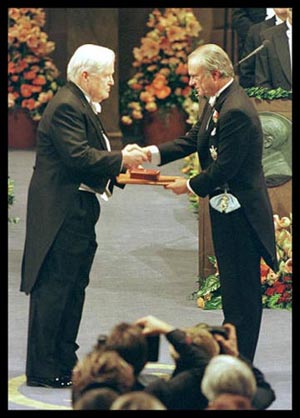
The Royal Swedish Academy of Sciences awarded the Bank of Sweden Prize in Economic Sciences in Memory of Alfred Nobel, 1999, to Professor Robert A. Mundell, Columbia University, New York, USA For his analysis of monetary and fiscal policy under different exchange rate regimes and his analysis of optimum currency areas. |
Economic
policy exchange rates and capital mobility
Robert Mundell has established
the foundation for the theory which dominates practical policy
considerations of monetary and fiscal policy in open economies. His work
on monetary dynamics and optimum currency areas has inspired generations
of researchers. Although dating back several decades, Mundell's
contributions remain outstanding and constitute the core of teaching in
international macroeconomics.
Mundell's research has had such a far-reaching and lasting impact because it combines formal - but still accessible - analysis, intuitive interpretation and results with immediate policy applications. Above all, Mundell chose his problems with uncommon - almost prophetic - accuracy in terms of predicting the future development of international monetary arrangements and capital markets. Mundell's contributions serve as a superb reminder of the significance of basic research. At a given point in time academic achievements might appear rather esoteric; not long afterwards, however, they may take on great practical importance.
How are the effects of monetary and fiscal policy related to the integration of international capital markets? How do these effects depend on whether a country fixes the value of its currency or allows it to float freely? Should a country even have a currency of its own? By posing and answering questions such as these, Robert Mundell has reshaped macroeconomic theory for open economies. His most important contributions were made in the 1960s. During the latter half of that decade, Mundell was among the intellectual leaders in the creative research environment at the University of Chicago. Many of his students from this period have become successful researchers in the same field, building on Mundell's foundational work.
Mundell's scientific contributions are original. Yet they quickly transformed the research in international macroeconomics and attracted increasing attention in the practically oriented discussion of stabilization policy and exchange rate systems. A sojourn at the research department of the International Monetary Fund, 1961-1963, apparently stimulated Mundell's choice of research problems; it also gave his research additional leverage among economic policymakers.
The
Effects of Stabilization Policy
In several papers published in the early 1960s - reprinted in his book
International Economics (1968) - Robert Mundell developed his analysis of
monetary and fiscal policy, so-called stabilization policy, in open
economies.
The
Mundell-Fleming Model
A pioneering article (1963) addresses the short-run effects of monetary
and fiscal policy in an open economy. The analysis is simple, but the
conclusions are numerous, robust and clear. Mundell introduced foreign
trade and capital movements into the so-called IS-LM model of a closed
economy, initially developed by the 1972 economics laureate Sir John
Hicks. This allowed him to show that the effects of stabilization policy
hinge on the degree of international capital mobility. In particular, he
demonstrated the far-reaching importance of the exchange rate regime:
under a floating exchange rate, monetary policy becomes powerful and
fiscal policy powerless, whereas the opposite is true under a fixed
exchange rate.
In the interesting special case with high capital mobility, foreign and domestic interest rates coincide (given that the exchange rate is expected to be constant). Under a fixed exchange rate, the central bank must intervene on the currency market in order to satisfy the public's demand for foreign currency at this exchange rate. As a result, the central bank loses control of the money supply, which then passively adjusts to the demand for money (domestic liquidity). Attempts to implement independent national monetary policy by means of so-called open market operations are futile because neither the interest rate nor the exchange rate can be affected. However, increased government expenditures, or other fiscal policy measures, can raise national income and the level of domestic activity, thereby escaping the impediments of rising interest rates or a stronger exchange rate.
A floating exchange rate is determined by the market since the central bank refrains from currency intervention. Fiscal policy now becomes powerless. Under unchanged monetary policy, increased government expenditures give rise to a greater demand for money and tendencies towards higher interest rates. Capital inflows strengthen the exchange rate to the point where lower net exports eliminate the entire expansive effect of higher government expenditures. Under floating exchange rates, however, monetary policy becomes a powerful tool for influencing economic activity. Expansion of the money supply tends to promote lower interest rates, resulting in capital outflows and a weaker exchange rate, which in turn expand the economy through increased net exports.
Floating exchange rates and high capital mobility accurately describe the present monetary regime in many countries. But in the early 1960s, an analysis of their consequences must have seemed like an academic curiosity. Almost all countries were linked together by fixed exchange rates within the so-called Bretton Woods System. International capital movements were highly curtailed, in particular by extensive capital and exchange rate controls. During the 1950s, however, Mundell's own country - Canada - had allowed its currency to float against the US dollar and had begun to ease restrictions. His far-sighted analysis became increasingly relevant over the next ten years, as international capital markets opened up and the Bretton Woods System broke down.
Marcus Fleming (who died in 1976) was Deputy Director of the research department of the International Monetary Fund for many years; he was already a member of this department during the period of Mundell's affiliation. At approximately the same time as Mundell, Fleming presented similar research on stabilization policy in open economies. As a result, today's textbooks refer to the Mundell-Fleming Model. In terms of depth, range and analytical power, however, Mundell's contribution predominates.
The original Mundell-Fleming Model undoubtedly had its limitations. For instance, as in all macroeconomic analysis at the time, it makes highly simplified assumptions about expectations in financial markets and assumes price rigidity in the short run. These shortcomings have been remedied by later researchers, who have shown that gradual price adjustment and rational expectations can be incorporated into the analysis without significantly changing the results.
Monetary
Dynamics
In contrast to his colleagues during this period, Mundell's research did
not stop at short-run analysis. Monetary dynamics is a key theme in
several significant articles. He emphasized differences in the speed of
adjustment on goods and asset markets (called the principle of effective
market classification). Later on, these differences were highlighted by
his own students and others to show how the exchange rate can temporarily
"overshoot" in the wake of certain disturbances.
An important problem concerned deficits and surpluses in the balance of payments. In the postwar period, research on these imbalances had been based on static models and emphasized real economic factors and flows in foreign trade. Inspired by David Humes's classic mechanism for international price adjustment which focused on monetary factors and stock variables, Mundell formulated dynamic models to describe how prolonged imbalances could arise and be eliminated. He demonstrated that an economy will adjust gradually over time as the money holdings of the private sector (and thereby its wealth) change in response to surpluses or deficits. Under fixed exchange rates, for example, when capital movements are sluggish, an expansive monetary policy will reduce interest rates and raise domestic demand. The subsequent balance of payments deficit will generate monetary outflows, which in turn lower demand until the balance of payments returns to equilibrium. This approach, which was adopted by a number of researchers, became known as the monetary approach to the balance of payments. For a long time it was regarded as a kind of long-run benchmark for analyzing stabilization policy in open economies. Insights from this analysis have frequently been applied in practical economic policymaking - particularly by IMF economists.
Prior to another of Mundell's contributions, the theory of stabilization policy had not only been static, it had also assumed that all economic policy in a country is coordinated and assembled in a single hand. By contrast, Mundell used a simple dynamic model to examine how each of the two instruments, monetary and fiscal policy, should be directed towards either of two objectives, external and internal balance, in order to bring the economy closer to these objectives over time. This implies that each of two different authorities - the government and the central bank - is given responsibility for its own stabilization policy instrument. Mundell's conclusion was straightforward: to prevent the economy from becoming unstable, the linkage has to accord with the relative efficiency of the instruments. In his model, monetary policy is linked to external balance and fiscal policy to internal balance. Mundell's primary concern was not decentralization itself. But by explaining the conditions for decentralization, he anticipated the idea which, long afterwards, has become generally accepted, i.e., that the central bank should be given independent responsibility for price stability.
Mundell's contributions on dynamics proved to be a watershed for research in international macroeconomics. They introduced a meaningful dynamic approach, based on a clear-cut distinction between stock and flow variables, as well as an analysis of their interaction during the adjustment of an economy to a stable long-run situation. Mundell's work also initiated the necessary rapprochement between Keynesian short-run analysis and classical long-run analysis. Subsequent researchers have extended Mundell's findings. The models have been extended to incorporate forward-looking decisions of household and firms, additional types of financial assets and richer dynamic adjustments of prices and the current account. Despite these modifications, most of Mundell's results stand up.
The short-run and long-run analyses carried out by Mundell arrive at the same fundamental conclusion regarding the conditions for monetary policy. With (i) free capital mobility, monetary policy can be oriented towards either (ii) an external objective - such as the exchange rate - or (iii) an internal (domestic) objective - such as the price level - but not both at the same time. This incompatible trinity has become self-evident for academic economists; today, this insight is also shared by the majority of participants in the practical debate.
Optimum
Currency Areas
As already indicated, fixed exchange rates predominated in the early
1960s. A few researchers did in fact discuss the advantages and
disadvantages of a floating exchange rate. But a national currency was
considered a must. The question Mundell posed in his article on
"optimum currency areas" (1961) therefore seemed radical: when
is it advantageous for a number of regions to relinquish their monetary
sovereignty in favor of a common currency?
Mundell's article briefly mentions the advantages of a common currency, such as lower transaction costs in trade and less uncertainty about relative prices. The disadvantages are described in greater detail. The major drawback is the difficulty of maintaining employment when changes in demand or other "asymmetric shocks" require a reduction in real wages in a particular region. Mundell emphasized the importance of high labor mobility in order to offset such disturbances. He characterized an optimum currency area as a set of regions among which the propensity to migrate is high enough to ensure full employment when one of the regions faces an asymmetric shock. Other researchers extended the theory and identified additional criteria, such as capital mobility, regional specialization and a common tax and transfer system. The way Mundell originally formulated the problem has nevertheless continued to influence generations of economists.
Mundell's considerations, several decades ago, seem highly relevant today. Due to increasingly higher capital mobility in the world economy, regimes with a temporarily fixed, but adjustable, exchange rate have become more fragile; such regimes are also being called into question. Many observers view a currency union or a floating exchange rate - the two cases Mundell's article dealt with - as the most relevant alternatives. Needless to say, Mundell's analysis has also attracted attention in connection with the common European currency. Researchers who have examined the economic advantages and disadvantages of EMU have adopted the idea of an optimum currency area as an obvious starting point. Indeed, one of the key issues in this context is labor mobility in response to asymmetric shocks.
Other
Contributions
Mundell has made other contributions to macroeconomic theory. He has
shown, for example, that higher inflation can induce investors to lower
their cash balances in favor of increased real capital formation. As a
result, even expected inflation might have a real economic effect - which
has come to be known as the Mundell-Tobin effect.
Mundell has also made lasting contributions to international trade theory.
He has clarified how the international mobility of labor and capital tends
to equalize commodity prices among countries, even if foreign trade is
limited by trade barriers. This may be regarded as the mirror image of the
well-known Heckscher-Ohlin-Samuelson result that free
trade of goods tends to bring about equalization of the rewards to labor
and capital among countries, even if international capital
movements and migration are limited. These results provide a clear
prediction: trade barriers stimulate international mobility of labor and
capital, whereas barriers to migration and capital movements stimulate
commodity trade.
|
Robert A. Mundell was born in Canada in 1932. After completing his undergraduate education at the University of British Columbia, he began his postgraduate studies at University of Washington and continued it at M.I.T. and London School of Economics. Mundell received his Ph.D. from M.I.T. in 1956 with a thesis on international capital movements. After having held several professorships, he has been affiliated with Columbia University in New York since 1974. Professor
Robert A. Mundell |
| On September
5-6, 2001, Robert Mundell was one of the distinguished speakers in
the International Conference: Monetary Outlook on East Asia in
An Integrating World Economy, organized by the Faculty of Economics,
Chulalongkorn University on its 30th anniversary. The conference took
place at Arts Building 1, Chulalongkorn University, Bangkok, Thailand.
His news in Bangkok, Thailand Nobel laureate says EU a good example |
Go back to the Main Page