|
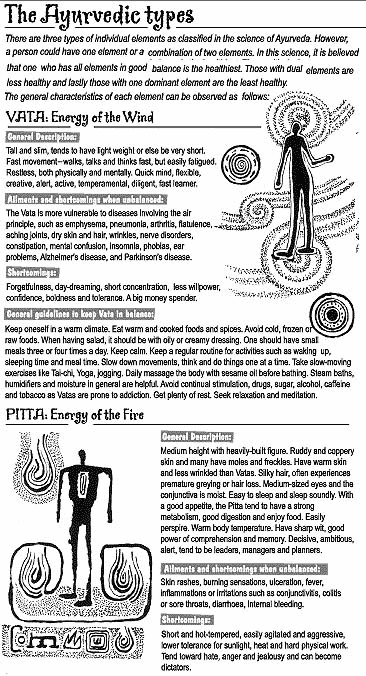
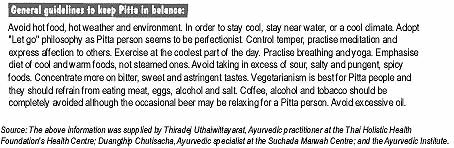
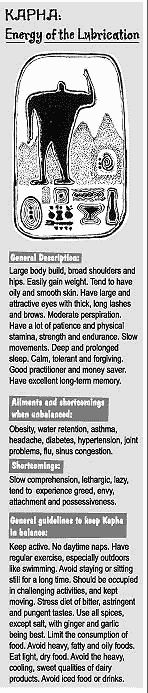
Ora-ong was suffering from a chronic cough with discharge of thick phlegm, as well as pain in her joints. She would have received intense medical treatment and been given several pills had she visited a modern physician. Instead, Ora-ong decided on an unconventional healing approach. She sought the help of an Ayurvedic practitioner, who asked her to reduce consumption of ice-water and fatty foods that she loved. He also asked her to exercise more and avoid eating in-between meals. After a while, her irritating symptoms were gone. Young, professional, Ora-ong is among the burgeoning members of society who wish to avoid modern medications as much as possible by taking an alternative approach to their health care need. Among those approaches is Ayurveda. An ancient healing science, Ayurveda stresses a more natural healing process, which can occur when one switches back to natural foods instead of exotic and yet unhealthy food. Ayurveda is concerned specifically with addressing longstanding or chronic health problems. Most of the people resorting to Ayurvedic consultation and treatment suffer mainly from chronic diseases, such as bone and muscle pain, sinus problems, asthma, obesity, and hypertension. "Interestingly, most ailments these days stem from our modern lifestyle that has greatly affected our health," pointed Duangthip Chutisacha, Ayurvedic specialist at the Suchada Marwah Centre. "Ayurveda is to understand oneself, to be with oneself. It is about what to eat and how to live so that we may learn to live in balance and harmony without having to visit the doctors." Ayurveda, meaning "Knowledge of Life", is an ancient medical science that originated in India. It stresses a holistic approach to life that consists of the body, mind and spirit. When all the elements are in good balance, it means good health and a sense of well being. This ancient science has been used for curative and preventive purposes for thousands of years in India, and Thailand adopted it hundreds of years ago. But it has been recently that the health-conscious middle class has resorted to this ancient science. From modest beginnings, the Thai Ayurvedic clinic of Ayurveda College, established 18 years ago, has gained a strong niche in modern society. More clinics have opened since last year. Samrong Hospital opened a Thai Ayurveda Health Centre to give complementary treatments for patients about a year ago. And just this year, two more clinics were opened: the Health Centre of the Thai Holistic Foundation and the Suchada Marwah Centre. Each is attracting a growing number of people with health problems. In Ayurveda, the secret of good health lies within oneself-one's nature. "Identifying each person's mind and body type and providing advice on their diet and lifestyle are the main Ayurvedic principles for both curative and preventive purposes," said Duangthip. "Each person has a different inclination. It is important for us to know our nature so that we know how to lead a harmonious life with our nature." What is our nature? Have you ever wondered why some people take ill after eating durian while others who shared the same fruit at the same time did not? Take the case of two persons sharing a room. Why is it that one sweats while the other feels comfortable? Or, after being exposed to the sun, why do some people develop rashes while many others do not? Modern science may have to look at a person's DNA or tally several scientific factors but Ayurveda simply reasons that each individual is unique in nature and thus responds differently to various things, said Thiradej Uthaiwittayarat, an Ayurvedic practitioner at the Health Centre of the Thai Holistic Health Foundation. In Ayurveda, each human being is composed of five basic elements: earth, wind, water, air and space, but in different proportions. Each is likely to have one dominant element in their nature which can be classified into three main types: Vata (the energy of air and space), Pitta (the energy of fire) and Kapha (the energy of earth and water). However, most generally have two dominant types with one being more dominant than the other. It is quite rare to find someone with a very high degree of one dominant type or for some person to have an equal blend of all the three elements. Our nature will not change but it can fluctuate. Age, time, seasons, environment, food and lifestyle will affect the functioning of these elements. The ways to distinguish these three types can be done by observing the outer physical appearance, character and emotions of the individual. In addition, Ayurvedic practitioners also pose a series of questions to probe into one's nature and check the pulse to identify the "type" of that person. People's identification in Ayurveda forms an important aspect in judging the state of one's health. "Once we identify the type of a person, we can advise how their diet and activities should be in order to maintain their equilibrium in life," said Duangthip. "And if they need a cure, what kinds of cure or herbs will suit them is also determined." Unlike modern medicine, Ayurveda does not have the same general standards to assess the health of all. Each of the three types have their own nature of health. "By modern standards, a tall and thin person who weighs lesser than the prescribed weight is advised to eat more or is given medicines to boost his weight. However, in Ayurveda, if we find a person belonging to the vata type is slim, tall, and weighing less than he should, it is deemed normal, and is thought to be perfectly healthy and in accordance with his nature. It is quite hard for a vata person to be overweight no matter how much they consume," explained Thiradej. "While for a kapha person who tends to be overweight, there is no need to lose weight in order to prevent ailments. They can be perfectly healthy despite being obese. They are made to be that way," he added. When in good balance, Thiradej said, our body will show its true nature; slim and tall for vata, medium-set for pitta or heavy-set for kapha along with the other dispositions. However, when one loses his natural balance, physical and mental disorders strike. Anyone can fall sick with any illness associated with any of the three elements. "For example, if you are a pitta, you have more of the fire quality in your body. If you eat a lot of spicy food or remain in warm temperatures for a short or prolonged period, your pitta quality will increase or may spill out of balance, resulting in sickness. "When a pitta person consumes excessively hot or spicy food, he is likely to develop ulcers. When such persons expose themselves to too much heat, they are likely to develop skin rashes," Thiradej added. The principle of maintaining one's balance of energy is quite simple-"Attributes with a similar quality will supplement, opposite things will counteract," he explained. Today's nutritionists believe that we should have a balanced diet with food containing carbohydrates, proteins, vegetables and fruits, but Ayurveda does not subscribe to this view. They believe that each individual needs a different proportion and a different kind of food. You eat what is meant for you, is perhaps the right motto for Ayurveda; otherwise, you can have health problems. "If two persons eat an equal quantity of the same food, their bodies will react differently. For example, a vata person may be constipated even after having a big bowl of high-fibre vegetables, while a pitta person may not," said Thiradej. Ayurveda has a unique way of classifying diet. Food has two potencies: hot and cold; and is divided into six tastes: sweet, salty, sour, bitter, astringent, and pungent. "Like modern nutrition's principles, one should have a variety of food types, all six tastes and both hot and cold potencies. However, we should be more aware of our nature and should reduce or have in moderate quantities foods that will not aggravate our dominant energy," said Thiradej. As the vata person possesses the qualities of coldness, lightness and dryness in his nature, he should eat rather oily, heavy and warm food with pungent, bitter and astringent tastes in order to balance with his nature. Being hot and oily, a pitta meanwhile should stress cool to warm foods with bitter, astringent and sweet tastes including vegetables as his staple food. A kapha whose nature is moist, heavy, and cool, should avoid having a fatty and oily diet with a sweet taste and instead focus on a diet with bitter, astringent and pungent tastes. Apart from the tastes, each food has its energy, a hot and cold potency. Hot-potency foods, for example, are durian, longans, ginger, seafood, yoghurt, carrots. Green leafy vegetables, chicken, and milk constitute the cold-potency diet. "As a pitta is a hot person [by element], they should have hot-potent food such as longans, durians, red meat, seafood and unripe or sour fruits in limited quantities while vata and kapha people can enjoy more of these varieties," said Thiradej. The classification is not only for food. Herbs are also grouped into hot and cold potencies. "When prescribing herbs, we practitioners have to bear in mind the nature of the person as well as the potency of the herbs. Pitta persons cannot have hot-potent herbs, while vatas should not have cold-potent medicines," said Thiradej. Apart from physical health, Ayurveda stresses health of the mind which contributes to the well being of a person. Adapting lifestyles to meet one's nature is quite important. "Naturally, kapha people easily put on weight. So they should engage themselves in a lot of physical activities," suggested Duangthip. "Given their restless character, a vata can be very active and that can lead to fatigue. So they need to be aware of that and try to slow down their movements and thoughts," she added. "As pitta persons may get sunburnt and are prone to skin cancer, they should avoid sunbathing." If the mind is in balance, their character reflects this. "Pitta persons are intelligent, decisive and ambitious which make them good managers, planners or leaders. However, if their elements are not balanced, they could become dictators," said Thiradej. The imbalance can change the creative and active vata into a day-dreamer. A kapha person is very calm, kind and forgiving, but an imbalance can make them lazy and lethargic. Knowing these basics of the Ayurvedic science, said Duangthip, will help reduce the risk of chronic disorders and equip one with first aid to treat simple remedies triggered by the imbalance of energy. To many, Ayurveda may still sound a bit complicated. But Thiradej said the science itself originated from the keen observation of human beings. "Observe yourselves, be more perceptive as to how you feel after having a certain kind of food, expose yourself to different environments and time. And you will know what is right and good for you without having to know which type you belong to in Ayurveda," said Thiradej. "Health problems come mainly because one ignores one's body. People pay more attention to their mental cravings," added Duanthip. "For example, when you eat very hot food, you feel a burning sensation in your stomach or have pimples on your back. That's how your body tells you that it does not suit you. Yet if one persists in indulging in something that does not suit one's body, then there is an adverse effect on the health," she added. "Our body communicates with us all the time. It sends us signals of what it wants or does not want, what's good and what's not. If we listen to our body carefully, we can avoid some of the ailments we are suffering from."
If you do not know which type you belong to in Ayurveda's three elements, it does not really matter. There are still some basic golden rules to a healthy life, suggested by an Ayurvedic practitioner and consultant. - Start your day peacefully and in slow pace. It is also good to practise yoga and meditation. Breathe more deeply. - Have a warm breakfast and eat consciously and slowly. - Eat only when you are hungry, drink when you are thirsty. Feeling hungry means that your body needs more energy. But if you are not hungry, your body does not need any food; so adding up more food may lead to indigestion. However, one should be able to distinguish physical hunger from mental craving. - Do not indulge in other activities while eating. - Do not eat when you are in a bad mood. In such a mood, the food can be converted into toxic substances. Eat with a sense of gratitude. - Eat in a quiet and harmonious atmosphere. - Exercise moderation of diet consumption and tastes. - Food should be prepared with love and cleanliness, especially by loved ones. - Do not take incompatible food like hot and cold food together. For example, when having a hot soup, do not drink iced-water as the cold water will disrupt the completeness of digestion. - Have dinner at least four hours before going to bed. - Avoid canned, frozen and sealed food. These types of food lack life-force that is good for the body. - Thai food is very Ayurvedic. - Those above 40 should stress their diet on wholesome and lighter food. - Get sufficient sleep to allow your body to re-energise. To learn more about Ayurveda, the book Kin Tam That (Eat According To Your Element) written in Thai by Theradej Uthaiwittayarat is now available at leading bookshops and costs 120 baht. There are also many Web sites devoted to Ayurveda. |
 How to lead a healthy life