 |
 |
| The D-DAY LANDING (6 JUNE 1944)
by 1st Section, Co E, 16th Inf, 1st Division. Interview with: Lt. John Spalding (Leader 1st Section) |
| We loaded into LCVP's from larger ships at 0300. The companies were divided into sections and each LCVP had 32 men, including a medic, plus two navy men. I was leader of the first section of Company E and we were scheduled to go in on the first wave. My assistant section leader was T/Sgt Phillip Streczyk. The sergeant, who was wounded in the Hurtgen forest action, was the best soldier I have ever seen. He came into the army as a selectee and worked his way up to platoon sergeant. He was in on landings at Oran and in Sicily. If we had more men like him the war would soon be over.
We unloaded into LCVP's in a very rough sea. It took us much longer to load than it had during the practice landings because of the rough water. After entering the LCVP's we went an undetermined distance to a rendezvous point. Here the Navy crew took us around and around, getting us soaked to the skin. Many of the men got sick immediately and others got sick as we went in towards shore. About 0400 our boats lined up in a V formation and headed towards shore. As we went towards shore we could see the outlines of other boats around us and overhead we could hear a few planes. Between 0545-0600 we saw the first flashes from the shore. We didn't know whether they were our planes bombing, as we had been told to expect, or whether the flashes were from German artillery. We caught sight of the shore about 0615. We also saw a few of our fighter planes. About 0630 the rocket ships began to fire, but most of their rockets hit in the water. In the meantime the navy had been firing and the dust from debris plus the early morning mist made it difficult to see the coast. There was a very good basis for the failure of the navy crew to hit the right part of the coast. As we came in there was considerable noise from the shore and the sea. Enroute to the shore we passed several yellow, rubber boats. They had personnel in them, but we didn't know what they were. They turned out to be personnel from the DD Tanks which had foundered. About 800-1000 yards out we began to receive machine gun fire from the shore but it was not effective. As we neared the shore we came to the line of departure and here the odd numbered boats swung out abreast on one side, while the even numbered boats went to the other side. In this formation the boats came into shore. Our instructions were to land just to the right of the house at (677900); this house was to be the left boundary of my position. We were to go across the antitank ditch near the E-1 entrance and scale the seawall. Once this was done we were to send patrols into St. Laurent-sur-Mer, where we were to contact E Co of the 116th, which was supposed to land to our right, and then to push on to the high ground behind the town. It was assumed that the air force would have destroyed the beach defenses by this time and thus we could land without any great opposition. About 0630 we hit the line of departure; someone gave a signal and we swung into line. When we got 200 yards offshore the boat halted and a member of the navy crew yelled for us to drop the ramp. S/Sgt Fred A. Bisco and I kicked the ramp down. Shortly before this a navy man had mounted the machine gun on the rear of the LCVP and had started to return fire. We were now receiving not only MG fire, but also mortar and some artillery fire (the men said it was 88; however, in the whole fight in Europe I have only seen three 88 bursts). We had come in at low tide and the obstacles were noticeable. They stuck out of the water and we could see tellermines on many of them. No path had been cleared through them, so we followed a zigzag course in. It is difficult to know if the navy could have taken the boats in further. It is possible that they would have stuck on the sand bars. I am in no position to know whether they could have done any better. Because we were carrying so much equipment and because I was afraid that we were being landed in deep water, I told them the men not to jump out until after I had tested the water. I jumped out of the boat slightly to the left of the ramp into water about waist deep. It was about 0645. Then the men began to follow me. We headed ashore and the small arms fire became noticeable. We saw other boats to our left, but nothing to our right. We were the right front of the 1st Division. We had seen some tanks coming in, but didn't know what they were. As we left the boat we spread out in a V formation about 30 yards across. There was soon a noticeable decline of sand beneath our feet and we were soon over our heads, so we tried to swim. Fortunately when I pulled the valve of my lifebelt it inflated and saved me. I lost my carbine. We lost none of our men, but only because they helped each other or because they got rid of their equipment. There was a strong undercurrent carrying us to the left. I had had experience with the strong current of the Ohio River as a swimmer, but this was much stronger. Sgt. Streczyk and the medic�Pvt. George Bowen�were carrying an 18 foot ladder which was to be used for crossing the anti-tank ditch or for any purpose which might arise. They were struggling with it in the water just about time that I was having my worst trouble afloat. As the ladder came by me I grabbed it. Streczyk yelled and said "Lieutenant, we don't need any help", but hell I was busy trying to get help not to give it. I told them to leave the thing, so it was abandoned in the water. About this time we were able to put down our feet and touch bottom; the water was about up to our mouths at this time. I had swallowed about half of the ocean and felt like I was going to choke. We pulled out Sgt. Edwin Piasecki who was about to drown. About this time Pfc. Vincent DiGaetano, who was carrying a 72 pound flamethrower, yelled and said, "I'm drowning, what do you want me to do with this flamethrower". Streczyk told him to drop it, so he did. In addition to the flamethrowers and many personal weapons, we lost our mortar, most of the mortar ammunition, one of our bazookas, much of the bazooka ammunition. However, the men who kept their weapons were able to fire them as soon as they came ashore. It shows that the M-1 is an excellent weapon. As we were coming in I looked at the terrain and saw a house which looked like the one which we were supposed to hit, so I said, "Damn, the navy has hit it right on the nose." Later I found that we had landed near another house 1500 yards to the east at a point about (689893). Our first casualty came at the water's edge. Pvt. William C. Roper, rifleman, was hit in the foot by small arms fire just as he hit the beach. He kept trying to get his legging off, but couldn't reach the lacing, so I helped him get it off. Just after we got ashore one of my two BAR men was hit. Pfc. Virgil Tilley was hit in the right shoulder by a shell fragment, which drove a hunk of the shoulder out towards the back but did not come all the way through. By this time I noticed a number of my men on the beach, all standing up and moving across the sand. They were too waterlogged to run, but they went as fast as they could. It looked as if they were walking in the face of a real strong wind. We moved on across the shale to a house which was straight inland. The first place we stopped was at a demolished building; there was some brush around. We were halted there by a minefield at the first slope. My section was spread out�the men in accordance with orders had deployed the minute they hit the beach. They had been told to get off the beach as soon as possible. They walked on across because nobody stopped them. Down near the water's edge we ran into wire. S/Sgt. Curtis Colwell blew a hole in the wire with a bangalore. We picked our way through; I personally didn't see the gap he had blown, but I was still in a daze. I didn't see any mines on the beach except AntiTank mines. As we went across the beach my runner--Pfc. Bruce S. Buck�came over to me. I tried to get E Co with my 536 radio. I took the 536 off my shoulder, worked the antenna out as I walked across and tried to get contact, but it didn't work. I looked down and saw that the mouthpiece was shot away. Although the radio was useless and I should have thrown it away, training habits were so strong that I carefully took the antenna down as I had always been taught to do and put the 536 back on my shoulder. Your training stays with you even when you are scared. When we got up to the rubble by the demolished house we were built up as skirmishers and were returning what fire we could. Streczyk and Pfc. Richard J. Gallagher (later sergeant) went forward to investigate the minefield. They decided we couldn't cross it. They was pretty heavy brush around here. Streczyk and Gallagher now went to the left to a defilade (apparently a little stream had washed it out at one time) and tried to work their way through. In the meantime we were getting heavy small arms fire. One burst from a MG left a series of dots along the wall in front of us (at some places the demolished wall was 1 � � 2 feet high and we were hiding behind that and the brush). Sgt.Louis J. Raimundo was killed here, the only man killed in my section on the beach D-Day. One other man was killed later. On our left we had by-passed a pillbox, from which MG fire was coming and mowing down F Co people a hundred yards to our left. There was nothing we could do to help them. We could still see no one to the right and there was no one up to us on the left. We didn't know what had become of the rest of E Co. Back in the water boats were in flame. I saw a tank ashore about 0730-0745. After a couple looks back, we decided we wouldn't look back any more. About this time Gallagher said to follow him up the defilade which was about 400 yards to the right of the pillbox. We were getting terrific small arms fire but few were hit. About this time we were nearly at the top of the hill,We returned fire but couldn't hit them. We were also getting rifle fire. When Gallagher found the way up I sent word back for my men to come up to the right. Sgt. Hubert W. Blades, Sgt. Grant Phelps, Sgt. Joseph W. Slaydon, and Pfc. Raymond R. Curley went first. I went next; Sgt. Bisco followed me and the rest of the section came along. I couldn't take my eye off the machine gun above us, so Sgt. Bisco kept saying: "Lieutenant watch out for the damn mines." They were a little box type mine and it seems that the place was infested with them, but I didn't see them. We lost no men coming through them, although H Co coming along the same trail a few hours later lost several men. The Lord was with us and we had an angel on each shoulder on that trip. Trying to get the machine above us Sgt. Blades fired his bazooka and missed. He was shot in the left arm almost immediately. Pfc. Curley�rifleman was shot down next. Sgt. Phelps who had picked up Tilley's BAR on the beach, moved into position to fire and was shot in both legs. By this time practically all my section had moved up. We decided to rush the machine gun about 15 yards away. You may say why hadn't we hit it; I don't know. As we rushed it the lone German operating the gun threw up his hands and yelled "Kamerad". We would have killed him, but we needed prisoners for interrogation, so I ordered the men not to shoot him. He was Polish. He said that there were 16 Germans in the area; that they had been alerted that morning and were told they had to hold the beach. They had taken a vote on whether to fight, and preferred not to, but the German noncoms made them. He said that there were 16 Germans in the trench to the rear of his machine gun. He also said that he had not shot at Americans, although I had seen him hit three. I turned the PW over to Sgt. Blades, who was wounded. Blades gave his bazooka to Sgt. Peterson and guarded the prisoner with a trench knife. We moved Curley, Blades, and other wounded into a defile and the medic�Pvt. George Bowen�gave them first aid. He covered his whole section of the beach that day; no man waited more than five minutes for first aid. His action did a lot to help morale. He got the DSC for his work. Coming up along the crest of the hill Sgt. Clarence Colson, who had picked up a BAR on the beach, began to give assault fire as he walked along, firing the weapon from his hip. He opened up on the machine gun to our right, firing so rapidly that his ammunition carrier had difficulty getting ammo to him fast enough. At this point Lt.Bleau of G Co came up and contacted me. He had come up our trail. His company had landed in the second wave behind us. Just a few minutes later Capt Dawson of G Company came along. We still saw no one on the right. Capt Dawson asked if I knew where E Co was and I told him that I didn't know. He said that E Co was 500 yards to my right, but he was thinking in terms of where they were supposed to land; they were actually 500-800 yards to our left. I later found out that they had lost 121 men. Dawson said that he was going into Colleville and told us to go in to the right. He had about two sections. Said he had just seen the battalion commander. This was about 0800. I went over and talked to Lt.Bleau about the information we had gotten from the prisoner. I asked him to give us some support where the 16 Germans were supposed to be. As we went up in this direction we hit a wooded area. We found a beautifully camouflaged trench which ran along in zigzag fashion, but we were afraid to go in. We went along the top of the trench spraying it with lead. We used bullets instead of grenades since we had very few grenades, and thought that the bullets would be more effective. We did not fix bayonets at any time during the attack. We turned to the right and hit a wooded area; got no fire from there, so we yelled to Lt. Bleau to shove off and he started for Colleville. There I stood like a damn fool waving him a fond farewell. We were headed for St. Laurent; G Company went on to Colleville-sur-Mer. H Co came up next under Lt. Shelley. We were on top of the hill by 0900. Advanced cautiously. We were the first platoon of the 16th to hit the top. Now had 21-22 men in my section. Had spent more time at the rubble than anywhere else. Had taken up some time with prisoner. As we went inland we heard rifle and machine gun fire to our right. Streczyk and Gallagher volunteered to check on the situation. Our men were spread out over an area 200-300 yards. They located a machine gunner with a rifleman on either side of him. Streczyk shot the gunner in the back and the riflemen surrendered. The two prisoners were German and refused to give us any information. With them in tow we continued to the west. We still saw no one to the west. We were now in hedgerows and orchard country. We were watching our flanks and to the front and scouring the wooded area. We tended to send a sergeant with 3-4 men to check up on suspicious areas. We usually set up someone with an automatic weapon to cover them (we did not have any MG's at this time, however). We crossed through two minefields�one had a path through it, which looked like it had been made for a long time. When we got through it we saw the Achtung Minen sign. No one was lost; we still had an angel on each shoulder. We now found a construction shack near the strongpoint overlooking the E-1 draw. If you will examine the defense overlay you will find an almost exact duplicate of what we saw. Sgt. Kenneth Peterson fired his bazooka into the tool shed, but no one came out. We were about to go on when I spied a piece of stove pipe about 70 yards away sticking out of the ground. I formed my section into a semi-circular defensive position. We were now getting small arms fire again. Sgt. Streczyk and I went forward to investigate. We discovered an underground dugout. There was an 81 MM mortar, a position for a 75 and construction for a pillbox. All this overlooked the E-1 draw. The dugout was of cement had radios, excellent sleeping facilities; dogs. We started to drop a grenade in the ventilator, but Streczyk said "Hold on a minute" and fired three shots down the steps into the dugout. He then yelled in Polish and German (he had interrogated the prisoners earlier) for them to come out. Four men, disarmed, came up. They brought 2-3 wounded. I yelled for Colson to bring 5-6 men. We began to get small arms fire from the right (west). I yelled for Piasecki and Sakowski to move forward to the edge of the draw. A firefight took place. The navy now began to place time fire in the draw; this was about 1000. Piasecki deployed 6-7 men; shot several Germans and chased a number down into the draw where they were taken care of by navy fire. (The 81 MM was not manned; had beautiful range cards; lots of ammunition.) When Colson came over I started down the line of communications trenches. The trenches led to the cliff over the beach. We were now behind the Germans so we routed 4 out of a hole and got 13 in the trenches. The trenches had tellermines, hundreds of grenades, numerous machine guns. They were firing when we came up. We turned the prisoners over to Strecyk. We had a short fight with the 13 men; they threw three grenades at us, but they didn't hit anyone. We found one dead man in the trenches, but don't know if we killed him. If we did, he was the only German we killed. Several of us went to check the trenches. I did a fool thing. After losing my carbine in the water I had picked up a German rifle, but found I didn't know how to use it too well. When I started to check on the trenches I traded the German rifle to a soldier for a carbine and failed to check it. In a minute I ran into a Kraut and pulled the trigger, but the safety was on. I reached for the safety catch and hit the clip release, so my clip hit the ground. I ran about 50 yards in nothing flat. Fortunately Sgt. Peterson had me covered and the German put up his hands. That business of not checking guns is certainly not habit forming. We next took out an AT gun near the edge of the draw. There was little resistance. We now had the prisoners back near the dugout. We had split the section into three units. We got a little ineffective machine gun fire from the draw to the right at this time. We tried to use the 81 MM mortar, but no one could operate the German weapon. For the first time I saw people across the draw to the right (west). I supposed that they were from the 116th. They seemed to be pinned down. About this time two stragglers from the 116th came up. I didn't ask what company they were from but just took them along. We went back and checked trenches since we were afraid of infiltration by the Germans. In the meantime I sent the 17-19 German prisoners back with two men the way we had come. I told them to turn them over to anyone who would take them and to ask about our company. At this point I saw Lt. Hutch of Co E (second section which had been directly to my left in the boats) coming up. I pointed out a minefield to him and he told me that there was a sniper near me. We had sniper fire every few feet now we were getting pretty jittery. We set off our last yellow smoke grenade to let the navy know that we were Americans, since their time fire was getting very close. About 1045 Capt. Wozenksi of Co E came up from the left. He had come along practically the same route we had used. I was very happy to see him. We had orders to contact Major Washington, 2nd Bn Executive Officer, just outside Colleville. Our objective was changed; there were to be no patrols into Trevieres that afternoon as we had been told originally we would. We never crossed the E-1 draw. Instead we went along the trail (shown on the overlay) towards Colleville. We were to swing in the fields to the right of Colleville. Lt. Hutch and I had about 30 men; he was in charge (I was a 2nd Lt and he was a 1st Lt). Lt. James McGourty had also come with Capt. Wozenski. Three of our section leaders had been killed on the beach; Hutch, McGourty, and I were here together. Wozenski is now commander of 3rd Bn, 16th Inf. We ran into Major Washington, Exec Officer, 2d Bn, near Colleville; he was in a ditch outside town. Capt. Dawson had come up to Colleville, his original objective, earlier. G Co was already in and around the town. We got some small arms fire in this area, but no one was hurt. Lt. Hutch and I contacted Maj Washington about 1300. He told us we were to go to the right of Colleville and guard the right flank of the town. We went out and were surrounded in about 40 minutes. Lt. Knuckus [misspelling of Krucas] of G Co, with about 14 men, came up and said he had the right flank, so we reinforced him (altogether Lt. Hutch, Lt. Knuckus and I had about 45 men). In the position to the west of Colleville we had set up our defensive position. We selected a position where no digging was necessary; used drainage ditches; were now in orchards and hedgerows. We moved cautiously; didn't know where anybody was. About 1500 got German fire. DiGaetano was hit in the butt by shrapnel fire; we told him that he was too big to be missed. Sgt. Bisco was killed; rifle fire hit him in the face and throat. Only one round of artillery came in; we thought it was from one of our ships�exploded about 300 yards from us; had orange and yellow flame. As we looked back towards the beach we saw several squads of Germans coming towards us. We had no contract with the battalion. Just as a G Co runner started over to us and got to the edge of our defenses they opened fire on him. After he fell they fired at least 100 rounds of machine gun fire into him. It was terrible but we do the same thing when we want to stop a runner from taking information. Of course, we didn't find out what he was coming to tell us. We fired until we were low on ammunition that afternoon. I had six rounds of carbine ammunition left. Some of the fellows were down to their last clip. We were still surrounded. We called a meeting of Lts. Knuckus, Hutch, T/Sgt. Ellis, T/Sgt Streczyk and myself. About 1700 we decided to fight our way back to the battalion. We sent word for the men to come to us in the ditch where we were; we were several hundred yards south and west of Colleville. At about 1900 or 2000 we set up automatic weapons to cover us as we crawled down the ditch back towards Colleville. Lt. Hutch went in front. We got back to Bn and ran into C Co of the 16th on the way to reinforce us. We didn't know where we were. We found Maj Washington in a little gully at the west of town. He said we were to go back to about the same point with C Co in support. We took up defensive position about 500-700 from our original positions�this was closer to Colleville. We were still in hedgerows; we guarded roads and avenues of approach. I think that part of the company area bordered on the roads into Colleville. We now had machine guns (I believe from Co H). This was about 2100, nearly dark. Was quiet except for some aerial activity. We had heard American machine guns earlier in the afternoon; it is possible that they drove Germans towards us. We spent the night of the first day in the positions near Colleville. Of the section, five men got DSC's, which were later awarded by General Eisenhower. The men getting these awards were: Lt. John Spalding, Kentucky; T/Sgt. Philip Streczyk, New Jersey; Pfc. Richard A. Gallagher, Brooklyn, N.Y.; Pvt. George H. Bowen, Kentucky; and Sgt. Kenneth Peterson, New Jersey. During the day two men were killed (only one on the beach): Pfc. Lewis J. Raimundo and Sgt. Fred A. Bisco. Eight men were wounded: Sgt. Hubert W. Blades, S/Sgt. Grant Phelps, Sgt. Joseph Slaydon, Pfc. Bruce S. Buck, Pfc. Raymond R. Curley, Pfc. Virgil Tilley, Pvt. Vincent T. DiGaetano and Pvt. William C. Roper. |
| The members of the first section were:
Section Leader: Lt. John Spaulding, DSC Asst Sec Leader: T/Sgt Philip Streczyk,DSC S/Sgt Curtis Colwell, S/Sgt Grant Phelps, WIA Sgt. Fred G. Bisco,KIA Sgt. Hubert W. Blades,WIA Sgt. Clarence Colson DSC Sgt. Kenneth Peterson,DSC Sgt. Joseph W. Slaydon, Pfc. Walter Bieder Pfc. Bruce S. Buck, WIA Pfc. Raymond R. Curley,WIA Pfc. Stanley A. Dzierga Pfc. Richard J. Gallagher,DSC Pfc. Warren Guthrie, Pfc. Edwin F. Piasecki, Sgt. Louis J. Ramundo,KIA Pfc. Richard M. Rath, Pfc. Alexander Sakowski, Pfc. Virgil Tilley, Pvt. George H. Bowen, Pvt. William B. Brown, Pvt. Vincent T. DiGaetano, Pvt. Donald E. Johnson, Pvt. Robert E. Lee, Pvt. Raymond L. Long, Pvt. Carmen M. Meduri, Pvt. Elmer F. Reese Pvt. James O. Renfroe Pvt. William C. Roper,WIA Pvt. Charles Scheurman Pvt. Richard Sims, |
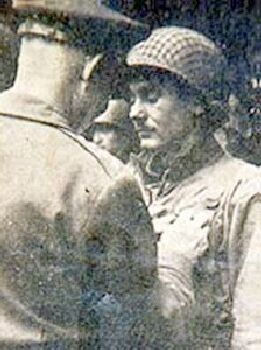 |
| Lt.John Spalding
being awarded the DSC by General Eisenhower |
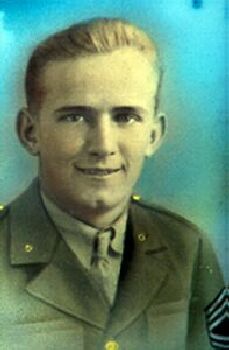 |
| My assistant section leader
T/Sgt Phillip Streczyk. |
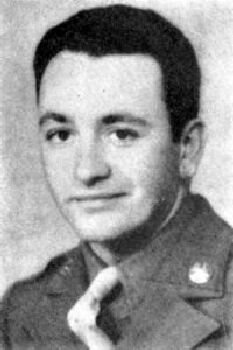 |
| S/Sgt Fred A. Bisco and I kicked the ramp down. |
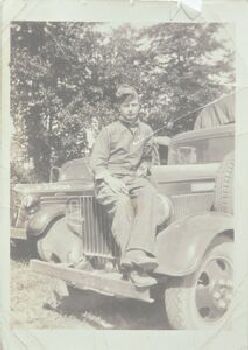 |
| Sgt. Clarence Colson, who had picked up a BAR on the beach, began to give assault fire as he walked along, firing the weapon from his hip. |
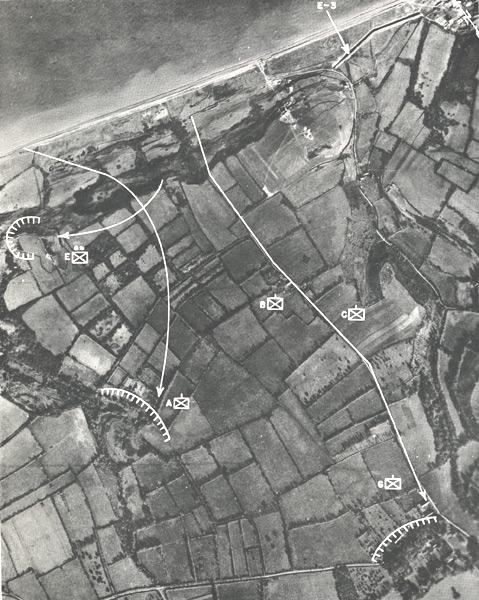 |
| ADVANCE FROM EASY RED
(Photograph of 15 February 1944). An aerial map. Spalding's section of E Company is represented at the upper left. Aerial view showing movement of Spalding's platoon (labeled E with two dots above an "x" in a box) and elements of other companies. Click Map for enlargement |
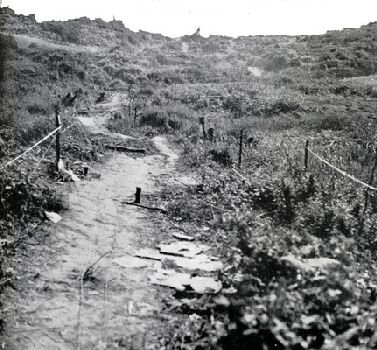
| PATH THROUGH MINEFIELDS, marked by engineers and followed by the assaulting units of the 16th Infantry from Easy Red. View taken from the foot of the slopes, looks directly up route taken D Day morning by units of the 16th Infantry (2nd and 1st Battalions). |
 |
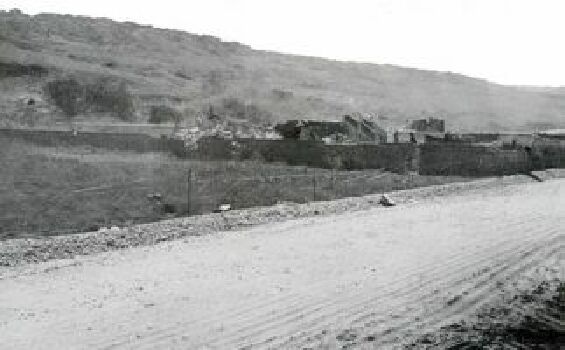
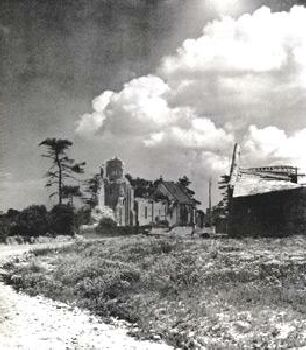
| EASY RED, between E-1 and E-3 draws, was the area where the 2nd Battalion, 16th Infantry reached the bluff. Company G made the penetration here from ruins in the foreground. Photo taken shortly after D Day shows beach road already improved by U.S. Engineers |
 |
 |
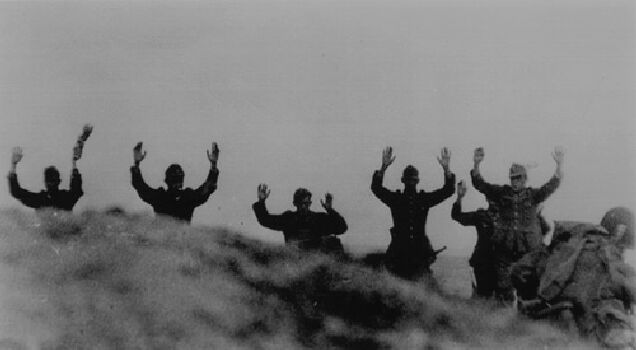 |
| Germans Surrender to men of the 16th |
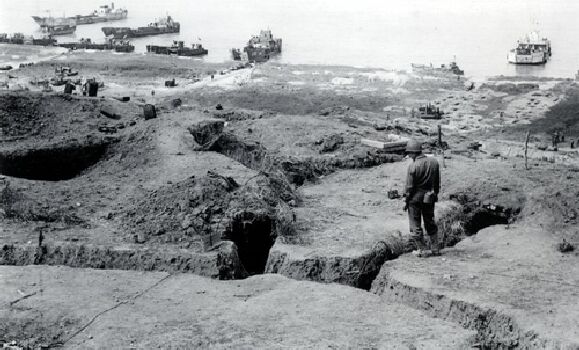
| German trenches at the top of Easy Red. |
| ENTRANCE TO COLLEVILLE FROM WEST. After advance from Easy Red Beach, Company G, 16th Infantry, fought into this village just after noon. G Company was held in Colleville the rest of the day by bitter enemy resistance in houses just beyond the church. (Photo taken June 1945.) |
 |
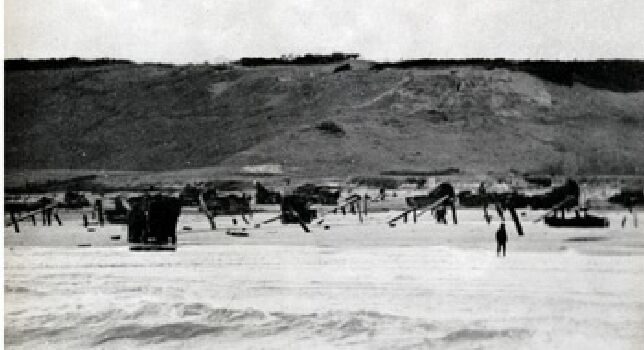
| E-1 STRONGPOINT, to the west of the draw, was neutralized by a boat team of Company E, 16th Infantry, which came on it from the woods to the rear. The photo above, taken a day later, shows beach obstacles and wreckage along the top of the tidal flat. |
 |