Breeding Betta splendens
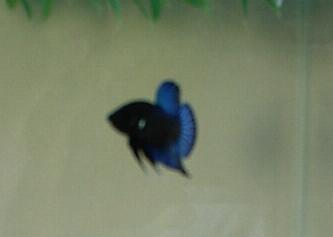
My male Plakat
Have you ever wanted to breed your bettas, but have not known where to begin? I know that when I started keeping aquariums, I had no intention of breeding my fish. However, as I got my hands on more and more information about fishkeeping (and learning basic genetics in science class) I began to get curious about breeding my fish, not only to increase my stock, but also to experiment with genetics. This is what I have learned about breeding bettas through reading many many pages of information and looking through many many web pages and talking with many many experienced hobbyists. All my experience in breeding bettas has been compiled into this one page, what has worked for me is all I have included. For more information on different breeding techniques, go to the links page and browse through other breeders' pages. If you succeed and need to find new homes for your young bettas, you can post an ad in the stock shop.
Materials Needed to successfully Breed your Betta splendens --
1.) A pair of Bettas that
you would like to spawn (MUST be a male and a female, of course)
2.) At least a 2 ½ gallon tank (5 ½ gallons is
better).
3.) A heater -- Set to 80º for optimum results.
4.) A box filter or a sponge filter
5.) A styrofoam cup cut lengthwise for the male to build his
bubble nest in.
6.) A protection system for the female -- whether it be a jar, a
bunch of floating plants, or a glass divider.
7.) Cover for the spawning tank -- a sheet of glass/plastic or
plastic food wrap.
Pre-spawn preparations --
1.) Condition the fish! All of your efforts will be a waste if you don't complete this step before spawning attempts with the fish. About a week before the planned spawn, feed both fish heavily with a diet leaning heavily on live foods such as mosquito larvae (for you people in the wet south like me, here in tx they are everywhere!) tubifex worms, blood worms, brine shrimp, etc. Also include in this diet high quality pellets and cubes, such as freeze dried or frozen blood worms, tubifex worms, and brine shrimp. In my experiences my fish do not eat flakes, so I just don't buy them anymore.
2.) Fill the tank with approximately 6 inches of properly conditioned water, I've done well in 4 inches but I had trouble bending over to examine the eggs. With 6 inches of water it is shallow enough for the male to easily find the eggs and put them back in the nest, and for the new born fry to swim back to the surface if the males attention is elsewhere at the time. Cover with the glass or plastic. If you are using plants for protecting the female, go ahead and put those in now, also.
3.) Put the heater in the tank and set it for 80º F. Over the next few days, while the fish are conditioning, you can check the temperature a few times to make sure the heater is functioning properly, nobody wants to boil their fish when trying to spawn them! Also put in the box/sponge filter, but leave it on LOW power so that a bubble comes out only every few seconds, or the bubble nest will be destroyed before it is finished.
Procedures (this is beginning to sound like an elemntary school science experiment...) --
1.) Place the nest base (almost-fancy word for half of a styro cup) floating in the corner opposite the heater and filter, so it looks like (my friends calls it this...) a miniature airplane hangar. This is where the male will (hopefully) start to build the bubble nest.
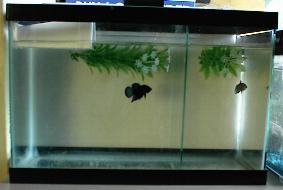
The Proper Setup.
2.) Place the male in the tank. If you are using plants then put the female into the tank also, if not, then just put her in a jar and float it in the tank. If you are using a glass divider, you can add plants to either side so that when you remove the partition to bring the fish together, she will have a place to rest during the rough courtship. When she begins to flare back at the male and swim displaying with her head pointing downward, you can let her out - just be careful to not break up the bubble nest.
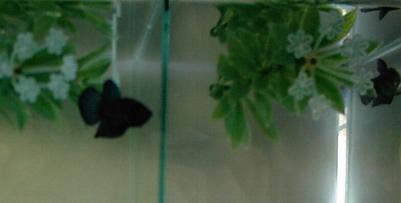
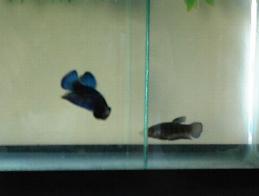
Male Displaying
3.) All you can do now is watch. The male will vigorously chase the female around the tank, she will play hard to get sometimes, or she may just give in and get to it. When she begins to display the usual spawning colors (vertical stripes on dark fish, may not be visible on lighter varieties) and swim with her head pointing downward, the male will then attempt to lead under his nest. This entire process may take anywhere from a few hours to a few days, I wouldn't leave the female in for more than 4 days, if she isn't willing to breed she might get brutally beaten or even killed.
4.) When she is ready, he will lead her under the nest, and prepare to embrace. They will swim in circles around each other a few times, then embrace. The actual embrace consists of the female flipping belly side up and the male trembling and wrapping himself over the anal region of the female, then 'locking' into place like an upside down 'U' for about 10-20 seconds. The first few tries will produce no eggs, however after a few tries anywhere from 1 to 10 eggs will be expelled and fertilized.
5.) When the male recovers from the embrace, he will release the female and gather the eggs in his mouth. The female meanwhile either floats to the surface or sinks to the bottom, in a 'paralyzed' state. Quite often when the female recovers she will assist in gathering any eggs the male might have missed.
6.) These embraces will conintue repeatedly for up to 6 or 7 hours, and produce anywhere from 70 to 300 eggs, depending on the size and health of the female, including how well she was conditioned.
7.) When the embraces have ended, the male will chase the spent female away from the nest. Take her out and put her in her own jar and treat her w/ Methylene Blue to help fight infection and heal any fin damage caused by the male. (Although with some females it's the male that takes most of the damage!)
To find out how to hatch the eggs and fry, go to the rearing section.
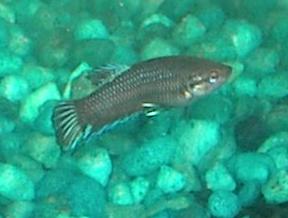
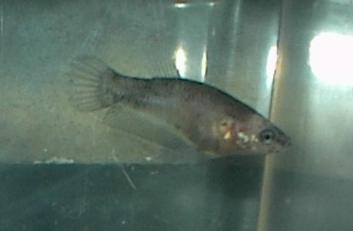
Here are some pictures of this pair's offspring (click to enlarge):
Built and
Published by WebMaster Rogelio Garza.
Copyright © 1999
All Rights Reserved