| Ohio's first Capital |
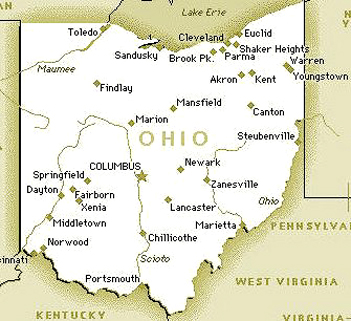
| Chillicothe is located in south central Ohio. Long before white settlers came to the region it was home to Native Americans. During the early years of settlement, numerous mounds and earthworks of the Adenas and Hopewells dotted the landscape. The Shawnee was the predominant tribe to inhabit the area before the arrival of the white man. Chillicothe, the county seat, was founded in 1796, just 20 years after the Declaration of Independence was signed. Nathaniel Massie, a Virginian, surveyed the land, some of which was to be given to soldiers from the state that fought in the Revolutionary War. Massie found the rich, fertile valley lying between the Scioto River and Paint Creek and claimed it as his own for a future town site. Massie and his men laid out his town and called it "Chillicothe," a name derived from the Shawnee word "Chalagwatha," which means town or gathering place. Among the Virginians Massie attracted to his settlement were Thomas Worthington and Edward Tiffin. Edward Tiffin was elected governor in January, 1803 and Worthington was one of Ohio's first two U. S. senators. Thomas Worthington, who has become known as the "Father of Ohio Statehood," was elected as the state's sixth governor in 1814. Nearby, on the Ohio River, Marietta, was the first organized settlement (1788) but Chillicothe became the first state capital. In 1810 it was moved to Zanesville. It was returned in 1812 to remain there until 1816, when the permanent capital was built at Columbus. The Great Seal of Ohio is a constant reminder of Chillicothe's place in the history of the state. As described by the legislative act creating the seal, its background is a representation of Mount Logan to the east of the city as viewed from Adena, Thomas Worthington's home. The Ohio-Erie Canal in 1831 and the railroad in 1851 made economic growth possible, and the city and county exported a large variety of agricultural and manufactured goods. Then Chillicothe was chosen for a training camp for World War I. Within two and a half months, the work force that ultimately numbered more than 14,000, had erected a camp for 40,000 men and 12,000 horses and mules. Upon completion, there were 2,000 buildings; the cost of construction was $4,000,000. The camp was called Camp Sherman. The population increased from 16,000 to 60,000. There was a flurry of housing construction and opening of new businesses. The community made the soldiers and their visiting families welcome. The economy continues to rely on industry and agriculture. Paper is the leading manufactured product, and the Mead Corporation has been a presence in the community for over a hundred years. Tourism is also important to the region, and there are many attractions for people wanting to know more about the birthplace of Ohio. These include Hopewell Culture National Historic Park, the Ross County Historical Society's museum, and the Scioto Society's outdoor drama, Tecumseh! |
| After reading about Chillicothe, think about when you would like to have lived there and write about it. 1. Would you like to be a Native American living in a wigwam or longhouse? 2. Would you like to be a member of the Worthington family? 3. Would you like to live there now and work at the papaer mill or be in the play Techumseh? |
 |