ROOM 105B
BRAIN PHYSIOLOGY 101
(CONTINUED)

To fire or not to fire.  Dendrites control that decision; the soma carries out that order.  What happens next?  The soma sends out an electrochemical signal that travels down the axon to the axon terminals.  That signal excites packets of neurotransmitters which are released into the space between neighboring neurons.  This space is called the synaptic cleft.  These neurotransmitters are taken up by the dendrites of the neighboring neuron and tell the neighboring dendrites to send a "fire" or "don't fire" signal to the soma.  The process then repeats itself....many, many, many times a second.

All that is fine and good, you say.  But, how does protein synthesis fit into the picture?  Neurotransmitters are proteins, proteins that are synthesized in the cell nucleus, the dark oval located in the soma (cell body) in the figure to the right.  These neurotransmitters meander their way down the axon to the axon terminals where they await their signal to be released into the synaptic cleft.

So, that's it!  Congratulations!  You now know the basics of the neuron and the process called a synapse.  You also now have a basic understanding on what those hard-working, ingenious scientists are working.  If you need to review the material, feel free to return to the previous page.  Review until you understand the material and you will be glad you did!

For more information on neurotransmitters and which ones are implicated in schizophrenia, please climb the stairs to The Attic.
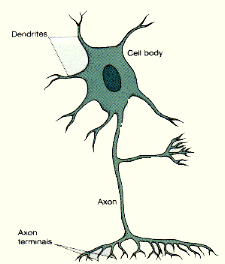
The axon of the neuron carries the electrochemical signal from the soma to the axon terminals, where neurotransmitters (or chemical messengers) are released into the synaptic cleft.  Axons range in length from a few micrometers to a full meter in length.
Links:
BACK TO ROOM 105A
BRAIN CHEMISTRY
BACK TO THE STAIRWELL
THE ATTIC
Hosted by www.Geocities.ws

1