BRAIN PHYSIOLOGY 101

genes
chromosomes
protein synthesis
neuron
dendrites
soma
axon
axon terminal
neurotransmitters
synapatic cleft
synapse
receptor sites
These are the words with which you need to familiarize yourself to make it through this room. I introduce them first, so that the next time you see them, you won't be shocked. I will define them as our discussion progresses.
Let's begin with protein synthesis. Protein synthesis is simply the production of proteins. Simple, right? Well, not exactly. Protein synthesis is a complex process involving many different biomolecules. We'll forgo the details and concentrate on the general idea, but before we get into that, we need to define some terms. Chromosomes are (for our discussion) groups of genes. There are 23 pairs of chromosomes in virtually all of your cells (red blood cells are the exception). You get 23 chromosomes from your mother and 23 from your father. Genes are the basic hereditary unit and are indirectly responsible for traits such as eye and skin color, the size of your big toe, and even the structure and functioning of your brain. DNA is the hereditary molecule and is the primary constituent of genes. To recap, DNA makes up genes, and genes make up chromosomes, all of which are located in the cell nucleus.
Protein synthesis occurs when the DNA molecule is transcribed into messenger RNA, which in turn is translated into amino acids, the basic building blocks of proteins. Proteins are directly responsible for your traits. If you are thoroughly confused, just remember that protein synthesis occurs in the interior of the cell and that the proteins this process produces are responsible for your physical traits (including thoughts, feelings, and actions).
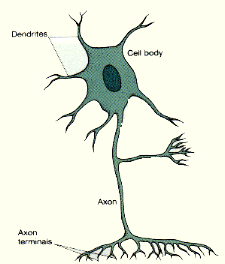
So, that covers protein synthesis. But, how does that have anything to do with neurons??? Good question. Let's define neurons, give a little info about them, and then talk a little bit about the structures that make up the neuron. Neurons are simply the nerve cells that make up your brain (see figure). Your brain is composed of approximately 100 billion neurons. Surrounding the neurons are cells called neuroglia (Latin for "neural glue"). There are approximately twice as many neuroglia as there are neurons. They serve a supportive function for the neurons.
Structures of the neuron include the dendrites, soma (or cell body), the axon, the axon terminals, and packets of neurotransmitters located in the axon terminals. The other terms you need to know are the synaptic cleft, synapse, and receptor sites. Dendrites are the branch-like structures located at one end of the neuron. They receive neurotransmitters (chemical messengers) from neighboring neurons in a process called a synapse. The dendrites' function cannot be overstated. They collect information from many neurotransmitters, process that information, and send a signal to the soma (cell body), telling the soma to fire or stay silent (more on this in a minute). So,the dendrites function to collect information via neurotransmitters and send that information to the soma. The soma in turn collects that information and does what it is told to do...that is to fire or to stay silent.
(continued)

BRAIN CHEMISTRY (CONTINUED)