 |
 |
| * Items Marked With This Symbol Indicate That You Must Be Logged Into Yahoo To Use Them. |
 |
 |
 |
 |
 |
 |
 |
 |
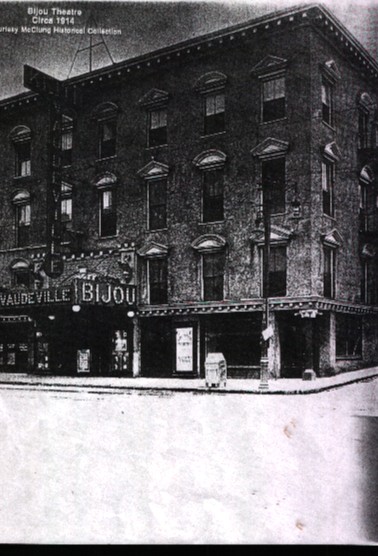
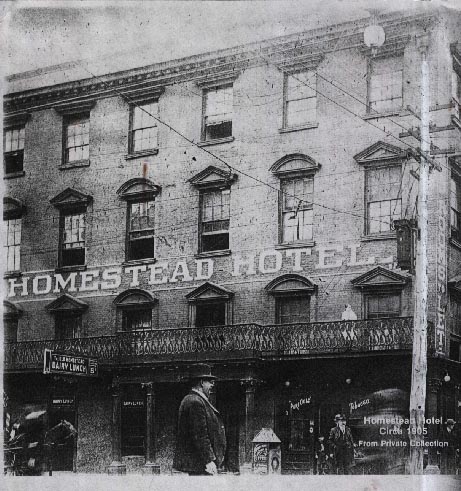
In 1900 the hotel was put up for auction by a court order. The highest bid was for $25 made by a Mr. McNab. From 1903-1904, the building was known as the New LaMarr House; it became the Homestead house during 1904-1907. After owning the building for 8 years, McNab sold it to the Auditorium Company for $50,000. In May 1908 the Auditorium Company made some major renovations. A major part of the hotel was remodeled and transformed into a theater called Jake Well's Bijou Theater. The remaining section of the hotel was located in the back of the building with the only entrance at Cumberland Avenue, it was known as the Auditorium Hotel.The venture was financed by three of Knoxville's prominent citizens: C.B. Atkin, Mrs. Jeanette Cowan, and W.G. Brownlow. Their combined investment totaled $50,000. The managing partners were Jake Wells and Fitz Staub. Wells already owned about 30 theaters and Staub owned and operated the Staub Theater, located across the street from the Bijou. The Knoxville Sentinel printed an article about the Bijou Theater and proclaim that it was |
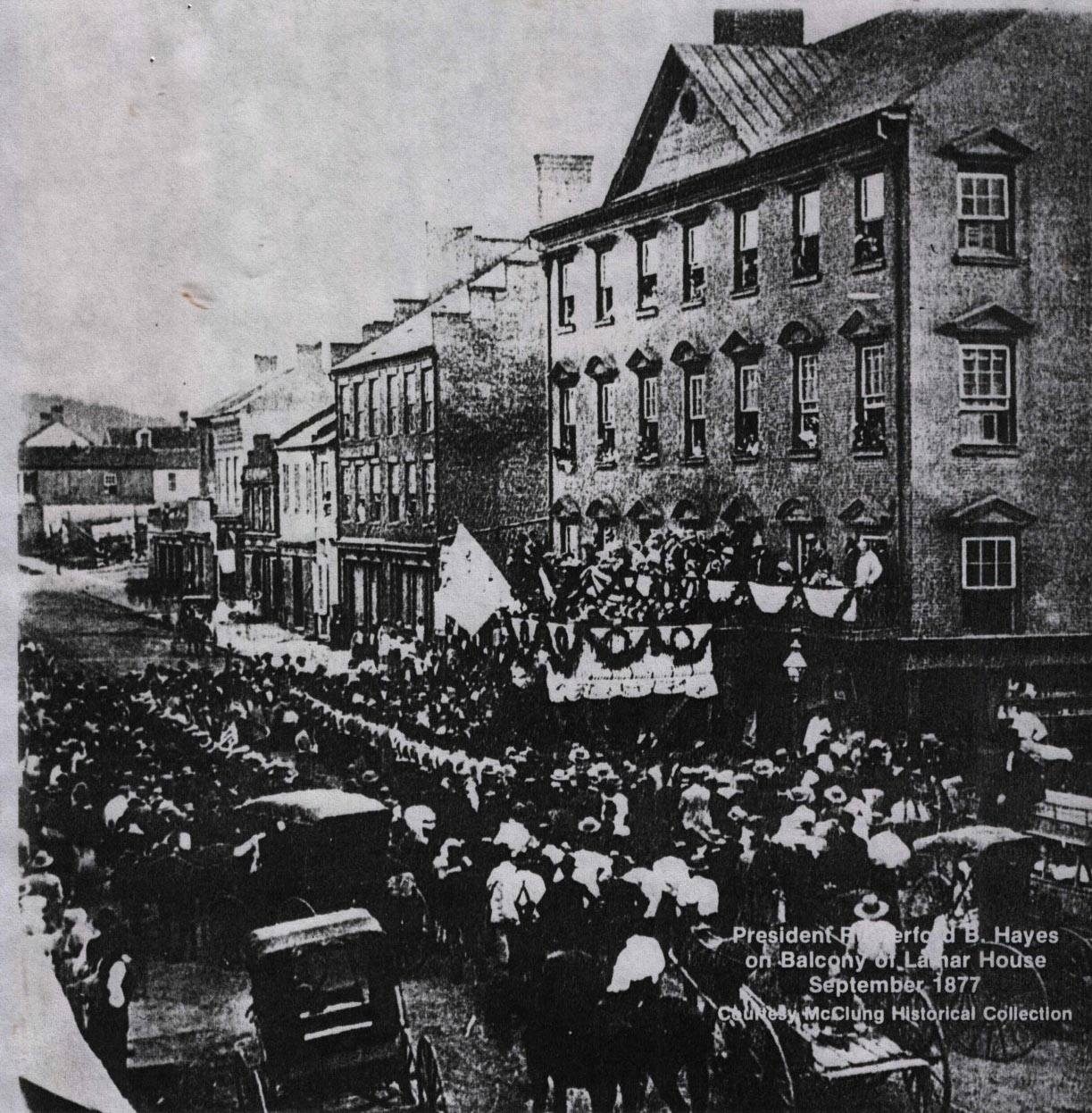
| Sanders was wounded in a brief skirmish on Kingston Pike. He was taken to the Lamar Hospital where he died on November 18, 1863 in what was formerly known as the bridal suite. During the Union occupation, Generals William Sherman and Phil Sheridan made Larmar Hospital their headquarters and laid out their plans for battle on the dining room table. After the war was over,Sneed had to go to court to retrieve his property. In the 1870s the hotel became a center for Knoxville social life once again. In 1877 President Rutherford B. Hayes paid a visit to the city and made a speech from the balcony. A huge celebration was held there in his honor. In 1895 the Bijou's name was changed once again, this time it was called The White House. This was due mainly because presidents such as Andrew Jackson, James K. Polk, Andrew Johnson, Theodore Roosevelt, William F. Taft, and U. S.Grant, all enjoyed the hospitality of the hotel. |
| Located in the historic section of town, the Bijou Theater in Knoxville has a history that is about as long and colorful as the city itself. Serving first as a dwelling and then later as a hotel/theater, the building has continuously been in use since 1819 and is the fourth oldest building in Knoxville. The saga of the Bijou Theater began just after the American Revolution when General James White received a grant of 110 acres for his services in the American military. The lot where the present-day Bijou Theater now stands was included in the parcel as lot number 38; it was 47.8 square feet. Later General White sold the lot to Thomas Humes and James Pardis for $8. In 1801 Thomas Humes purchased a 1,200 foot lot in downtown Knoxville; lot number 38 was included in this parcel. Humes built a general store on the property and soon became a very wealthy as well as a highly respected leader in the community. Over the years Humes increased his holdings until he owned the entire block. In 1813 he began constructing a hotel/tavern which was to be named the Thomas Humes House. Humes died on September 23, 1816, shortly before the construction was completed. The building was completed in 1817 and its first occupant was a man named Archibald Rhea. Rhea rented the building from Thomas Humes' widow and re-named it Archie Ray's Tavern; later it became Knoxville House. With its 13 guest rooms, bar, ballroom, and dining room, the hotel became a place for many social gatherings. In 1819, President Andrew Jackson came to Knoxville and was a guest of Knoxville House. In 1821, Rhea gave up his lease and the building was up for rent. Little is known about the property until 1823 when General Joseph Jackson moved his Jackson's Hotel from the corner of Main and Gay Streets to the old Humes' property. Once again the hotel became the most popular social gathering spots in Knoxville. Joseph was proprietor for 13 years then the hotel was sold in 1836 to James Pickett who wanted to open his own hotel. Pickett remodeled the hotel and renamed it Picketts Hotel; later it was re-named City Hotel. Unfortunately, by 1842, Pickett found himself deeply in debt; consequently, the hotel was sold at public auction. Two banks, also owned by Pickett, bought the hotel to help defray expenses. Joesph Jackson returned as proprietor for a short time then retired. In 1846, David S. Danner took over as proprietor. In 1852 the banks sold the hotel to a New York businessman whose last name was Coleman. The new owner renovated it so that it more than doubled its previous size. An elevator was added to the northwest corner and a smaller one to the southwest corner. Also added were a new kitchen, parlors, dining room, a courtyard and a ladies' entrance. It was re-named Coleman house and opened for business in October 1854; later during the year, Coleman added a ballroom to the rear of the house. That same year, the hotel gained an extra floor when Gay street was graded for resurfacing. In 1857, the building was purchased by William H. Sneed. A New York banker named Gazaway Bugg Lamar invested a huge sum of money in a residential area in north Knoxville and Sneed renamed the hotel, The Lamar House, in his honor. The building remained Lamar House for the next 40 years; again Knoxville social life centered around the building. In 1861, U.S. Senator John C. Breckinridge stood on the balcony of Lamar House and announced to the crowd below that he would rather exchange his seat in the senate for the musket of a soldier. Then the American Civil War erupted and the town of Knoxville was soon occupied by the union army. Sneed, a confederate sympathizer, fled the area. The Lamar House was taken over by the Union Army and part of it was converted into a hospital; known as The Lamar Hospital. In 1863, Brigadier William P. |
| History of The Bijou Theater |
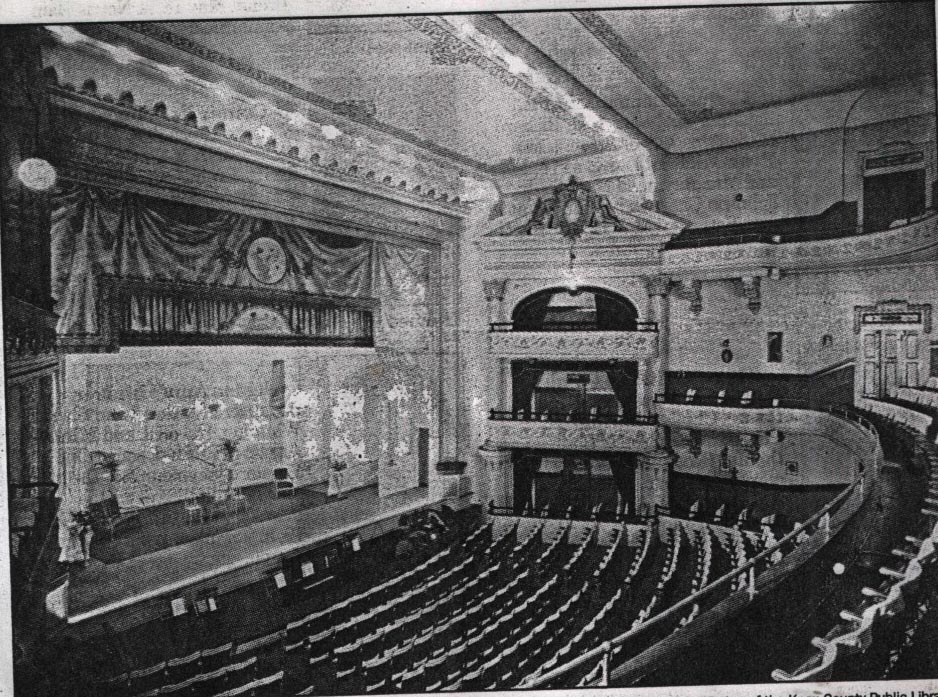
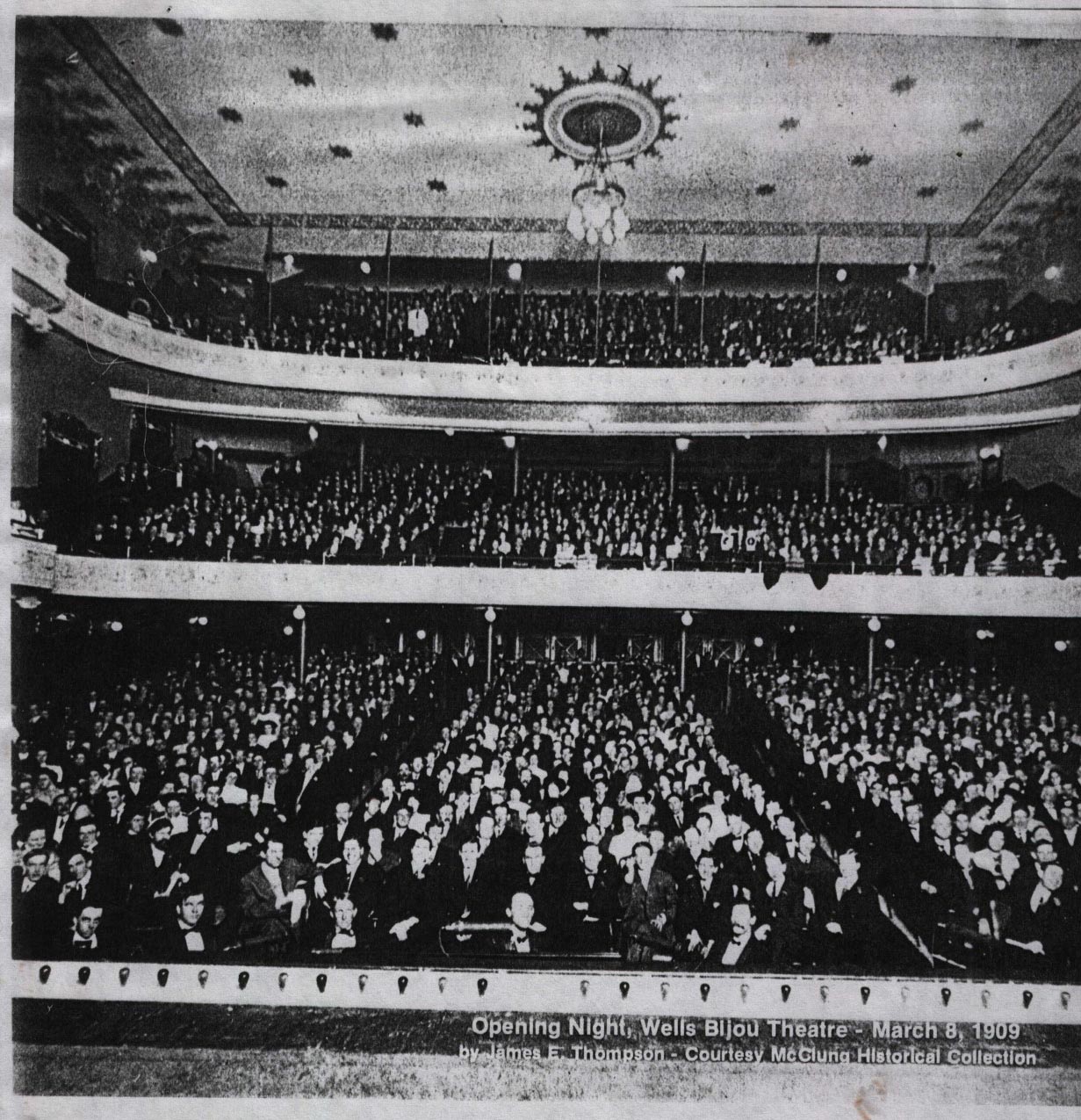
| "one of the best constructed and most conveniently arranged houses in the entire south". The theater opened March 8, 1909 with the production of "Little Johnny Jones" starring George M. Cohan. Between the years of 1908 and 1957, the hotel portion experienced many changes. It changed management and names around seven times. Although the hotel slowly began to deteriorate, it managed to maintain its aura of dignity and respectability. Unfortunately when it became the LaMarr Hotel in 1957 it began to degenerate into a home for transients and prostitutes. The grand old hotel began to loose its aura of integrity. Consequently there came a public outcry to put the hotel out of business. In 1969, after 152 years of continuous operation, the Lamarr Hotel was closed by order of a circuit judge. In 1926, construction began on the Tennessee Theater. By this time the Bijou had been sold again; this time to the builders of the Tennessee. The owners of the Tennessee sold the Bijou to a local Knoxville businessman with the stipulation that, for the next five years, the theater could not be used for theatrical productions of any kind. |
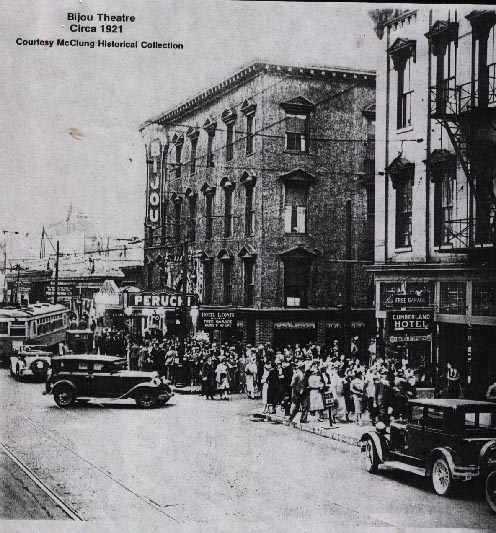
| In 1928 the Bijou Theater became a used car lot. The theater entrance became The Bijou Fruit stand and, according to local legend, the first bananas ever to be sold in the Knoxville, were sold there. In 1932 the hotel re-opened and became LeConte Hotel. One could get a room there for $1 a day. In 1935 a company that was part of Paramount Pictures distribution network leased the Bijou Theater for 30 years. The Bijou was used to show second-runs and holdovers of films that had already been shown at the Tennessee Theater. Paramount's lease expired in 1965. By this time the older portion of Knoxville was slowly degenerating. Due to urban growth and development of the suburbs, the businesses along Gay Street began to fall, one of the first to go was the Bijou Theater. The theater was leased to a new company, which began showing "adult art" films; the name was changed to the Bijou Art Theater. Six years after the closing of the LaMarr Hotel, another outcry erupted to close the Bijou Theater. |
| Sometime before 1971 the property fell into the hands of Mr. and Mrs. Frankie Sherman Rasnake. At the death of Mrs. Rasnake on February 15, 1951 the property was donated to the United Methodist Church. At that time the building was leased to Quinton A. Cooke, Jr. According to an ad in the entertainment section of the Knoxville Journal, the theater produced "exotic dancers", "novelty acts", "Frisco-style burlesque", and stage shows. In 1973, the Bijou Theater was closed due to unpaid rent and amusement taxes. Consequently, Knoxville's grand old theater was scheduled for demolition. In 1975 the Bijou Theater was added to the list of historical places in the National Historic Record and the Knoxville Heritage Group launched a campaign to halt the destruction of this grand building. The owners of the property agreed to sell it for $325,000. The deadline for raising the money to buy the property was July 1, 1976; which gave the Heritage Group only three months to raise the money. They launched a full-scale "Save the Bijou" campaign with telethons and T-shirt sales. |
| Unfortunately, when the deadline came, they were short by about $50,000. For two weeks the fate of the Bijou Theater hung in the balance. Then, John S. Goodstein, acting trustee for the Bijou, donated the remaining $50,000. The Bijou Theater was saved. Today, still retaining its dignity and its elegance, the Bijou continues to serve the city of Knoxville as one of the most outstanding entertainment centers in the world. In its era it has made its mark in the entertainment industry by presenting operas, musicals, orchestral concerts, and comedy. It has hosted many well-known artists such as Phyllis Diller, Maria MacPartland, Chet Atkins, and Mel Torme. It has withstood wars and fires, and throughout its many name changes and structure changes, its has remained Knoxville's Gem of the South. |
| President Rutherford B Hayes on the balcony Lamar House. Sept. 1877 |
| Homestead Hotel circa 1905 |
| Opening Night Wells Bijou Theatre March 8, 1909 |
| Bijou Theater circa 1914 |
| Bijou Theater circa 1921 |
| *All photos courtesy of The McClung Historical Collection. ETPS holds no claim to copyright for the historic photos on this page.* |