now with 50% less sodium


The Eastern Absolutist Monarchs of the the 16th and 17th centuries were able to maintain and build stable governments for various politcal, social, and economic reasons. Absolutist monarchs of Eastern Europe, during their prime, reestablished the practice of serfdom and instituted harsh legislation that stripped the peasentry of the rights they had had fought so hard to earn over the previous two centuries. In France, however, the nation was moving through an age of enlightenment that would bring about attitudes of tolerance, liberty, social justice and equality.
Russian Monarchs and nobility during the 16th and 17 century found that the strongest form of goverment attainable was built upon the exploitation and domination of the lower classes. Politcally, the Eastern European Nobility and the Soveriegns were obligated to perform civic duties while disregarding human rights for the good of the state. An essay from Fredrick II exemplified how a monarch should act in "honesty,wisdom and complete disinterestedness..." (Doc. 3) so that he may be completely accountible for his actions and trusted in his judgment. As well, an account of the Prussian court as oberserved by Fredrick II (Doc. 7) states that the Nobility and the Monarchy were very close in business and friendship, forming a stable simbiotic relationship that promoted the general stability of the region and that it is "one of the duties [of the ruler] to aide those noble families which have become impoverished in order to keep them in possession of their lands". (Doc. 7) Despite the cooperation and succeses of the Nobility and Monarchy many peasents were forced to live in horrific conditions that always kept the monarchy weary of revolt well into the 19th century.(Doc. 12) However, during these years of opression and control one part of Europe was moving through an Enlightened age.
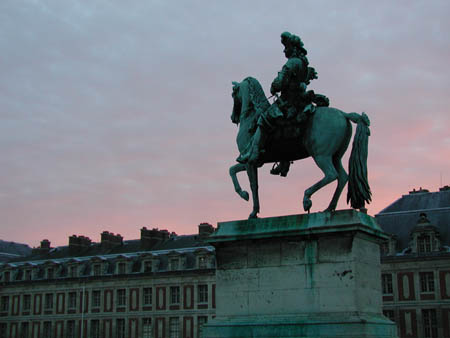
France, during the reign of Louis XIV was politically unstable. Paranoia and mistrust became the norm in government business. An account of Louis XIV's court describes the oppulent palace of Versailles as " a means of controlling the nobility, reducing their power and watching for any potential rivals." (Doc. 1) This disunion in the ranks of French power allowed for enlightenment ideas to flourish and spread; peasents and the growing burgoise capitalized on royal inatentivness and were able to promote new ideas of equality. Charles Montesquieu in The Spirit of the Laws was even so bold as to suggest that the best form of government did not rest in the actions of one man (monarch) but in the collaborative actions of a family...and therefore a more democratic approach to government. (Doc. 6) Other enlightenment thought that accumulated under the nose of Louis XIV stressed the equality of all men as represented in a statement from Jean Domat, a renowned French jurist, who said that government is neceassary because " within natural equality people are differentiated by factors that make their status unequel and forge between them relationships and dependancies." (Doc. 10) Even though France remained weak in political unity it still maintained a unified, nationalistic atmosphere that is represented in the glorification and commemoration of it's royal absolutist monarch Lousi XIV. Document 4 is perhaps just one example of god-like glorification that symbolized Louis XIV's reign. Where Eastern Absolutist monarchs were dependant on cheap serf labor to sustain the economy; France relied on a system of Mercantilism that supplied raw materials and gold to help sustain the economy. The Royal Absolutism of Louis XIV, however, was not without it's simillarites to Eastern Absolutism.
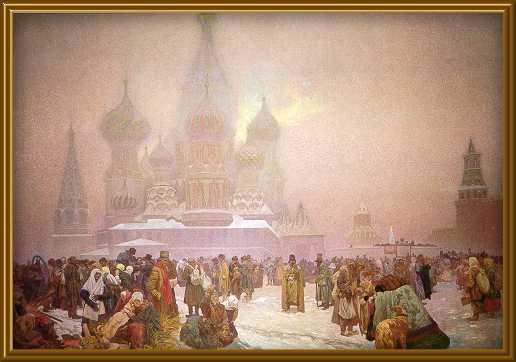
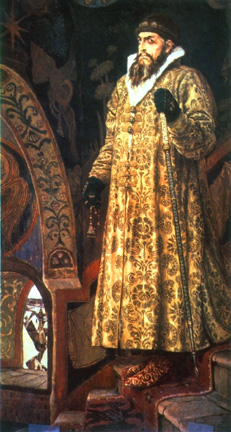
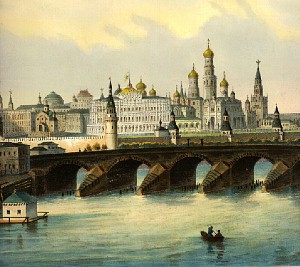
The French court and Eastern courts were centers of splendor that defined the power of the times. The Kremlin, depicted in Document 8 shows the magnificence of the Russian state despite it's geographic isolation. Tremendous resources obviously went into building great works such as St. Basil's Cathedral, The Kremlin and the Palace of Versailles. Ivan the Terrible, Russia's premier Absolute Monarch was not one to hide his extravegant life-style and is shown in heavy golden robes and fur in Document 5. The idea of having an effective admistration as well as a larger than life image were both areas in which absolutist states drew power.
Eastern Absolutists and Western Royal Absolutist were able to effectively build and maintain stable forms of government. The Eastern Absolutist Monarchs exploited the lower classes to ensure stability and economic longevity whereas the Royal Absolutism of Louis XIV was tolerant of free thought and allowed enlightenment ideas to flourish.

The seventy-two year reign of Louis XIV was marked by an opulent extravagance best exemplified by the construction of his palace at Versailles in 1682. Here, the entire French nobility was expected to take residence and to participate in elaborate ceremonies, festivals and dinners. Louis' motivation was not based solely on his desire to have a good time but was a means of simultaneously controlling the nobility, reducing their power and watching for any potential rivals.
Frederick II (1740-1786: Essay on the Forms of Government
A sovereign must possess an exact and detailed knowledge of the strong and of the weak points of his country. He must be thoroughly acquainted with its resources, the character of the people, and the national commerce....
Rulers should always remind themselves that they are men like the least of their subjects. The sovereign is the foremost judge, general, financier, and minister of his country, not merely for the sake of his prestige. Therefore, he should perform with care the duties connected with these offices. He is merely the principal servant of the State. Hence, he must act with honesty, wisdom, and complete disinterestedness in such a way that he can render an account of his stewardship to the citizens at any moment. Consequently, he is guilty if he wastes the money of the people, the taxes which they have paid, in luxury, pomp, and debauchery. He who should improve the morals of the people, be the guardian of the law, and improve their education should not pervert them by his bad example.
The general strength may be in the hands of a single person, or of many. Some think that nature having established paternal authority, the most natural government was that of a single person. But the example of paternal authority proves nothing. For if the power of a father relates to a single government, that of brothers after the death of a father, and that of cousins-german after the decease of brothers, refer to a government of many. The political power necessarily comprehends the union of several families.
Frederick the Great, who ruled the eastern German state of Prussia from 1740-1786, was the model for a new type of monarch: The Enlightened Despot. In this document, written in 1752, he sets out his basic theory of politics and the role of the sovereign.
[The Prussian nobility] has sacrificed its life and goods for the service of the state; its loyalty and merit have earned it the protection of all its rulers, and it is one of the duties [of the ruler] to aid those noble families which have become impoverished in order to keep them in possession of their lands; for they are to be regarded as the pedestals and the pillars of the state. In such a state no factions or rebellions need be feared . . . it is one goal of the policy of this state to preserve the nobility.
We have never spilled blood in the churches. As for the victorious, saintly blood - there has none appeared in our land, as far as we know. The thresholds of the churches: as far as our means and intelligence permit and our subjects are eager to serve us, the churches of the Lord are resplendent with all kinds of adornments, and through the gifts which we have offered since your satanic domination, not only the thresholds and pavements, but even the antechambers shine with ornaments, so that all strangers may see them. We do not stain the thresholds of the churches with any blood, and there are no martyrs of faith with us nowadays. . . . Tortures and persecutions and deaths in many forms we have devised against no one. As to treasons and magic, it is true, such dogs everywhere suffer capital punishment. . . .
Because all men are equal by nature, that is to say, by their basic humanity, nature does not make anyone subject to others .... But within this natural equality, people are differentiated by factors that make their status unequal, and forge between them relationships and dependencies that determine the various duties of each toward the others, and make government necessary ....
Jean Domat (1625-1696) was a renowned French jurist in the reign of Louis XIV, the king who perfected the practice of royal absolutism.
Peter the Great and the Rise of Russia, 1682-1725
He went from hence to the court of Vienna, where he purposed to have stayed some time, but he was called home sooner than he had intended upon a discovery, or a suspicion, of intrigues managed by his sister. The strangers, to whom he trusted most, were so true to him that those designs were crushed before he came back. But on this occasion he let loose his fury on all whom he suspected. Some hundreds of them were hanged all around Moscow, and it was said that he cut off many heads with his own hand; and so far was he from relenting or showing any sort of tenderness that he seemed delighted with it. How long he is to be the scourge of that nation God only knows.