

|
|
|
|
|
2002: Conference explored future of internet news  (Classic In Depth) More than thirty journalists gathered in
July 2002
in Minneapolis to discuss the future of internet news, including how
new audiovisual technologies might have an impact on the presentation
of
news on the web. The workshop, titled “Sensing the News: New Audio and
Video Techniques for Storytelling,” was the second joint venture
between NewsLab, a Washington non-profit that seeks to improve
television newscasts, and the Institute for New Media Studies, a part
of the
University of Minnesota’s School of Journalism and Mass Communication
which focuses on adapting news content to new technologies such as the
Internet and personal digital assistants (PDAs). The conference was
also the third part of an Institute-sponsored workshop series,
“Innovation in Online News.” (Classic In Depth) More than thirty journalists gathered in
July 2002
in Minneapolis to discuss the future of internet news, including how
new audiovisual technologies might have an impact on the presentation
of
news on the web. The workshop, titled “Sensing the News: New Audio and
Video Techniques for Storytelling,” was the second joint venture
between NewsLab, a Washington non-profit that seeks to improve
television newscasts, and the Institute for New Media Studies, a part
of the
University of Minnesota’s School of Journalism and Mass Communication
which focuses on adapting news content to new technologies such as the
Internet and personal digital assistants (PDAs). The conference was
also the third part of an Institute-sponsored workshop series,
“Innovation in Online News.”A
goal of the conference, as laid out in a joint NewsLab-Institute
release, was to examine “how 360
degree video, 3-D imaging, immersive
or interactive audio can lead to, or detract from, greater
understanding of the news story.” Participants listened to
expert
speakers on various technologies and concluded possible uses for each
technology in sessions held Friday and Saturday. The idea was to get
the participants to “help lead the thinking in the industry about
adapting some of these new media techniques,” stated the release. Attendees
thought of a variety of possible applications for the new technology.
360-degree images and video could take viewers to the scene of news
events to provide context and give added information. Interactive audio
could let users hear oral history from their community. Advanced web
cams could be used for live reporting and set up by a reporter anywhere
internet access is possible. 3-D photography could show viewers the
scene of news to help them better understand it, such as a picture of
the mountainous terrain of Afghanistan. Different roles may form as
newsgathering changes. Merrill Brown,
the then-recently departed editor-in-chief of MSNBC.com, spoke in the
keynote address. “We've only tiptoed
down the road of
television-internet convergence. We've only begun to measure the
impact
of internet news in a 24-hour global news culture,” Brown stated. He
likened the current incarnation of the Internet to the early days of
television. “To be sure, it is not 1947 any longer, but it is 1952 and
we've got a long, long way to go,” he said. Despite the
fact that the growth of Internet use and the use of news sites on the
web has slowed, Brown says there is a great deal of positive data on
which to focus, including the fact that daily circulation at MSNBC.com,
at some four million users per day, is double the size of any newspaper
in the United States, and that 58 million people at work use the web
more than TV. He also noted that a general consensus among the
advertising community that internet advertising is growing and will
continue to grow is often overlooked. But most importantly, Brown said
that internet news is a new market for news that wasn’t around only a
decade ago, cultivating an “entirely new and unappreciated audience.” “What we do
today simply did not exist,” he told the assembled audience. “We work
in the most successful new medium ever created and we must not forget
it.” 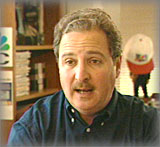
Brown
noted that the medium has come far in its short history, moving from
what he calls the first generation of internet news – repurposed
headlines and bios of “overpaid network talent” (this comment generated
quite a laugh among attendees) – to the second generation, where
webcasts and other new and original content began to be produced on
station websites, with top TV sites doing more to “extend the
storytelling experience.” He said we were entering the third
generation of internet news, where “improved interactive
applications”
will “engage consumers in new ways.” As more users
begin viewing the internet over high-speed and broadband connections,
video content on news sites is expected to take on an increasing
importance. Brown sees a greater degree of live and custom content
being streamed in the future, with sites like MSNBC.com “in short
becoming video distribution portals.” Streaming video is already taking
on increased importance at websites like that of KSTP-TV in
Minneapolis. Users of KSTP.com can select video stories from the
station’s newscast by checking boxes next to story headlines and create
their own “5Cast.” Story text is also available. KSTP.com is
promoting high-speed cable modem connections from the local cable
companies, AT&T and Time Warner Cable, as a way to get “instant
access” to 5Cast. Other stations have similar features, including KENS
in San Antonio. At the station website, MySanAntonio.com/kens, news is
centered around the “KENS 5 Video on Demand” service, which provides a
similar checklist of video stories available for viewing. For some local
station websites, the FeedRoom service has been an alternative to a
main focus on video stories. “The FeedRoom is where television and the
internet converge,” announces the company website. “Just like TV – only
better. The best news and information when you want it.” Stations
supplement text coverage on their sites with their video stories
that
come up in a co-branded FeedRoom window from which users can access
other video clips from the station and connect to coverage from other
FeedRoom affiliates. All NBC owned-and-operated station websites as
well as five major market Tribune stations and two major market Journal
Broadcast Group stations use FeedRoom. Improvements
in internet news are not only about finding a new outlet for news
content and better informing viewers, however, according to Brown. He
says it is about “reinvigorating the entire news business with better
information and technology.” The fact that his vision is not shared by
the “myopic” view of executives doesn’t faze Brown, who encouraged
fellow web journalists and their colleagues to speak out in support of
financial and journalistic commitment to web news. “All of us need to
be champions in ways that are not necessarily how journalists normally
behave,” he said. During the
question-and-answer session following Brown’s address, Dorian Benkoid
of ABCNews.com wondered how much support can be generated for web
journalism when most internet news organizations are not generating a
profit. “Patience is required by both us and our management,” Brown
said. He notes that high profit expectations are not unique to web
news, but are a feature of the entire business right now, including the
financial demands on television newscasts. Brown points out that both
CNN and Sports Illustrated took some fifteen years to generate a
profit, with USA Today needing twenty years to make money. Beth Pearlman
of Internet Broadcasting Systems (IBS), the company that manages a
number of local station websites, thinks that there are “ways
[executives] can and do cut back so
drastically that [Internet news]
has become a shell of what it ought to be.” “Some
people
are gonna screw this up badly,” said Brown, who referred to ABC’s
short-lived 1980s venture into cable news throughout the speech. “I can
only hope we don’t work for them.”
|
Classic In Depth In preparation for the new In Depth
features East Coast
TV News will bring you in the coming months, we are revisiting a few of
our long-form stories from the past. The original version of this story
was posted in July 2002. In preparation for the new In Depth
features East Coast
TV News will bring you in the coming months, we are revisiting a few of
our long-form stories from the past. The original version of this story
was posted in July 2002.For more information Read more about interactive audio, 360-degree video, 3-D photography, and other technology that could change the way news is delivered. Outside link: NewsLab Quick Clicks Nielsen markets listing TV news audio clips E-Mail East Coast TV News NEW! Latest headlines Outside link: Google search Outside link: MSNBC.com |