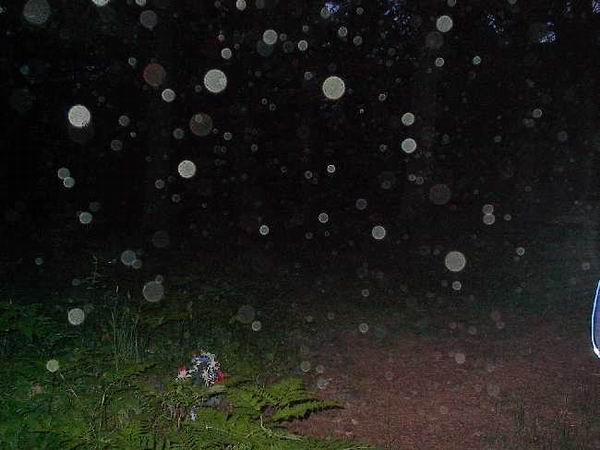
With this arrangement where the camera is set to view a room, you have perfect conditions for generating orbs. A small piece of dust a few inches in front of the camera will drift slowly by, mostly in the light beam from the illuminator. Whilst in the beam, it will be a very bright point source but it'll be way out of focus, hence the orb-like form.
Dust too, is easy to generate. No room is completely free of life; there's always a source of dust, however minor as it can also be tree and grass pollen, moisture and ice crystals and a vast array of other environmental particles.
The person setting up a camera, however slowly and quietly they move, will always stir up dust, and after they go the small air currents caused by heating will conspire to keep the dust moving for a while and then you get your orbs!
This phenomena isn�t a new thing it has been known about for years.. Photographers working in caves have long known that if you take a photo with a flashgun close to the lens, you will see only mist. Cave photographers always separate camera and illumination as much as possible, to avoid orbs.
Those investigating paranormal activity should take separate infra red illumination for cameras.