| Subsidence and Weathering |
| As the plate moves away from the spreading ridge where it was created, it becomes older. Equally, the volcanic islands on the Pacific plate age as they move away from the hotspots which created them. It should be noted that the island chains were not created by a single hotspot source - as has been discussed in the page on Hotspots and Volcanism, there are many hotspots in the Pacific. The islands have been formed at different times, and as a result island ages across the Pacific differ greatly. The diagram below shows the ages of some islands across the Pacific Ocean. |
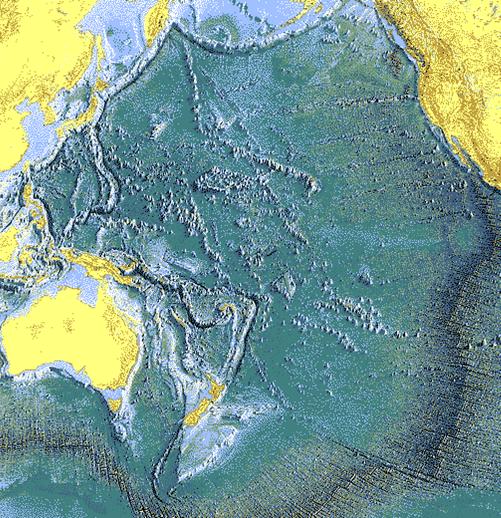 |
| Image sourced from www.anheizen.com/volcanoes/index.php?content=tectonics.php After Tharp and Heezen (1977) |
| Louisville Seamounts 45 - 8.2Ma |
| Hawaii Seamounts 42Ma to current |
| Emperor Seamounts ~80 - 42Ma |
| Marquesa Seamounts 5.2 - 1.6Ma |
| Micronesia 88 - 71Ma |
| Pitcairn - Society Seamounts 10Ma to current |
| As we have seen, the volcanic core is eroded by subsidence and weathering processes. These processes ultimately destroy the atoll which remains behind after the volcanic core. It is known that the Pacific plate subducts underneath the plates to the west - how much does this subsidence effect the islands of the Pacific? To answer this, an examination of the subducting crust, and how its depth changes with age, is required. To do this, use the calculations provided by Stein & Stein(1992), whose calculation allows for the sinking of the plate as it cools and loses bouyancy. For crust older than 20Ma, their equation states that: depth (km) = 5.65 - 2.47 x exp^(-age/36) For the Louisville seamounts, the depth of crust is calculated to be - for the 45Ma seamount: depth = 5.65 - 2.47 x exp^(-45/36) depth = 4.94km As volcanic growth has long since stopped, and reef growth is unable to keep up with subsidence, the atoll begins to sink beneath the waves. The point at which reef growth cannot keep pace with subsidence is known as the Darwin Point - in the case of the Hawaii chain, this point is at 28 degrees north (Duff, 1988). The erosive processes of wind and wave action also affect the island, but these are held to have less effect than subsidence (Goes, S, pers comm). The effects of climate also influence drowning, as rising sea levels will effect atolls, which have no significant topography. Tu'valu, an island atoll nation in the Pacific, has no point higher than 4.5m above sea level (BBC, 2008) - during significant tides most of the islands are flooded with salt water, destroying local agriculture. Current sea lvel rises are attributed to climate change, as the world heats up as a result of human activity. The islanders of Tu'valu, and those of many other Pacific island nations, may soon have to find somewhere else to live - a problem for many of the world's governments. However, as the BBC report states, with only 11,000 people on Tu'valu, will the outside world think it worthwhile saving Tu'valu? From a geological point of view, its subsidence and destruction is inevitable, as is shown in the cartoon below, describing subsidence of Pacific Islands - this one refers to the Hawaiian island chain. |
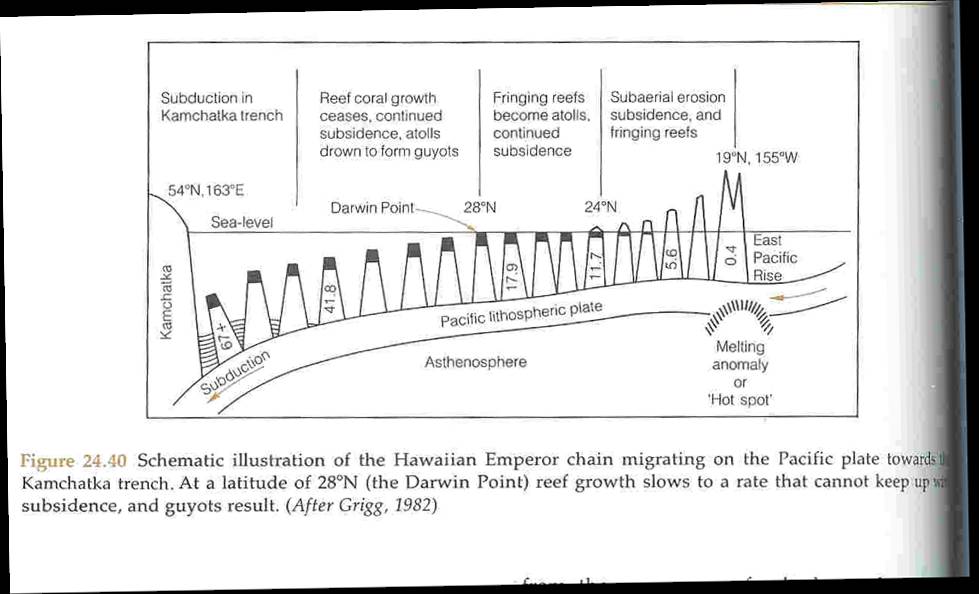 |
| After Grigg (1982) |
| So it appears as Tu'valu heads towards the subduction zone, it will inevitably sink beneath the waves. So where now for the small number of people on the tiny island nation of Tu'valu? References BBC (2008) "Tuvalu struggles to hold back tide", 22nd January 2008. http://news.bbc.co.uk/hi/sci/tech/7203313.stm Duff, Donald (ed) (1998) "Holmes Principles of Physical Geology (4th Edition)", Stanley Thornes, Cheltenham, UK, 1998 pp567-579 Grigg, R.W. (1982) "Darwin Point: A threshold for Atoll Formation" in Coral Reefs, Springer, Heidelberg, Germany. Volume 1, Issue 1, June 1982, pp29-34 Stein, Carole & Stein, Seth (1992) "A model for the global variation in oceanic depth and heat flow with lithospheric age" Nature 359, pp123-129. http://www.nature.com/nature/journal/v359/n6391/abs/359123a0.html |