 |
| Hotspots and Volcanism |
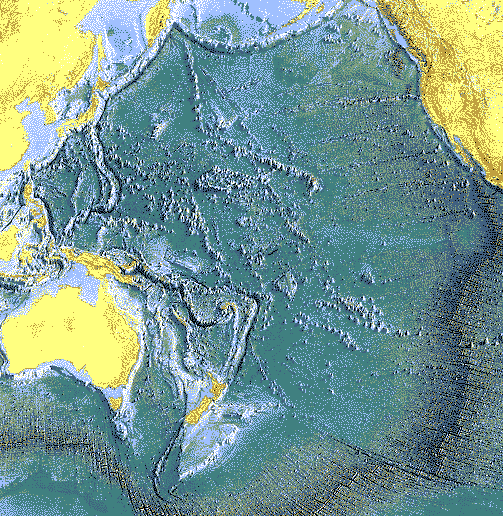
| Image sourced from www.anheizen.com/volcanoes/index.php?content=tectonics.php After Tharp and Heezen (1977) |
| East Pacific Rise - Spreading Ridge |
| San Andreas Fault - Transform Fault |
| Japan Rench - subduction zone |
| Tonga Trench - Subduction Boundary |
| The above map is a result of the work by American oceanographers Marie Tharp and Bruce Heezen. The Pacific plate lies in the centre of the map, bounded by the East Pacific Rise - a spreading ridge -in the southeast, where new oceanic crust is created. On the eastern side of the Pacific lies the San Andreas transform fault: the other boundary is formed by a lengthy subduction zone from Alaska in the northeast to New Zealand in the southwest, where the Pacific plate is forced beneath the neighbouring plates.. The subduction zone is associated with earthquakes and volcanism, and is known as the 'Ring of Fire': it is caused by dehydration processes in the subducting slab of plate resulting in partial melting in the slab of the plate above (Duff, 1988). Due to the subducting Nazca plate, the 'Ring of Fire extends into South America.The Ring of Fire and the plates bounding the Pacific plate is shown in the diagram below: |
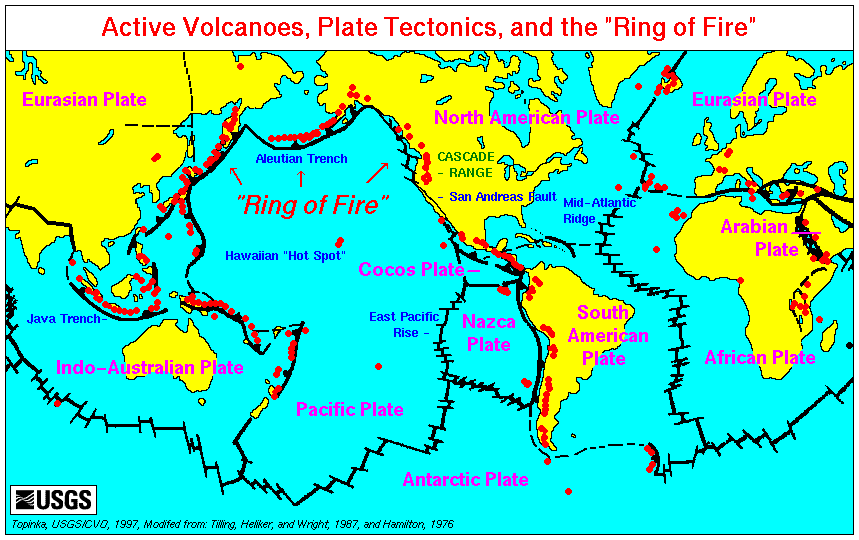 |
| Image courtesy of: http://vulcan.wr.usgs.gov/Glossary/PlateTectonics/Maps/map_plate_tectonics_world.htm after Tilling, Heliker &Wright, 1987 and Hamilton, 1976 |
| Analysis of the age of the islands in the Pacific indicates that the Pacific plate is moving northwest at roughly 9cm/year (Brantley, 1994), although other sources have the plate moving at 4.7cm/yr (Wedgeworth & Kellogg, 1987). The island chains in the Pacific have an aging trend in this direction. This aging trend occurs due to the interaction of the moving Pacific plate with the hotspots underneath. Hotspots A hotspot is an area of upwelling mantle in the asthenosphere, which in the case of Hawaii is thought to ascend at 340mm/year (Duff, 1988). The plume itself is solid, but the increased heat causes partial melting, This partial melt forms magma, which is erupted through the oceanic crust. The crust itself is around 8km thick under seamounts: the magma pools in a chamber around 2km below the seafloor, having risen from depths around 60km (Wedgeworth & Kellogg, 1987) Eruption is not continuous, and each shield is estimated to take 400,000 years to grow (Duff, 1988). Plumes are believed to be essentially static, and the plate moving results in the islands moving NW. This results in the creation of an island chain - such as the Hawaii-Emperor chain in the Pacific, which extends throughout the Pacific for over 6,000km. (Duff, 1988). Active volcanism in the Pacific, away from the plate boundary and thus responsible for island chains, takes place on the Hawaiian islands, Society Islands,Pitcairn Island, Marquesa islands, and the Samoan islands (USGS) The hotspot-plume model best suits the Hawaii-Emperor seamount chain, in the north of the Pacific. However, Koppers et al (2003) question the classical hotspot model's accuracy when applied to all seamount chains, and conclude that plumes are not fixed over time, but instead are short upwellings over 20Ma. They identify around 11 mini-hotspots in the South Pacific by this means, when other findings attribute around four large hotspots across the whole Pacific (Morgan, 1972). In any case, whether the volcanism results from a few larger, fairly constant plumes, or many smaller plumes of shorter duration, the magma rises from the mantle and exploits overlying weaknesses in the crust to erupt. Once on the seafloor, the hot magma begins to crystallise due to the large temperature contrast, leading to the evolution of an igneous cone. Volcanism Depending upon the rate of volcanism, the nature of the lava erupted will change. Low rates of emission produces small pillow lavas, which have cooled quickly. High rates of emission prouce pahoehoe sheet-flows of lava (Duff, 1988). Pahohoe - a hawaiian word for ropy - lavas are those where a smooth surface of lava is deformed by rapidly moving lava underneath. This is a feature particularly found in basaltic eruptions. Seismic surveys (Wedgeworth and Kellogg, 1987) and drilling (Keating, 1987) confirm that the volcanic core of the island is of basaltic composition. This is also shown on hotspot islands such as Hawaii and Tahiti, where the island is composed of basaltic volcanic rock. It is worth noting that the basaltic lava produced from hotspot volcanism has a different composition to Mid-Ocean Ridge Basalt. Ocean Island Basalts are of tholeiitic composition, whereas Mid-Ocean Ridge Basalts are alkaline in composition. According to the Oxford Dictionary of Earth Sciences: "alkali basalts have in their groundmass pyroxene titanaugite (an augite rich in titanium), whereas tholeiites have pigeonite (a calcium poor pyroxene).Also, for a similar composition of SiO2, alkali basalts have a higher concentration of Na2O and K20 than tholeiities." The interaction of the hotspot with the above oceanic crust is illustrated in the cartoon below: |
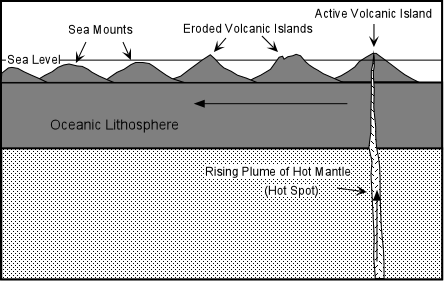 |
| Image courtesy of Tulane University: www.tulane.edu/~sanelson/geol212/ocean_basins.htm |
| If the volcano continues to be fed by magma, it will grow to reach a shallow marine environment near the ocean floor. What happens then will be discussed in the next page: Reef Formation References: Brantley, Stephen R (1994) "Volcanoes of the United States" USGS General Interest publication, http://vulcan.wr.usgus.gov?Glossary/PlateTectonics/description_plate_tectonics.html Duff, Donald (ed) (1988) "Holmes' Principles of Physical Geology (4th Edition)" Stanley Thornes, Cheltenham, UK, pp212-219, 567-579 Keating, Barbara (1987) "Structural Failure and Drowning of Johnston Atoll" in "Seamounts, Islands, Atolls" Keating, Barbara (ed). American Geophysical Union, Washington DC, USA. pp50-58 Koppers, Anthony et al (2003) "Short-lived and discontinous intraplate volcanism in the South Pacific: Hot-spots or extensional volcanism?" in G3 - Geochemistry, Geophysics, Geosystems, American Geophysical Union, Washington DC, USA. Volume 4, No. 10. pp1-10, 27-39 Wedgeworth, B. and Kellogg, J. (1987) "Isostatic Compensation and Conduit Structures of West Pacific Seamounts - results of 3D Gravity modelling" in "Seamounts, Islands, Atolls" Keating, Barbara (ed). American Geophysical Union, Washington DC, USA pp85-91 |