 |
|
|
|
|
|
|
|
|
|
|
|
|
|
|
The Debate On Women's Education (Contin'd) |
|
|
|
While many argued against the education of the �inferior� sex, there were those that defended women, or at least had good intentions. Some clerics argued that reading and any other forms of education were �only suitable for nuns� under the pretense that all other women would waste their time on reading �love letters or reading heretical literature.�1 This was based on the fact that since women lacked the intellectual strength to focus on �real� educated material, and following the idea of the �Curse of Eve,� women were prone to evil. Therefore all secular and religiously untrained women would not be able to control themselves. Yet the nuns were still �permitted� due to their heightened level of religious awareness. |
|
|
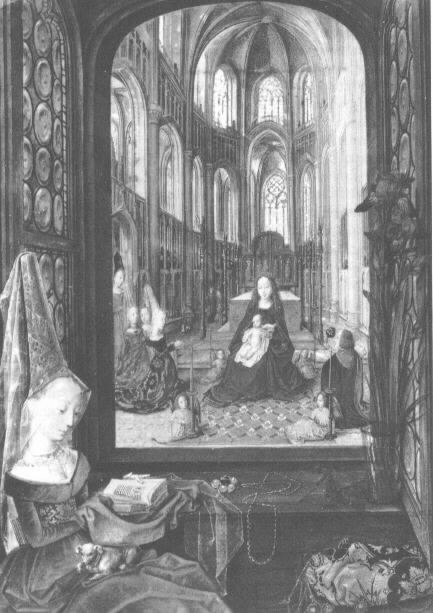
The major intellectual movement Humanism spurred interest in women�s education and many men that subscribed to the movement were firm supporters of women�s education but for very interesting reasons. A few highly influential men wrote on the subject and their opinions and discourse had a major impact on all European women, not just English women. Baldassare Castiglione produced a very popular book in 1528 entitled Book of the Courtier, in which he argues for an education of women. His argument stems from a fear that he felt all men had: "There is hardly one among us who does not fear more the shame which comes to him from the vices of his wife than from his own;�who would not prefer to be a thief and a blasphemer and that his wife were a murderer and heretic, than that she should be less chaste than her husband."2 An education for his wife was the perfect protection of a husband�s reputation against her inherently strong inclination towards an evil, or at least unchaste (since they appear to be rather similar by Castiglione�s standards) desires. His book was vastly popular and widely read, so his opinions on women and their subsequent education were very important to the Early Modern period. There were �forty editions [of his book] in the in the 16th century alone.�3 |
|
|
|
 |
|
|
|
|
|
#5 |
|
|
|
|
Another standpoint is that of Desiderius Erasmus, which he stated in his work Colloquies: �A sound classical education would give a woman the wisdom to be a better wife, and mother and would contribute to a more permanent and happier union.�4 Of course, the classical education was made up of domestic duties because the sole purpose of a woman was �to please her husband�her �lion,� as Erasmus called her spouse�[and that] was the new bride�s principal function.5 Along similar lines of argument was Jean-Louis Vives, who argued in his work De l�institution de la femme chretienne (On the Institution of the Christian Woman) in 1553, for �education for young girls, married women, and widows,� yet he was �quick to lay down limits.�6 Classes were to be segregated, domestic work was to take priority over reading and writing, and teaching Latin was to be taught with caution.7 Many defenders of women�s education did so with only the bare minimum in mind, which usually only meant religious and domestic subjects were taught to reinforce the hegemonic assumptions of women�s gender and render them useful in regards to their private, domestic sphere.
One of the most influential and popular defenders of women�s education was Sir Thomas More. In 1518, while in correspondence with one of his new teachers at the school he founded, he discussed his position as �valu[ing] moderate learning in a woman: �They both have the name of human being whose nature reason differentiates from beasts; both I say, are equally suited for the knowledge of learning by which reason is cultivated��8 While this statement seems feminist in nature, the same androcentric motivations were behind More�s defense of women�s education as well. He saw �instruction of a young wife as a way of inculcating the proper attitude toward her husband.�9 More was even more popular in that he did not just discuss in theory but lived by his beliefs. He had his three daughters Margaret, Elizabeth and Cecily educated equal to that of their brother John and while his intention was the creation of subservient future wives, the end result was concrete proof that flew in the face of all the gendered assumptions about women�s intellectual inferiority. All three went on the become classical scholars and there is even mention in a letter from John Palsgrave to More in 1529 that he was sorry he missed More�s daughter�s �disput[e] in philosophy� done before the king.10
While all four men defended a (noble) woman�s right to an education, the important backdrop of their arguments is the idea that the end result is a more satisfying, subordinate wife. The true beneficiary of a woman�s education was still a man. As the 16th century progressed, women�s education became more popular to defend through this androcentric paradigm and women�s education was becoming more normative on various levels of society. |
|
|
|
1 Marty Newman Williams, Anne Echols. Between Pit and Pedestal: Women in the Middle Ages. (Princeton, New Jersey: Markus Wiener Publishers, 1994). 213.
2 Bonnie Anderson, Judith Zinsser. A History of Their Own. (New York: Oxford University Press, 2000). 28-9.
3 Anderson and Zinsser, 26.
4 Pearl Hogrefe. Tudor Women: Commoners and Queens. (Ames: Iowa State University Press, 1975). 105.
5 Anderson and Zinsser, 27.
6 Natalie Zemon Davis, Arlette Farge. A History of Women in the West. Vol. 3. (London: Belknap Press, 1993). 102.
7 Davis and Farge, 103.
8 Hogrefe, 100.
9 Anderson and Zinsser, 29.
10 Hogrefe, 101. |
|