
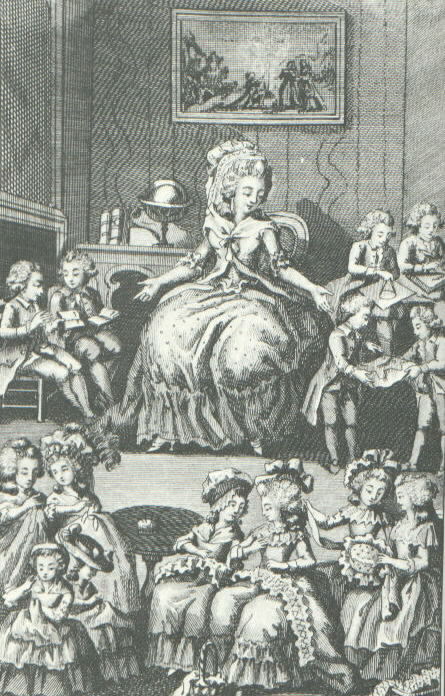
The convent was a very popular, and socially deemed appropriate, location for women to receive an education. There was the issue of costs however being that �only the very wealthy could afford to send their daughters to live at convent schools, which cost fabulous sums.�2 The convent became the suitable place for women to become moderately educated in religious matters, to either serve as preparation for a husband, or if dowry issues or a lack of husband occurred, keep them there to stay on and become nuns.
Women that could afford it also had the option of a secular boarding school, usually designated to women of the merchant, middling sort. The goal here, since she could not devote herself to God, was to become an eligible, suitable woman that could marry into or above her class, with a focus on �grooming, comportment and fine arts,� which would later in the century come under question as a �superficial education.�3 London�s first boarding school opened in 1617, and schools in the suburbs of Hackney, Putney and Chelsea, despite educational quality questions were highly renowned and from �the vogue,� boarding schools popularity expanded outward to Manchester, Exeter, Oxford and Leicester.4 In the end, the schools managed to aid greatly in the boost in literacy rates and education for women.
Lastly there were the elementary schools that at best were able to teach basic reading skills and at worst, not make much of a difference at all. Since classes revolved around �seasonal rhythms� there was never a regular calendar to follow and attendance was erratic for all and less frequent for girls.5 Yet for a lot of girls, this was the only affordable option to gain any type of education or level of literacy. Usually the basics were taught via catechism but most of these girls got the more valuable training appropriate to their class at home in regards to domestic duties versus any type of academic knowledge.
2 Zemon and Farge, 114.
3 Zemon and Farge, 116.
4 Zemon and Farge, 116.
5 R.A. Houston. Literacy in Early Modern Europe. (Harlow, England: Longman, 2002). 13.