| The Aristocractic Women Of The Early Modern Period |
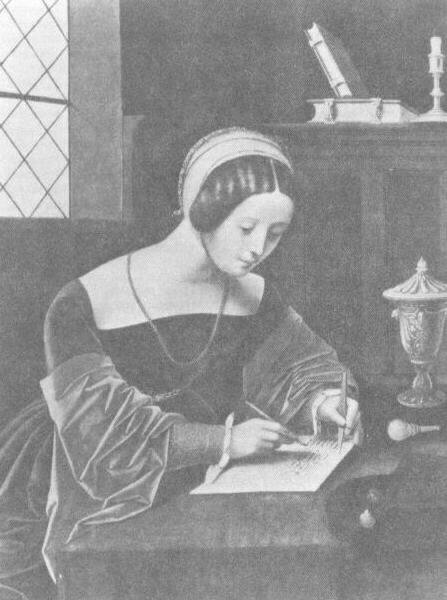 |
| The most documented information historians have is in regards to the aristocracy and their way of life: their gendered assumptions and expectations, belief structures, ordered hierarchies of power, educational practices and all other major aspects of the Early Modern period. However, it cannot be emphasized enough that they were coined the �elite� for a reason. As of 1500 �the ability to read and write at anything more than a fairly basic level was confined to women of high noble birth�dealing with under one per cent of the population.�1 As with today, there was a specific top one per cent that seemed to own everything and had all of the money needed to fully educate their sons, and if deemed appropriate, their daughters. The topics studied were highly gendered however, with an emphasis on religion, Christian morality, classical texts and literature as basics for daughters that were permitted the option of an education. There was �few concessions made to notions of a weaker sex�the course of reading [was] demanding and above all ethical�[and] the final consequences of this education [would] be a virtuous death which confirm[ed] the status and renown of family name.�2 |
| The interesting point made here is that while the subjects taught were still gendered, the assumptions and therefore expectations about the inherent nature of her gender did not manipulate her sense of self the way lower class girls felt when placed farther away from their middling sort counterparts. These women had the money, time, tutors and better levels of self-confidence to fulfill their potential as academic, classical scholars. Although even at the top, limits were set, such as all women being barred from higher education, so that the female mind could never surpass that of a man�s. Some major examples of English educated, upper class women were Catherine of Aragon, who �wrote fluent Latin, and later provided a similar education for her own daughter, Mary Tudor.�3 Bathsua Makin was also highly educated and even tutored Elizabeth Tudor. After Queen Elizabeth I came to power, �English families planned education for their daughters to make them fit members of the learned monarch�s court.�4 Elizabeth I had a great influence over the aristocracy and their daughter�s educations by acting as a role model and also becoming living proof that women were not intellectually inferior and could be educated as well as run an entire country. Sir Anthony Cooke also encouraged his daughters to learn Latin and Greek, as well as work on translations, write poetry and be affluent enough to engage in religious debate, all of which (excluding the Latin and Greek) became more and more acceptable forms of knowledge for women to comprehend.5 Unfortunately, after Elizabeth�s death in 1603, King James did nothing to further the education of noble women and actually had a great distaste for women, which hindered the aristocratic daughters chances at a more complete education. A famous story involved a ��learned maid� [that] was presented to him because she could speak and write in Latin, Greek and Hebrew: �but can shee spin?�� was the only response he could give.6 |
| 1 Olwen Hufton. The Prospect Before Her. (New York: Alfred A. Knopf, 1995). 426. 2 Nigel Wheale. Writing And Society. (London and New York: Routledge, 1999). 117. 3 Bonnie Anderson, Judith Zinsser. A History of Their Own. (New York: Oxford University Press, 2000). 84. 4 Anderson and Zinsser, 86. 5 Pearl Hogrefe. Tudor Women: Commoners and Queens. (Ames: Iowa State University Press, 1975). 85. 6 Mary Prior. Women in English Society 1500-1800. (London and New York: Methuen, 1985). 215. |
| #9 |