 Hi,
Hi,
Coleford is about 15 miles from Huntley, through the Forest of Dean.
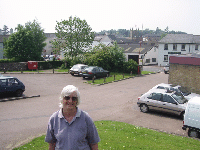
Click on the image to see a larger version. We parked at the Library, and admired the view. Coleford, part of Newland parish until 1894, became the principal centre of the St Briavels Hundred, securing a market and fairs in 1661. Newland developed as a residential village with its gentry houses, almshouses and school grouped around the large church and churchyard to create a most picturesque village. The inefficient medieval forges left large mounds of iron slag, or cinders, which were later dug out and rendered down in the water-powered blast furnaces that were established from c1600. Coleford prospered as the main business and retail centre on the west side of the coalfield, and was also the principal local base for the nonconformist churches.
May God smile on you today,
Elizabeth
|
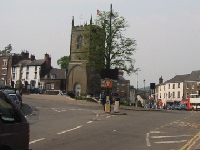 This triangular open area has been restored to space, needed by the modern volume of traffic. Coleford is the focal point of six roads serving the area. For example there is the ancient route known in 1345 as the coal way going south-east to the forest and on to the Severn River. Coleford had eight houses recorded in 1349, and a chapel by 1489. It was granted a market in 1661 and by 1710 also had over 160 houses. In the 1730s Viscount Gage tried to assert his manorial right to prevent building, but housing space was obtained by infilling between existing houses 'and in several places streams were culverted and houses built over them'.
The chapel was rebuilt in 1820 and then pulled down in 1882 when a bigger church was built on higher land, leaving the clock tower. The Market House also saw expansion as a community centre before being demolished in 1968 to ease traffic movement in the town centre.
|
 In 1643 Royalist troops marching on Gloucester from South Wales dislodged a Parliamentary garrison stationed at Coleford to intercept them.
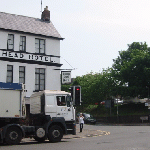
The Kings Head (recorded 1785), together with The Angel (opened 1650s), The Feathers (open in 1654) and the Old White Hart (recorded in 1730) continue to provide for travellers.
Religious independance has a long history here, as Newland was where the church was located. In 1667 ten people were charged for not attending Newland Parish Church. In 1677 Quakers were persecuted, and in 1689 a house was registered for worship by the Baptists who developed a mission to the extraparocial area of the Forest
|
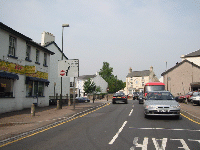 This road leads back to the Library, the Kings Head is on the corner the car is approaching.
Modern life - traffic lights and road markings, a lending library, schools and newspapers - have grown from traditions that include an association to combat crime in the town formed in 1786, a schoolmaster living here in 1790, a Town Crier was recorded in 1863, and in 1871 a board of health was formed.
|
Speech House
We visited the Tourist Information office and collected the maps and pamphlets we needed to find Speech House. For much of its history the Forest of Dean, using the term for the area subject to forest law, included two distinct sorts of land:-
1. Land held by the Crown in demesne, mainly extraparoachial and uninhabited woodland and waste, crossed by many tracks including the Dean road recorded in 1282 as having a pitched stone surface and kerbstone border, possibly linking the Roman sites at Lydney and Ariconium in Herefordshire.
2. Other manorial and private freehold land mainly cultivated, settled and formed into parishes. These form a border around the Crown land.
|
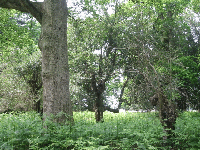
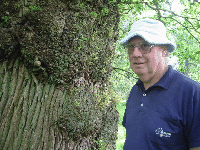 How old is that tree?
England has been actively farmed for the last 1000 years, and this includes the present forest, with trees planted for the hardwood harvest expected to be needed 200 or more years into the future.
The Forest of Dean has coal and iron-ore under land not considered good for pastures, so the woodlands were harvested then replanted with varying degrees of success. The iron workers needed charcoal, which was at odds with the King's concepts of it being his private hunting ground with deer reserved for his exclusive use. The King also needed to reward people who pleased him.
The Forest Law was designed to defend the vert and venison, and the mining and ironmaking industries. Then the basic aim shifted to the preservation and management of the woods for shipbuilding timber, so reducing the significance of deer (who ate young trees) and free miners (who burnt trees to make coke).
|
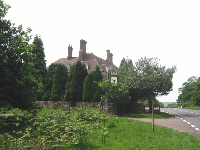
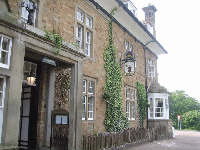 Laws have courts to see they are kept, and from 1338 a courthouse was at Kensley, where Speech House was built in 1676, and served as a keeper's lodge until 1841 when it was leased as an inn. It continued to host the Verderers' court. In present times the Forestry Commission is in control.
This block facing the Cinderford-Coleford road was added in 1882 to the east side of the Courtroom.
|
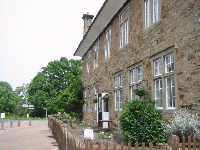 The south end contains the ground-floor room used as the courtroom, where roof beams were renewed in 1956 and in the present-day is furnished as the hotel dining room.
Speech House was one of six Forest Lodges established in 1675, and assigned an inclosure of about 30 acres (12 hectares) which was farmed by the keeper. Kennels for hounds, cattle pounds and workman's cottages were needed to support the Keeper.
|
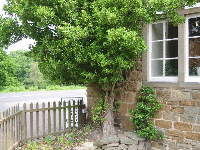 A closer view of the corner of Speech House, with a tree growing close to the wall. As principal courthouse for the Forest, it hosted livestock and timber sales, fairs, sporting events and rallies, and was the scene of a visit by Prince Alfred in 1861 and Queen Elizabeth II in 1957. On sunny Sunday 1 June 2003 over 3000 gathered for a Forest Showcase event displaying and tasting local crafts, with cider, cheese, and bread making displays entertaining the visitors.
|
An odd collection of details
St Briavels Hundred was recorded in 1270 as 'Forest of Dean' bordered by manors administered by St Briavels castle and manor, with a court held every three weeks in theory, but in fact a deputy was left to do the work, and collect the rents and fees.
The actual land left as 'Forest of Dean' was gradually reduced by means ranging from gifts from the King to encroachments.
The Crown's hunting rights, which provided the original motive for the Forest's preservation, were much exercised in the thirteenth century, and gifts reveal the presence of fallow deer, with smaller numbers of red deer and roe, which were classed as 'beasts of the forest'.
During the 17th century felling of the woods reduced the numbers of deer, and laws were made to restore them. In 1849 the Crown Commissioners of Woods ordered the destruction of the deer because their presence was having 'demoralising effects ' on the local people who were poaching the animals. Some deer survived on land adjoining the forest, and in 1969 a herd of about fifty was recorded near Speech House.
Other beasts of the forest were wild boar, with 100 boars and sows taken for a Christmas feast in 1254, and packs of wolves were recorded at the same time.
The human occupants, officials, woodsmen, miners and quarrymen, pastured cattle, pigs and sheep on the forest waste and worked small arable plots, gardens and orchards
The administration was to enforce the forest law in defence of the vert and venison and of the mining and ironmaking industries, restricting rights to the 'free miners'.
A system of fines under a lack of government control led to corrupt officials, and much discord and claims of tradition rights versus squatters. Riots in 1831 were followed by an Inquiry and resulted in regularising existing cottages and parochializing the Forest (previously outside parish boundaries).
Being extraparochial had advantages, for example bastardy claims could not be made of a child born in the Forest. Becoming parochial included water supply, sewerage systems and roads, schools and churches for 20 villages in 1921 with 26,624 citizens.
|
If you enjoy this page, please Email me.