Hend
My life in India, 2005-2006
4/30/2006
As promised, below is a little
bit about the trip to Delhi I took in late March.
One month later, I now realize how stupid it was to let my memories dim. I
scribbled down a lot during the trip, but everything was a lot more vivid in my
mind a few weeks ago.
I’m not going to summarize all
the touristy things I did, just because you can find a much better description
of Delhi, Jaipur,
and Agra by punching those names
into Google. What I’ll do is just tell a few short
stories.
If you do want to see
pictures, I took some great ones and posted the best on http://photos.yahoo.com/eamon19.
Enjoy.
I arrived in the early morning
of March 19th, a couple days before the end of the Baha’i fast and the festival of Naw
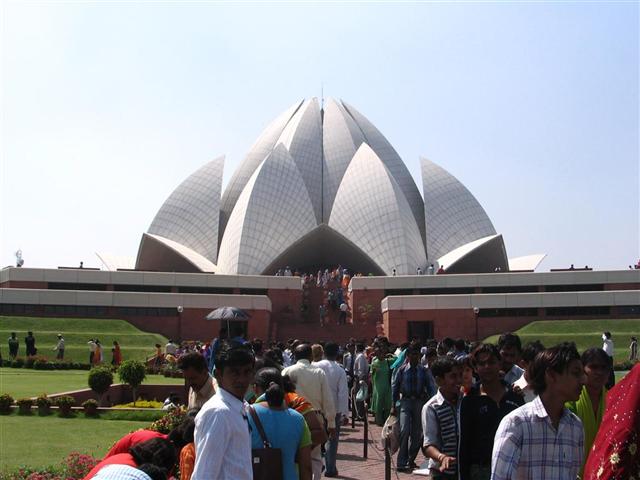
Ruz. This was the main reason I went to Delhi, to see the house of
worship and spend my Naw Ruz
in the vicinity of the beautiful Baha’i House of Worship there. The 19th
was a Sunday, and throngs of people had come to the temple that day. Some of
the volunteers told me that on certain occasions, upwards of 50,000 people come
to visit. I arrived around noon in a noisy
auto rickshaw. As we got within sight of the temple, we bounced around on a
long potholed road with a big slum-like area towards the right and the Delhi
Development Authority offices on the left. That last sentence, by the way,
contains everything you need to know about India.
It is downright amazing to see
so many people coming to visit a Baha’i holy place,
very few of whom are Baha’is themselves. The temple, after all, was built
as a place for people of all faiths to come and pray and meditate and sit in
silent reverence. And for one percent of the visitors, this is exactly the
appeal of the house of worship. Sometimes this one percent is a young
man by himself in the corner, sitting with eyes closed and head titled toward
the floor, his glasses resting in his shirt pocket, as he meditates for hours
about some private subject that he will share with no one. Other times the one
percent is a mother with two small children. They cause a ruckus, obediently
silent but goofing around just enough to disturb everyone in the general area
except their very own mother right next to them. She sits up straight with a
half smile, finally finding the only place where she can escape the dusty
noises of diesel engines and barking dogs and crying babies, a place where,
before entering, she has discarded her shoes, and with them the mud and dirt
that they have collected after a lifetime of long and back-breaking sacrifices.
These are the one percent. The other 99 percent treat the temple
as a picnic area, which is, within reason, their right. They hang around
outside the main gate and chat and laugh with friends, licking an ice cream
from one of the dozen vendors who have arrived early in the morning to make
their living. Most often, they have no idea what the House of Worship is or is
meant for, only recognizing that it is staggering beautiful in real life, a
giant marble lotus flower that, somehow, doubles as a place for prayer. Some of
the 99 percent, when they enter, don’t know what to do. They walk around the
nine-sided building searching for something to look at and admire, and find
nothing but a few one-sentence English and Hindi excerpts from the Baha’i writings. There is no idol there, not even a central
place to aim one’s prayer, which throws off many Hindus who are accustomed to
focusing on a statue or image while they pray.
Some of the 99 percent are Iranians who, with a couple
weeks off for Naw Ruz, have
decided to travel to India for vacation. They
arrive with their tour buses to the “Lotus Temple”, as their guide has called
it, and are confused to learn it is in fact a Baha’i
house of worship, belonging to a worldwide community that has somehow stemmed
from what their high school history books taught was a perverse religious
movement that began and ended in a pocket of 19th century Iran. They
meet a handful of young volunteers from different countries, who lead them in
the right direction and give them bags to deposit their shoes. Among those
volunteers is Choba, a tall and graceful Manipuri girl who has memorized Baha’i
prayers in three languages, none of which is Farsi, and who with a simple smile
and gentle hospitality has captured the very essence of a mysterious Iranian
religion.
I spent a few days in Delhi,
which were spent mostly going to a few different Naw Ruz events and parties. I did
a little bit of sightseeing, but not much. It was enough to see the major
tourist places and get a feel for both the new and the old parts of Delhi.
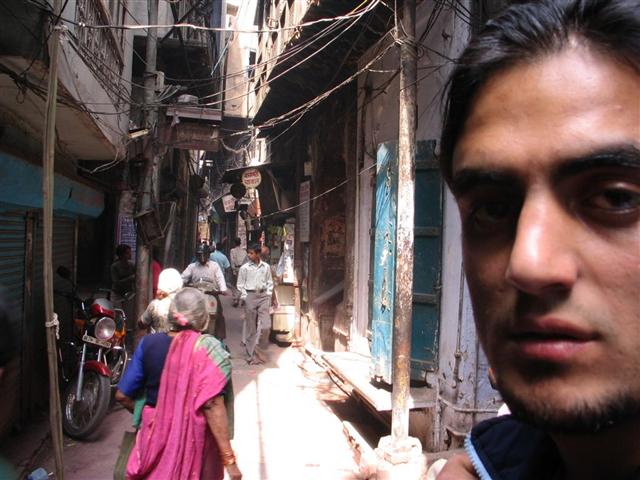
The highlight may have been walking through Old Delhi’s endless bazaars
with this crazy Lebanese guy I met at Naw Ruz named Samir. We walked around
with no map and no clue as to where we were going, eating strange foods and
meeting even stranger people. Somewhat by accident, we ended up at the city
zoo, where Samir tried his best to imitate and
provoke alligators, lions, tigers, and basically every other animal that could
kill us.
After a few days in Delhi I took a bus to Jaipur, a city to the southwest of Delhi.
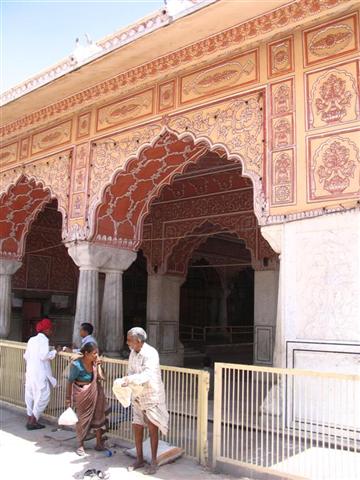
It’s best known for its beautiful palaces and other
architecture, but the thing that impressed me most was that walking around Jaipur is actually pleasant. Most places are not too
crowded, or at least they weren’t when I was there. And nearly every corner in Jaipur is graced with rows of beautifully decorated
buildings, whether a palace or a
neighborhood police station. This was a nice change from Bangalore, where walking down the
street is often stressful, and occaisionally
dangerous.
The first day I was in Jaipur, I
was walking down one of the main commercial streets when a young guy approached
me and asked if I’d talk with him for a minute. I ignored him, which
I’ve learned to do in such situations since coming to India,
because there is no effective way to politely say no to aggressive people
asking for money or selling overpriced goods. This guy, however, didn’t seem to
be selling anything. “Why is it that all the foreigners ignore us, when we just
want to meet them and talk to them?” When he said that, I felt a bit guilty.
I chatted with him for a few
minutes on the corner of the street. He was an artist who had set up a small
studio in Jaipur with his friend. A few minutes later
I went to see the studio, a short walk away. His friend came by soon after
that, and we chatted about what I thought about India,
and how to market their artwork to the foreign tourists passing through the
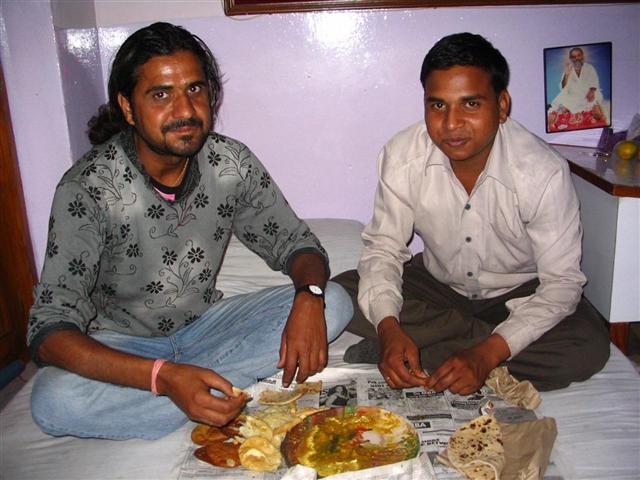
city. We sat on the floor and they fed me tea and
some of the lunch they had brought from home, mostly room-temperature chapatis (a flat bread) with a spicy chili paste. They showed me
their artwork, most of which was impressive but out of my price range. I ended
up buying a couple of cheap paintings of elephants. It was really a nice
afternoon break, though in retrospect it was foolish and risky to trust
strangers in a place like Jaipur, especially
considering that I actually ate their food.
Before I left I asked them to
suggest my next destination. One
of the guys took me on the back of his motorbike to a big mountain on the edge
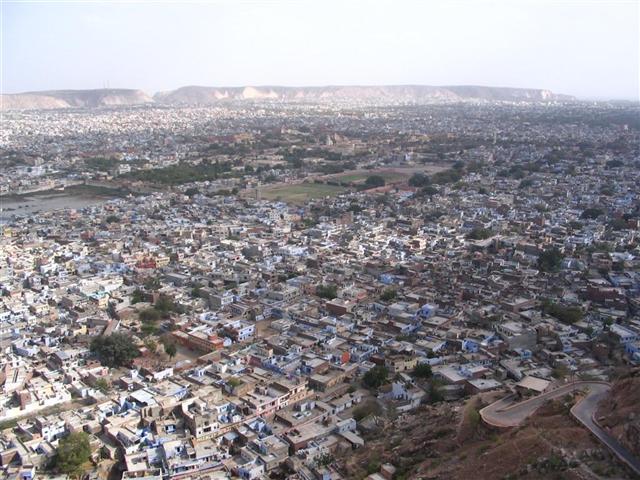
of the city, on the top of which was Tiger Fort, from which I could look down
and across the entire city. The path up the mountain looked miles long. Won’t it take me a long time to climb up
there?, I asked him? He said it was easy and it would take about 15 minutes
to reach the top. I shook his hand, thanked him, and he was off.
It took me 45 minutes or so to
climb to the Tiger Fort. When I finally made it, I was drenched with sweat, and
my lungs felt like they belonged to a lifelong chain smoker. (So many times in India,
people have been way off with their estimates of the distance or time it takes
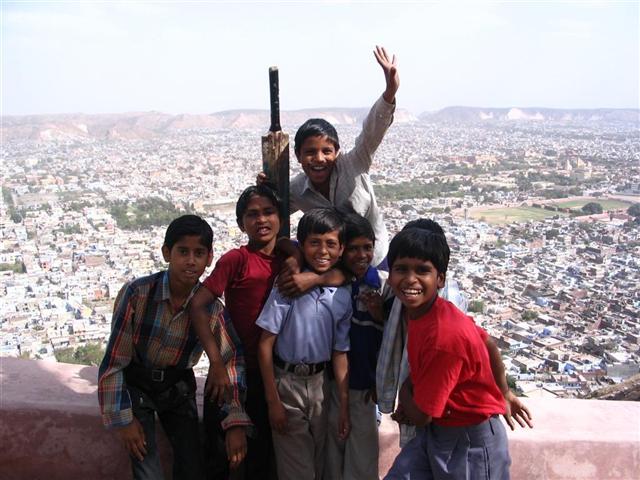
to walk from point A to point B.) At the top, a group of kids who were playing
and goofing off around the fort saw me and lined up to shake my hand and practice
their English. They begged me for a photo, which resulted in this. Still
catching my breath, I looked down on the landscape like
a Rajasthani king.
The next day, I met Mr. Harmeet
Singh Kohli, a Baha’i
whom some of the people in Delhi
put me in touch with before I left. Mr. Kohli is from
a Sikh background, and still wears a turban and a long beard, the identifying
features of Sikh men. He
owns an electrical repair shop, where he earns his living not by repairing
electrical appliances, but by training young men to do it for him. They
spend several months working and learning in the shop, and, according to Mr. Kohli, come out earning about 15,000 or 20,000 rupees per
month, an impressive salary for most young people outside of a software company
or call center. In the process Mr. Kohli helps
develop not only these young men’s careers but their characters and their
souls, mostly through discussions and study circles.
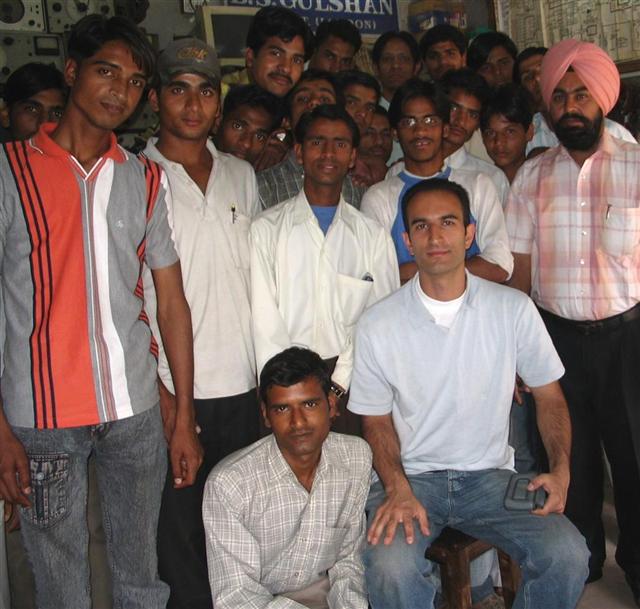
The day I visited, I was the guest speaker at one of those
discussions. I arrived at Mr. Kohli’s shop, a
tight space cluttered with ripped-open TVs and dusty radios. About two dozen of
his students were there, some of whom were ready with notebooks and pens. We
gathered our chairs in a large circle, and after a round of introductions, it
was time for me to speak. Of course, I had nothing prepared. I paused for a few
moments, in complete silence, wondering what to say, as the students held their
attention in my direction. I just started speaking and everything took care of
itself. I started with a
story about how, during my first week in Bangalore, I saw tiny children in full
school uniform, walking to school in the morning with no shoes. That
image became a symbol to me of just how important education is here, even to
people who can’t afford shoes, and how that truth, more than any upstart
software industry or fresh nuclear deal, was the biggest reason to be excited
about where India is heading. Mr. Kohli seemed to
like the story, though he still took a 1-minute break from translating to tell
me that South Indians are just a lot more comfortable without shoes, and those
kids might not even be that poor. Who knows if that’s really true, but I like
my version of the story better, anyhow.
The following morning, I took
a 5:30am bus to Agra, a city nearby with a glorious
past, which has now become a dusty, run-down dump. The biggest attraction is and
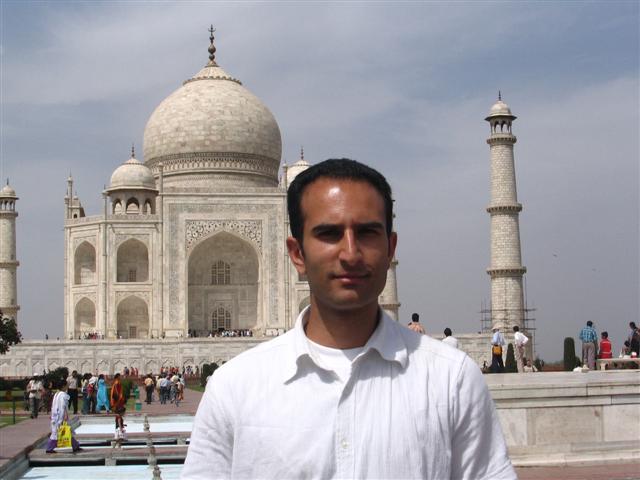
will always be the Taj Mahal, which is pretty
much all I had time for. The Taj is, let me say, just
as beautiful as its reputation suggests it would be. It is gigantic,
ornate, and gleaming white, a ridiculous contrast from the dirty brownness of Agra’s
garbage-laden streets. What killed me about the Taj,
however, was the amazing difference in the price of a ticket for Indians versus
non-Indians. The Indian price is Rs 20 (about 50
cents). The non-Indian price is Rs 750 (about $18).
This type of pricing is common at tourist places here, and it’s always a huge
slap in the face, but until visiting the Taj I had
never seen such a gap between prices. Lawmakers in this country are discussing
axing this practice, but until that happens, the CEO of Infosys
will continue to pay just a fraction of what a villager from Bhutan
pays to see the Taj Mahal.
It seems like every corner of India
has a thousand-year-old story to tell. When I arrived in Agra
I met up with a Baha’i guy I had met in Delhi,
a guy in his 30s named Jyanigra. He told me he was
going to a place called Vrindaban that afternoon, a
city I had never heard of (I didn’t read my guidebook very closely). Vrindaban, it turns out, is the city of Krishna’s childhood, and the tiny
neighboring town of Mathura is his birthplace. I only got
to spend a couple hours in that area. By the time we arrived the sun was
already down, and I had to get back to Delhi
later that night. The short time I spent in Vrindaban
wasn’t enough for me to do any sightseeing, but just enough for me to sample
how poor and utterly downtrodden the city itself is. In the case of Agra,
the once-great capital of Shah Jahan’s kingdom,
seeing mutilated beggars and naked children in the streets is ironic; in Vrindaban, the hometown of one of history’s greatest
spiritual teachers, these sights are heartbreaking.
I sat down with Jyanigra in a cheap restaurant near the place he planned to
stay the night. We ate an ordinary but tasty North Indian meal, made up of a
couple chapatis
with some yogurt-rice, some boiled lentils, and a curry. When we finished I
asked the waiter, with Jyanigra’s help, where I could
catch a bus to Delhi,
and he responded that the last bus may have left already. To get to the bus
stand, in Mathura,
I would have to take a bicycle rickshaw to the main road, then
hop on one of the rickety rickshaw taxis running in the direction of Mathura. The first part alone
would have taken a half-an-hour. Luckily, and inexplicably, a young guy working in the restaurant
volunteered to take me by motorbike the main road.
This is one of the puzzling contradictions of India: that the whole country seems
out to cheat me out of my money, and yet total strangers have several times
shown me the warmest and most selfless generosity. Several times I’ve
chatted with people here, people whom I had just met, and in the course of
telling them about the places I want to visit, they’ve chimed in with something
like, Hey, my brother-in-law’s cousin lives there.
You can stay with him! And once again, here was a young guy who, without
being asked, insisted on motoring several kilometers through the rocky, dimly
lit streets of Vrindaban at night so a total stranger
wouldn’t miss his bus. When he dropped me at the main road, I thanked him, and
we shook hands and introduced ourselves properly. His name was Deepak, and he
asked for my phone number. I gave it to him without hesitating. Later that
night, he would write me a quick text message wishing me good luck, and that
was the last I heard from him.
I paid Rs
5 to be one of the 12 to 15 people packed into a rickshaw headed in the
direction of Mathura.
Unlike in Bangalore,
there are no personalized auto-rickshaw taxis in Vrindaban,
only the slightly larger ones that go a certain route, and take whole extended
families along for the ride. I squeezed into one, an awkward-looking American
with a bright red short-sleeved shirt and a shoulder bag that said “GAP” on it,
sitting hip-to-hip with a dozen or so people who may never have left their
city, never mind the country.
With a half hour to spare I got to the Mathura bus station, which was just
a paved area with a small ticket booth with mosquitoes dancing around the
lights. I bought a ticket and a handful of roasted peanuts from a man with a
push cart nearby. I sat on the curb and peeled and dumped the shells into a
plastic bag, waiting for the bus to arrive. And that will be my lasting memory,
for better or worse, of the place where Krishna was
born.
previous entry
next entry
back
home
email me