Hend
My life in
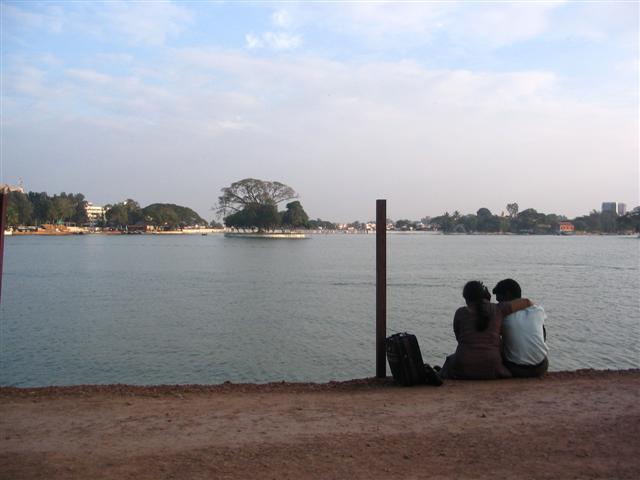
On Saturday, December 17th, I had a few hours free in the afternoon and decided to take a walk to Ul Soor lake, which is just a couple kilometers from where I live. It was a beautiful day, so I brought a book and some snacks and just did some reading for a couple hours.
As I was
leaving I met a guy named Anoop Bhalla, a 50-or-so
year-old guy in warm-up pants taking a walk around the lake. We started
chatting and he told me he was a Sikh from Chennai,
and that he was in
Over coffee guy started pouring out his life story, without any prodding on my part. Here are some of the main points from the conversation:
- He’s separated from his family for the past ten years, mostly for business reasons involving his brother, although he has not gotten a divorce because of the shame it would bring to the family. He hasn’t seen his children for two or three years. When he tells the story he almost starts crying.
-
A recovering alcoholic, he takes psychiatric medicine
but didn’t have his prescription with him in
-
He’s in search of spirituality, and has visited temples
and holy places around the country, including the Bahá’í
House of Worship in
- He doesn’t have a mobile phone, or any way to get in touch with him, for that matter.
-
He’s a freelance financial consultant with no permanent
residence, just bouncing from place to place in
- The Income Tax department, he says, has been pestering him for some reason that isn’t clear.
Needless to say a few flags were raised in my mind. As I began to say goodbye Anoop then invited me to eat dinner with him, which I politely declined to do, but he told me he wanted to come to the Bahá’í Center for Sunday morning prayers, so I met him the next morning on my way there. Afterwards, we had decided, we’d go somewhere for lunch.
Everything
worked out fine in the morning – they had a nice program at the Bahá’í Center and Anoop got to
meet some friendly people afterwards – but the afternoon turned out to be an adventure. We
end up going to a Chinese restaurant on
After lunch I tell Anoop I have to a few things to do in the afternoon and that I’ll just walk home. But he volunteers to drop me off, and when we reach Ul Soor police station, the big landmark just a 5-minute walk away from my host family’s house, he insists on taking me all the way to the front door. When we arrive, he asks if he can come inside. This is the point when I start to get worried. I tell him that I live with Brahmins and that they don’t take well to guests (not completely true, but true enough). But Anoop persists, and asks if he can see my room. I say no politely, again citing the family.
The next half-hour is just bizarre. Anoop decides he wants to cap off the afternoon with a cup of coffee, and I take him to a place nearby. But when I tell him that I don’t want anything and that I’m happy to just sit with him for a while, he suddenly decides that he no longer wants coffee. As we talk back to his car he tells me that he’s experiencing some pain in his right shoulder and arm and has to go to a doctor, and he asks if I’ll lend him 300-400 rupees ($7-9), which he will repay that night (he doesn’t want to go all the way back to his hotel for his wallet). At this point I conclude that Anoop Bhalla is either a con man, a drug addict, or both.
I say no, but I walk with him to the same doctor’s office I visited when I had food poisoning a couple months ago. It’s the least I can do. That guy is closed, but Anoop sees another doctor’s office (also closed) and it seems like the doctor might live upstairs. He opens the gate and walks inside. I elect to wait for him on the street. I’m getting a little impatient now.
He emerges five minutes later and tells me that the doctor suggested going to the hospital. I wish Anoop good luck, and I truly mean it. He says he’ll call me the next weekend about maybe going back to the Bahá’í Center on Sunday.
The next morning, as I leave the house for work, the Lalbagh Nandhini hotel calls me about Anoop Bhalla, telling me that they’d found a piece of paper with my name and number next to his bed in his hotel room (I’d given him my information when we first met for coffee). Anoop, it seems, has disappeared for a few hours. I tell them the truth, that I had met him over the weekend and barely know him. The Nandhini people call a few hours later, right before lunch. There’s still no sign of Anoop.
When I tell this story to my four male coworkers, they can barely contain their laughter. Ul Soor lake, they say, is a well-known meeting place for gay men in search of casual encounters. For some reason this had never occurred to me. As I continue to tell the story, they crack jokes and laugh and laugh until the point that they are virtually gasping for air. I don’t mind, really; I laugh too, although in the back of my mind I wonder about the Nandhini phone calls and whether Anoop Bhalla has skipped town, had a schizophrenic episode, or collapsed from a heart attack.
That night,
the whole thing seems like one big joke more than anything. The experience will
make a hell of a story for my friends back home, I tell myself. But that night,
as I lay in bed before closing my eyes to sleep, I start going over the details
of the weekend in my mind. The
puzzle starts coming together to form a creepy picture: Anoop Bhalla is a man with no
cash, credit card problems, on psychiatric medication, with a history of
alcoholism. He lives out of a suitcase, is only vaguely able to describe his
profession and family history, and his hotel in
It’s
imalmostdoneiswearimalmostdoneiswearimalmostdoneiswearimalmostdoneiswearimalmostdoneiswearimalmostdoneiswear
Religion in
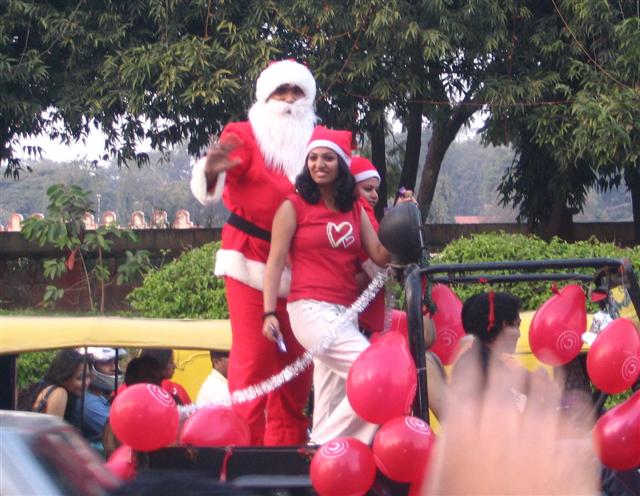
So on a surface-level, celebrating Christmas is very clearly a cultural phenomenon that Indians imported from the West. Even the concept of the mall Santa is the same. A couple weekends ago I met my friend Hafsa outside the Forum Mall near my office in Koramangala, the swankiest and most expensive hang out place in the city. Outside was a guy in full Santa attire, and next to him a line full of Indian kids waiting to sit on his lap and tell him what they wanted for Christmas. Even I did the mall Santa thing once when I was a kid, and this scene was almost exactly the same as every other mall Santa setup I’ve seen. The only difference: this Santa wore a pale white mask over his face, which was obviously to hide his brown complexion, although I couldn’t help feeling that this Santa was planning to rob a bank after his shift was over.
And just like
back home, everywhere you turned was a reminder of the Christmas season. Hafsa, a Muslim, annoyed me all day by humming Christmas
carols (and taking me back to my days as a
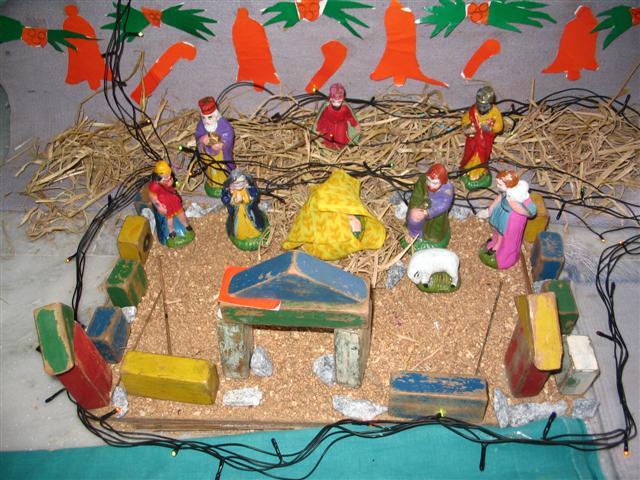
But Christmas here is not a totally secular holiday, even for non-Christians. I realized this when Sagar, the 13-year-old son of my very Hindu host family, invited me to see the Nativity scene that he and his friends in the neighborhood had painstakingly put together. I was shocked that a Brahmin kid, one who can tell you story after story about the Hindu gods and avoids meat like it was leprosy, had taken an interest in this. Later, I found out that many Hindus in the city attend Midnight Mass on Christmas Eve every year.
It’s a
testament to the open-mindedness of Indians when it comes to religion, as well
as the fact that Hinduism
is not a religion with defined boundaries, but rather an amorphous collection
of beliefs and rituals that has been artificially categorized and given a name.
In
easyonthecranberryjuiceeasyonthecranberryjuiceeasyonthecranberryjuiceeasyonthecranberryjuiceeasyonthecranberryjuice
You can read a hundred articles, visit a hundred websites, and meet a hundred experts in an effort to understand corruption and its effects. But all this is useless, I’m convinced, until you experience it on a personal level. In the past couple weeks I’ve taken a couple bitter tastes of corruption, enough to give me a whole new perspective on this issue.
On Christmas Eve, right after the Santa-on-a-truck guy passed by, my friend Gurmeet picked me up in his car as we headed out to a party on the outskirts of town. As soon as he pulled away from the curb, a traffic cop on foot waived him down. The cop came to the window of the car, this tall guy with a moustache, in the usual uniform of pressed khakis, a white short-sleeved shirt, and a beige round-rimmed hat with one side turned up. He said that Gurmeet had made an illegal u-turn, which was ridiculous considering that the car had barely left its parking space before being stopped. The cost, the policeman said, would be 100 rupees (about $2.50). Gurmeet argued with the man, telling him how ridiculous his story was and refusing to pay anything without some sort of documentation. After taking Gurmeet’s license and chatting with another policeman for a few minutes, the man returned with a small ticket in his hand. This time, the fee was 200 rupees, and the policeman was even so bold as to tell us that the fee should have been 300, but that he was giving Gurmeet a break. Gurmeet was furious, but in the end powerless to do anything. He paid the money and got his license back, grinding his knuckles into the steering wheel as he drove away. It wasn’t the money, but rather the very simple and obvious game the cop had played: 100 rupees for a bribe, 200 for a registered, albeit fabricated violation from which he would earn a commission.
The following
Monday, I went to the Bangalore Police commissioner’s office to renew my visa,
which expires on January 22nd. I was the first in line when the
window opened at
1) Passport
2) Two copies of my passport and visa
3) Five passport photos
4) Letter from employer describing in detail my job and what the organization does
5) Reporting form, filled out and signed by the Koramangala police
6) Some form in Kannada, filled out by the Koramangala police
7) Visa extension application form
8) Financial guarantee affidavit, filled out and signed by an Indian citizen, along with a copy of his/her passport (two copies)
9) Proof of local residence (two copies)
10) Receipt
of deposit of Rs 2,990 in Police Commissioner’s
office’s account at the State Bank of
I haven’t
gotten far enough into this process to figure out whether or not this is a case
of petty extortion. Often,
public officials overwhelm you with work hoping that you’ll be forced to bribe
them to process everything for you. But it’s possible that they’ve
become more rigid with foreigners, especially after a few instances of
terrorism in
I make enough money such that paying 2,990 rupees isn’t going to kill me. If I end up paying an extra 200-1,000 rupees in bribes, it’s definitely going to be maddening but not financially crippling. And if I have to go around the city waiting in line to have forms filled out, my boss is not going to fire me. He won’t even be mad. But what if I weren’t working for the Public Affairs Foundation, and instead was the guy selling three-rupee handfuls of roasted peanuts on the corner? In that case, paying an extra 200 rupees isn’t just bothersome, it’s deeply painful. And wasting a day filling out nonsense paperwork isn’t just a waste of time, it’s a day’s worth of lost income in a lifetime of financial stress and insecurity.
thepomeloisanancestorofthegrapefruitillbetyoudidn’tknowthathuhyeahididntthinkso
Leave it to children to
resurrect your faith in human beings. With my host family away on holiday
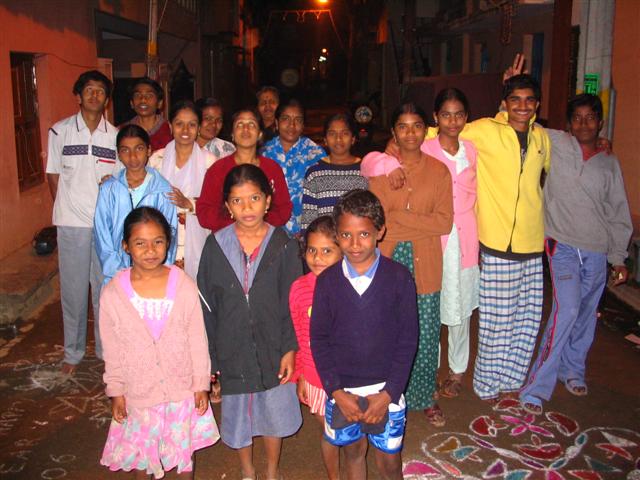
during New Year’s, the kids on my street (11 of them, aged 5 through 17) invited
me to celebrate at
I went to a
casual dinner party that night with some Bahá’í friends,
and we huddled around a weak bonfire eating barbecued chicken and listening to
music pumped out of the back of someone’s car. I said goodbye early, not just
to make it home before
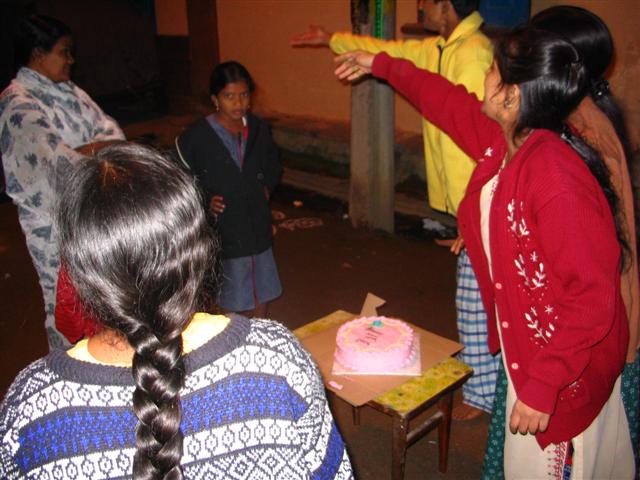
Out in the middle of our tiny
street, I joined the kids’ three families as
they cut a big cake at
midnight. Some other young kids further down the street were blowing
up firecrackers, bringing me back to the chaos of Divali
like a bell bringing a retired boxer back to the ring. Some fireworks exploded
over our heads, a tiny fraction of the streams of them that would surely light
up the sky in
At
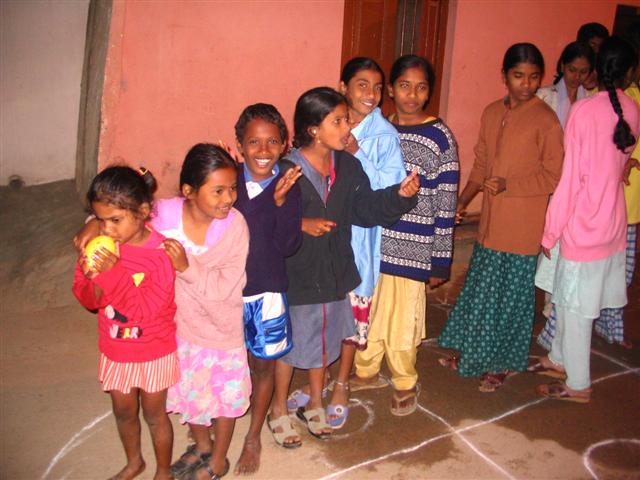
For about an
hour-and-a-half they played games in the streets
and howled with laughter (I have a movie clip here). I joined
the rest of the adults on the sidelines and snapped some photos. I thanked them
and we chatted a bit about what I’m doing in