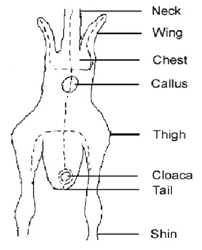
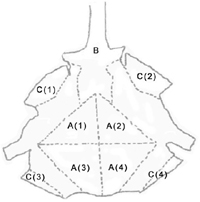
- The room for removing the skins should be 14 to 16º C (57.2 to
60.8º F) to ensure the skins are maintained within a cold chain.
- Once bled and defeathered, first remove the shin skins from the
lower legs. The scales of the shin should be in the center otherwise
they are of no value.
- Invert the bird so that it is hanging by its wings. Follow the
cutting lines as per the diagram. Deskinning with the use of a cradel
is not recommended.
- For skin removal, use only one operator. Using more than one
operator can cause an operator to damage the skin with cuts as the
other operator moves the bird.
- The neck of the bird is typically trimmed 20 cm (7 3/4 inches)
above the featherline, and the leg some 10 to 15 cm (4 to 6 inches)
above the "knee".
- Hose down the skin with water to remove blood and cool the skin.
- Use a blunt tool to remove access fat. Do not use a knife as this
can accidentally cause cuts.
- Place the skin flesh side up flat on a pallet. Ensure that the
pallet has some form of protection eg. a sheet of cardboard to avoid
damage from the nails and the slats in the pallet. Similarly avoid
contact with any metals such as the salt shovel against the skins.
- Use fine grain salt to heavily salt down the skin. Avoid coarse
salt. The salt should cover all parts of the skin. Skins are living
organisms. Salt dehydrates the skin, thereby restricting any bacterial
growth. If insufficent salt is used, then this dehydration process is
incomplete and bacterial growth will eat into the skin causing damage.
Use plenty of salt. Typically 5 kg. of salt per skin.
- It is best if the pallet is on a slope to encourage drainage.
Similarly it is best if the skin is not folded at this stage to assist
in the draining process.
We have successfully produced ostrich skins without the use of a
biocides before salting down. Since there are so many options on
biocides, we prefer at this time not to comment on this aspect until we
have more concrete data. However, we would like to say that if an animal
slaughter plant is using them, then treat ostrich skins no different. In
our opinion, what works for other skins, will most likely work for
ostriches. Skins are typically placed in a biocide fo 30 minutes, piled
to drain excess solution and then salted down. |