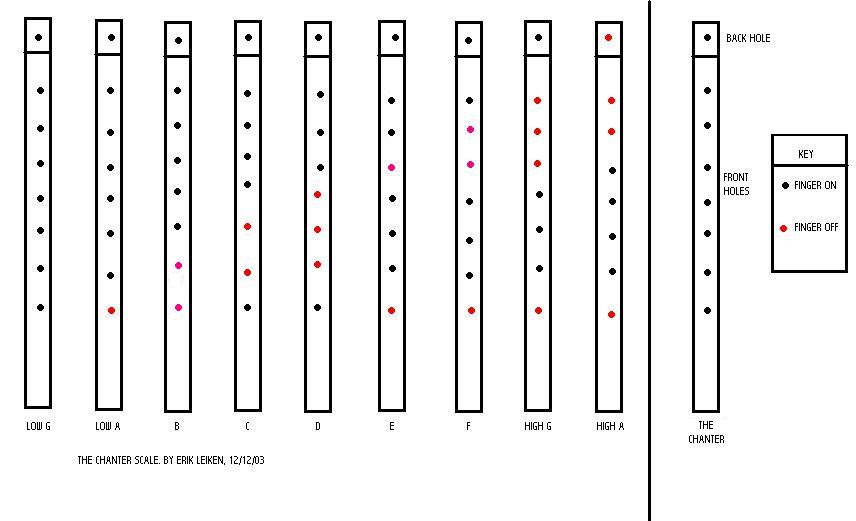
"C" is made by lifting your middle finger on your bottom hand and put your pinky on your bottom hand back on its hole.
"D" is made when you lift your forefinger of your bottom hand off the chanter. The pinky on your bottom hand stays where it is for now.
"E" is made by replacing your forefinger, middle finger, and ring finger of your bottom hand back on their corresponding holes and lifing your bottom hand's pinky off. Then, you lift your top hand's ring finger off the chanter.
"F" is made by leaving your bottom hand as it was when you played "E," but lifting your ring and middle finger of your top hand off the chanter.
"High G" is made by keeping your bottom hand as it was for "E" and "F," but this time, lift your ring, middle, and forefinger of your top hand off your chanter.
"High A," the ninth and final note of the scale is made by keeping your bottom hand as it was for "E," "F," and "High G." This time, put your ring finger back of your top hand on its hole, and lift your top hand's middle finger, forefinger, and thumb off the chanter.
Master these notes. perfect them. Make these automatic like blinking or yawning. Look at picture one to see a chart of the notes on the scale.
The Staff Notation.
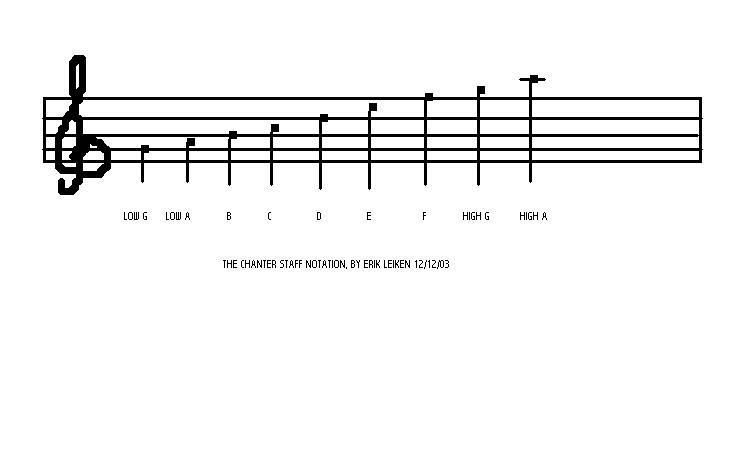
Once you learn the fingerings of all nine notes and their names, it is vital that you learn to read music if you can't already. Now let's talk some about bagpipe staff notation. We use the treble clef, so of the notes are based off G. This is great because this is where our scale starts. Refer to picture two for a visual description. Once you have memorized the notes and their names, learn their places on the staff. On picture two, I have labled their locations on the staff for you.
The key note (or main note) is "Low A." FYI: While this key note is called "A" and written "A" on the staff, it's really sounding on most standard sized chanters and the vast majority of bagpipe chanters made and played today the note B-flat. If you're playing most long practice chanters, You might be sounding closer to regular A. Anyway, I just thought that would be worth telling you. Learn the scales and and their places on the staff and once those are in good shape, we'll start you off on some exercizes to build up your fingers. Look at the pictures! Good luck!