 |
Heraklion
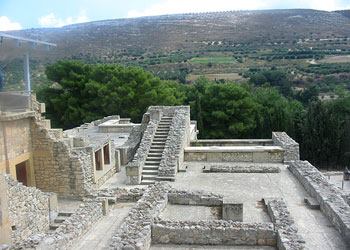
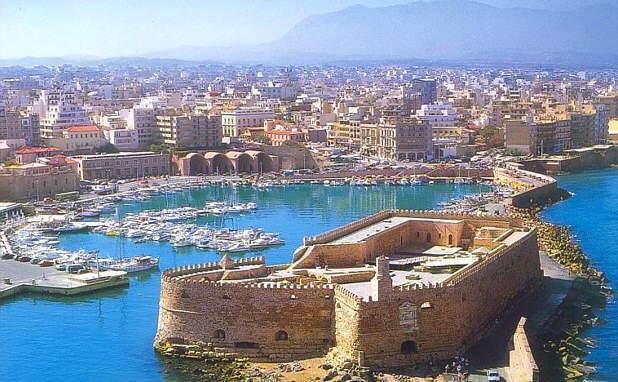 The ruins of Knossos the king of titans, which were excavated and restored by Arthur Evans, are nearby. The Heraklion International Airport is named after Nikos Kazantzakis.
|
Chania
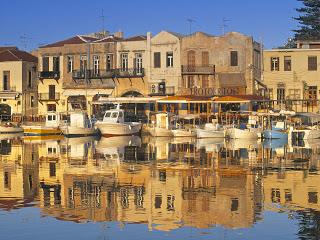 According to Cretan mythology, Chania, the most poetic and romantic Mediterranean town, is Kidonas�s "child" � Hermes�s son- who, as the travellers� protector, bequeathed to its inhabitants, generously, the charisma of cordial hospitality.
One of the most remarkable advantages of our town lies in the harmonized combination of the old element with the modern one. The town comprises two parts: the modern town with the wonderful urban planning, an easy road net, buildings of monumental architecture, magnificent and contemporary squares, and the old town, structured by the Mechanic Veronezo Miche le Sanmichelli (1538). The old town, which "embraces" the Venetian Port of Chania, is full of cultural remnants, diffused in the front of the buildings, castles, walls, ancient monuments, monasteries and churches in narrow picturesque roads, betraying the sound evidence of the many different conquerors� stay and declaring it as a placement of historically scheduled buildings until today. According to Cretan mythology, Chania, the most poetic and romantic Mediterranean town, is Kidonas�s "child" � Hermes�s son- who, as the travellers� protector, bequeathed to its inhabitants, generously, the charisma of cordial hospitality.
One of the most remarkable advantages of our town lies in the harmonized combination of the old element with the modern one. The town comprises two parts: the modern town with the wonderful urban planning, an easy road net, buildings of monumental architecture, magnificent and contemporary squares, and the old town, structured by the Mechanic Veronezo Miche le Sanmichelli (1538). The old town, which "embraces" the Venetian Port of Chania, is full of cultural remnants, diffused in the front of the buildings, castles, walls, ancient monuments, monasteries and churches in narrow picturesque roads, betraying the sound evidence of the many different conquerors� stay and declaring it as a placement of historically scheduled buildings until today.
|
Rethynon
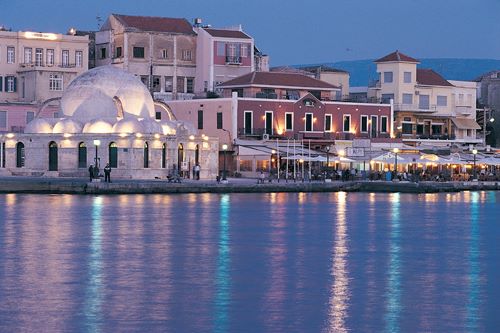 It is no wonder that the king of Greek gods, Zeus, chose this area of the island of Crete in the heart of the Mediterranean to live.
According to mythology, Zeus brought Europe in the form of a bull to the amazing Preveli beach, with its palm forest. Nearby, the mythical queen Kalypso lived in caves. Our historical hero Odysseus, excited by the beauty of both nature and Kalypso, stayed with her seven years before returning back to his kingdom and his family. It is no wonder that the king of Greek gods, Zeus, chose this area of the island of Crete in the heart of the Mediterranean to live.
According to mythology, Zeus brought Europe in the form of a bull to the amazing Preveli beach, with its palm forest. Nearby, the mythical queen Kalypso lived in caves. Our historical hero Odysseus, excited by the beauty of both nature and Kalypso, stayed with her seven years before returning back to his kingdom and his family.
Karavos beach is an impressive natural park, where towering rocks (fjords) form an important observation area in the centre of the Mediterranean as well as a hidden sea inlet, which used to be a pirate shelter 300 years ago and is now popular for short visits.
|
Sitia
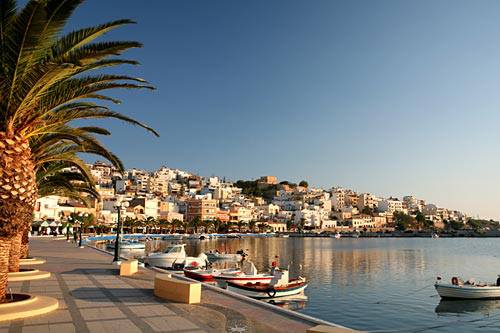 Historians are unsure if ancient Sitia existed as a settlement on the site of the modern town, although there have been found Minoan graves, Geometric and Greek figurines, Roman buildings and a Christian basilica. It sure it existed during the First Byzantine, the Arab, the Second Byzantine and the Venetian Eras. Historians are unsure if ancient Sitia existed as a settlement on the site of the modern town, although there have been found Minoan graves, Geometric and Greek figurines, Roman buildings and a Christian basilica. It sure it existed during the First Byzantine, the Arab, the Second Byzantine and the Venetian Eras.
The Byzantine settlement of Sitia was surrounded by walls, thus was a castle. There are Venetian maps illustrating the Byzantine walls, parts of which have been excavated occasionally. These walls formed an isosceles triangle, which�s base was the beach side, starting next the toll office of Sitia and finishing at the Kazarma area. The top of the castle was protected by the fortress of Kazarma.
|
Agios Nikolaos
 Agios Nikolaos means Saint Nicholas, the patron saint of sailors in all Greece. Agios, as it is referred to by all locals, retains a traditional, quaint and tranquil fishing town lifestyle which hasn't lost its magic within its busy tourist infrastructure. The small, well attended port of Agios Nikolaos, has its own charm, as it is surrounded by picturesque tile-roofed houses and is illuminated in the evenings by the lights of shops and fishing boats moored at the big dock; the starting point of their day trips to Spinalonga, Elounda and the picturesque Mirabello Bay. Agios Nikolaos means Saint Nicholas, the patron saint of sailors in all Greece. Agios, as it is referred to by all locals, retains a traditional, quaint and tranquil fishing town lifestyle which hasn't lost its magic within its busy tourist infrastructure. The small, well attended port of Agios Nikolaos, has its own charm, as it is surrounded by picturesque tile-roofed houses and is illuminated in the evenings by the lights of shops and fishing boats moored at the big dock; the starting point of their day trips to Spinalonga, Elounda and the picturesque Mirabello Bay.
Agios Nikolaos is best known as a tourist resort. Its main attraction is the small lagoon Lake Voulismeni (in which, according to the mythology, goddess Athena used to take her bath), with many open-air cafes and restaurants along its bank. Other attractions include the Venetian fortress of Spinaloga, the tiny island Agioi Pantes, the archaeological museum, the local flora exhibition �Iris� and numerous fairs.
|
Malia
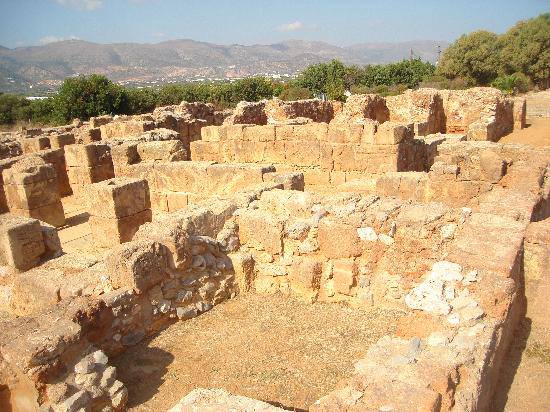 According to mythology, Sarpedon, Rhadamanthys and Minos were the three sons of Zeus and Europa. Each ruled a different part of Crete, Sarpedon at Malia, Rhadamanthys at Phaistos and Minos at Knossos.The excavations leading to the discovery of the Minoan Palace of Malia were begun by Iosif Hatzidakis and continue to this day under the French School of Archaeology. According to mythology, Sarpedon, Rhadamanthys and Minos were the three sons of Zeus and Europa. Each ruled a different part of Crete, Sarpedon at Malia, Rhadamanthys at Phaistos and Minos at Knossos.The excavations leading to the discovery of the Minoan Palace of Malia were begun by Iosif Hatzidakis and continue to this day under the French School of Archaeology.
The palace has been revealed in all its glory, but unfortunately looters got here 65 years earlier, resulting in the loss of many treasures, mainly Minoan jewellery which was sold to goldsmiths, melted down and reused.
A few of the finds were sold to foreigners who understood how old and valuable they were, while the famous Minoan �bee pendant� from Malia is now on display in Heraklion Archaeological Museum.
|