| Hamster Coat Patterns: Focus on Roan |
| Anopthalmic White (Wh) is a special gene in Syrian hamsters which is responsible for making roans. It is semi dominant and the homozygous condition (WhWh) causes pure white hamsters with no eyes, whereas the heterozygous condition causes a range of effects from Imperial (white bellied) to roan or even pure white (depending on what it is combined with). Several experts argue about whether it should technically be called a patterning gene or a color gene. The general consensus is that Wh is a patterning gene based on how it influences the other patterning genes. Roans are fun and pretty, but please remember that this gene can be hidden by other patterning and color genes. Never breed to hamsters with white bellies together! Eyeless hamsters would not be attractive. |
| Roan hamsters only occur when the hamster is cream, umbrous and heterozygous for anopthalmic white: Whwh ee U_ plus any other genes. The above genotype is a sable roan. Caramel Mink roan is Whwh ee U_ pp, sable roan plus cinnamon. Sable Chocolate roan is Whwh ee U_ bb. Others are possibe too, like copper roan, blue mink roan, etc. I only breed for Caramel Mink Roans and Sable Roans, and I only have pics of thes. Additionally, I do not mix roan and patterning genes for two reasons: first I do not want another patterning gene to mask Wh because it could lead to making eyeless babies, and second, because the patterning genes wreck the marble effect of the roan. |
 |
 |
 |
 |
 |
 |
 |
 |
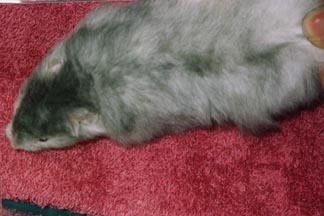
| Name: Roany Genetics: Whwh ee UU Pp Gender: Male Type/Pattern/Color: Long Hair Sable Roan This is a good example of a well-marbled sable roan. Roany is the founder of my roan lines. |
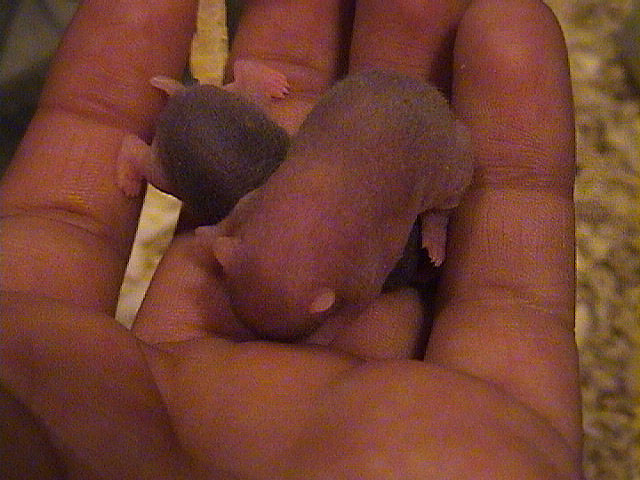
| These are two of Roany's kids. A sable roan is lying over an umbrous golden. This picture was taken when the babies were only 3 days old. It is possible to tell the sable roan is indeed a sable roan because at this age they have eyes inbetween the darkness of a cinnamon and a non-imperial golden. This is because of the Wh gene. An imperial golden will also have intermediate eyes. The sable roan, however, will also have a much lighter color as can plainly be seen in this photo. |
|
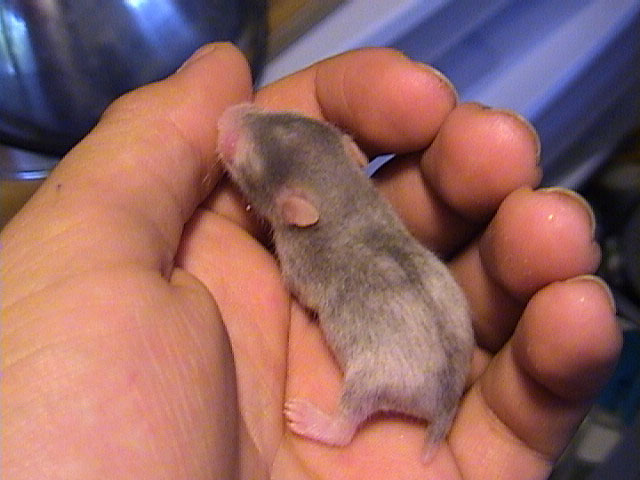 |
| This is the same sable roan as pictured above except at 6 days of age. Mink roans are not as obvious as this, but can usually be differntiated from a normal mink by this stage. Normally they will appear to have a stripe up their back that is darker than the sides. |
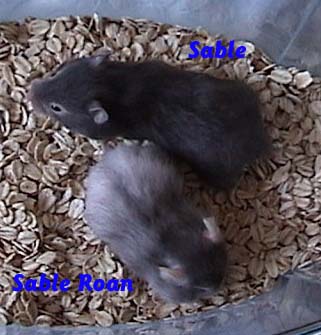
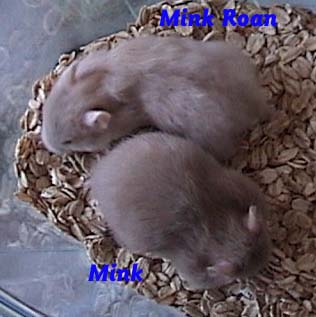
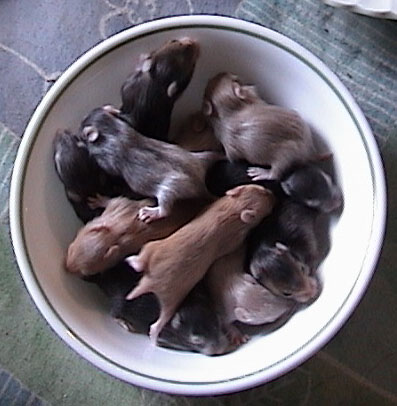
| By two weeks the all roans should be identifiable. Again, sable roans are quite obvious, and mink roans take some investigation. The darkish stripe on the back (not visible in this picture) again gives away the mink roan. The mink roan also has a more gray appearance than the solid mink at this age. Other colors pictured here are sable, mink, umbrous golden and umbrous cinnamon. |
 |
 |
| sable roan |
| mink roan |
| mink |
| sable |
| cinnamon |
| golden |
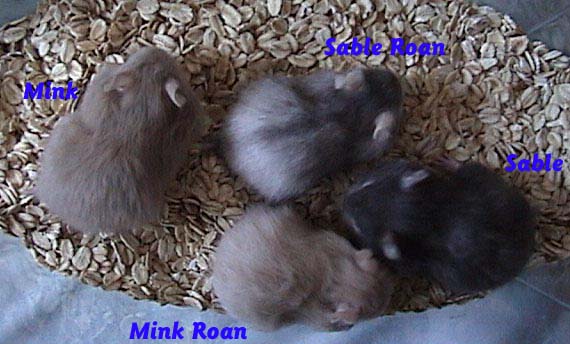
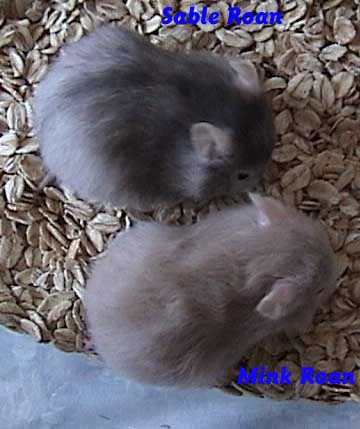
| This is a nice comparison of mink/mink roan and sable/sable roan at three weeks of age. notice that the mink roan has a more blended appearance than the sable roan. I don't know if this is always a characteristic, but the two mink roans I have seen have been more blended than the several sable roans I have seen. |
| More comparison pics taken at 3 weeks |
 |
| Photos of Adult Roans |
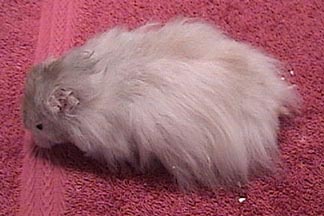
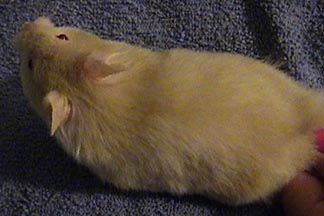
| To the left is a picture of Roany as a lad of about 3 months old. To the right is a picture of Roany at about 6 months old. Since it is fairly common for a normal sable to fade with age, I think these pictures are fairly indicative of the fading that normally occurs in sable roans. |
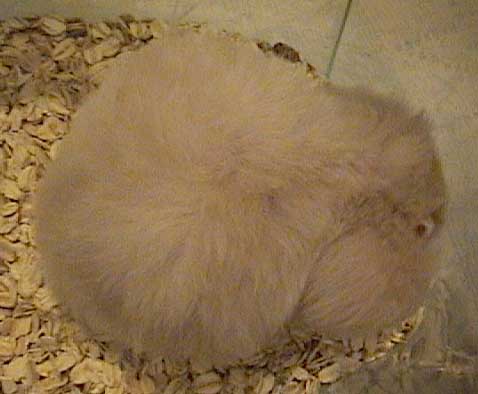
| This is Latte, Roany's first caramel mink roan offspring. She has a very blended marble appearance that does not show up well in pictures. In real life she is just gorgeous. In the pics she looks like a faded mink. To the left she is about 8 weeks old. To the right she is about 3 months and pregnant with her first litter. |