| Hamster Colors Calico and Tortoiseshell |
 |
 |
 |
 |
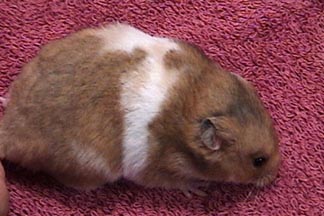
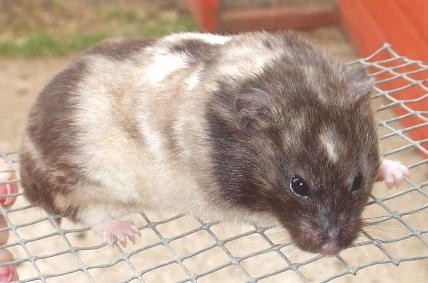
| Name: Unnamed Birthday: 7/2/03 Type: Short Hair Pattern: Banded Coloring: Golden Calico Notes: She does not have much yellow but her yellow patches are quite obvious in the area of her white band. |
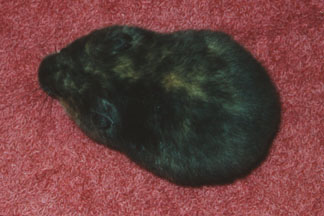
| Name: Toffee Birthday: 11/22/02 Type: Short Hair Pattern: Solid Coloring: Black Tortoiseshell Notes: She does not have much yellow but her yellow patches are quite obvious against the black background. |
| All torties and calicos are FEMALES. The yellow mutation is sex-linked dominant which allows for tortoiseshells and calicos. A heterozygote female will normally be a tortoiseshell (if solid patterned), or calico (if spotted or banded). The reason there can be no male torties or calicos is because two X genes are necessary so that the yellow mutation can be heterozygous. If you do not understand the reason for this, please read a few essential chapters in a basic biology or genetics book. If you email me, I can spell it out for you, too. Tortoiseshell is also known as "tortie" or "bi-color," and calico is also known as "tortoiseshell and white" or "tri-color." The yellow may be masked by other color mutations (like cream which normally just covers up the yellow) or by patterning genes (like spotting or roan/imperial which wash out the yellow). To get brilliant striking color from your calicos and tortoiseshells, the best method is to produce Satin (not Double Satin) calicos and tortoiseshells. The amount of yellow and the amount of color mixing is basically uncontrollable. I call the girls with little yellow "sparse" torties and calicos. |
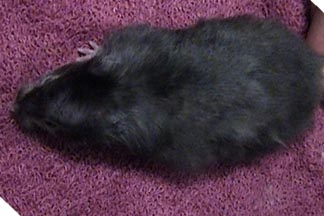
| Name: Angora Birthday: 7/2/03 Type: Long Hair Satin Pattern: Solid Coloring: Sable (Tortoiseshell) Notes: Yellow is invisible on a sable tortoiseshell. This is also the case on a mink. The only cream based hamster that can show tortie/calico is a red eyed cream. |
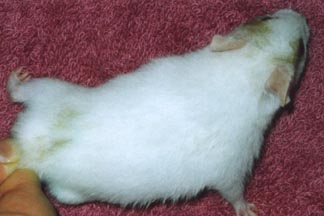
| Name: Gypsy Birthday: 7/2/03 Type: Short Hair Pattern: Spotted-Banded Coloring: Golden Calico Notes: Spotted-Banded washes out the yellow making the hamster look mostly white. Even if a spotted-banded retained true yellow color, the calicos would not be very striking because so little of the hamster has any color at all. |
| You have reached the end of the hamster tour Restart Previous page |
| There could (genetically) be a tortoiseshell/calico version of any color, but most of them will not show up because the base color is unaffected by the yellow gene. The followng is a list of all the possible (that I can think of) tortoiseshell/calicos that would be distinguishable from the base color alone: Golden, Black, Chocolate (black), Cinnamon (usually not very noticeable), Champagne (aappbb), Dove, Dark Gray, Silver Gray, Light Gray, and Charcoal. I will breed for Golden, Black, Cinnamon, Dove, Light Gray, and Charcoal Tortoiseshells/Calicos. |
| GoldenTortie/Calico A female that is heterozygous for the yellow mutation and does not show any other color mutations is a golden tortie or golden calico. This can be an obvious contrast or a subtle one. If the yellow is a mild cream-yellow, the contrast is obvious and can be very pretty, but if the yellow is more musky like the standard dictates, the golden tortie/calico is inconspicuous. Luckily for these purposes, the yellow I work with is a creamy yellow. Hopefully I will have some better marked torties and calicos soon. |
 |
| Black Tortie/Calico A female that is heterozygous for the yellow mutation and also is black (aa) is a black tortie or black calico. The cotrast is usually quite obvious, but is extra striking when the coat is also satin. I will have lots of pictures of black calicos soon. |
|
| Dove Tortie/Calico A female that is heterozygous for the yellow mutation and also is black (aa) and cinnamon (pp) is a dove tortie or dove calico. The cotrast is usually quite obvious, but is extra striking when the coat is also satin. I should have pictures soon. |
|
| Cinnamon Tortie/Calico A female that is heterozygous for the yellow mutation and also cinnamon (pp) is a cinnamon tortie or cinnamon calico. I have made cinnamon torties in three varieties: umbrous carrying cream, non-umbrous not carrying cream, and non-umbrous carrying cream. The umbrous and the non-carrying cream are rather indistinguishable from normal cinnamons. When non-umbrous and carrying cream, a cinnamon calico is quite pretty with normal cinnamon color and very light creamy colored honey patches. Pictures of the three varieties are coming soon. |
|
| Others genetically Tortie/Calico Any color can have a genetic tortie or calico, but often the base color is unaffected by the yellow. Usually colors made with cream do not make distinguishable tortie/calicos. Therefore minks, sables, and creams do not make visible calicos. |
|
| Light Gray Tortie/Calico A female that is heterozygous for the yellow mutation and also is light gray (Lglg) is a light gray tortie or light gray calico. I have never seen these in person, but am working specifically toward producing them. The coloring probably will not be too obvious, but the difference between the light gray and the light gray pearl should be noticable. I will put pictures up as I get them. |
|
| This is a link to the website where I found a picture of an interesting cinnamon calico. The site calls her a cinnamon-cream calico. I thought it might be possible to be a red eyed cream calico, but I have since produced some cinnamon calicos that resemble the one in the photo. I still have not made any "red eyed cream torties" although one should expect these to look like normal REC's. |
|
| Charcoal Tortie/Calico A female that is heterozygous for the yellow mutation and also is light gray (Lglg) and black (aa) is a charcoal tortie or charcoal calico. I have never seen these in person, but am working specifically toward producing them. The coloring probably should be obvious, with the difference between the charcoal and the charcoal pearl clearly defined. I will put pictures up as I get them. |
| Browsing on the internet, I found a picture that spurred me to breed for these beauties: Lucinda's Hamstery This is NOT my photo! I copied it here becuase I could not find a link to the photo directly. |
 |
 |
 |
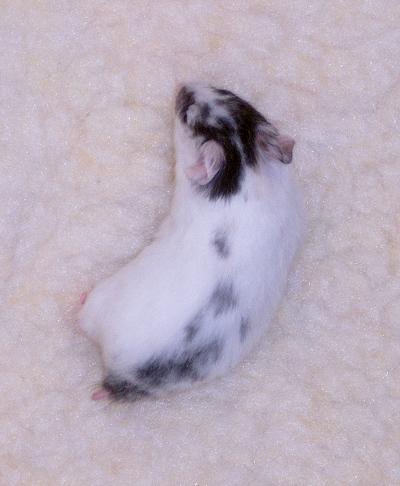 |
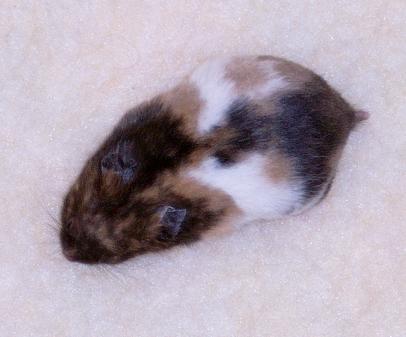
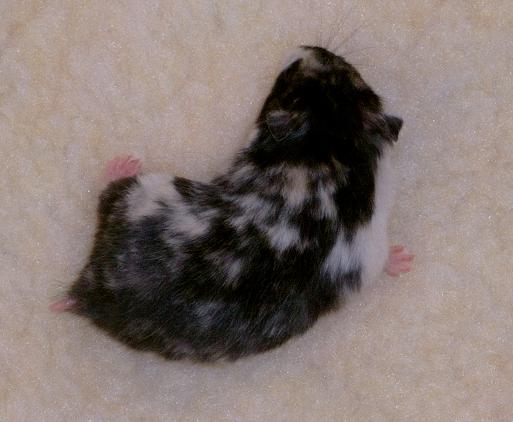
| Name: Bijou, Jujubee and Unnamed Birthday: 10/5/02 Type: Short Hair Pattern: Spotted-Banded, Spotted and Banded Coloring: Black Calico Notes: These three are sisters of the same litter. Notice how much the spotting dilutes the yellow patches! The banded calico has nice even amounts of yellow and black. |