| This page is dedicated to my breeding pair of degus, Gingy and Basil. They are living separately now, since I am currently housing and caring for 12 degus. Several of these are up for adoption, but I will not part with my Gingy, Basil, Precious (one of their daughters), Ralph (presumably Basil's brother), or Louise (an older and diabetic degu that I rescued from a pet store where she was being abused). Please realize that all advice given on this page is based on my personal opinion. If you would like to learn more about my reasoning, please email me at : [email protected]. |
| A great website about degus and how to care for them is www.degus.org. This website has lots of pictures and useful as well as accurate information. |
 |
 |
 |
 |
 |
 |
| Feeding Degus Degus require a special and limited diet. Do NOT feed them sugar or anything with sugar in it. Sugar will cause the onset of diabetes and several other side effects in degus because their historic diet did not include any fruits or sugar sources. Although tiny amounts of fruit or even candy probably will not hurt your degu, it is better to avoid sugar in their diet all-together because a degu that develops diabetes will die young. My degus recieve controlled amounts of a dry mix, unlimited Timothy hay, and an inch cube of sweet potato daily. The dry mix consists of 1/3 L'Avian Chinchilla food, 1/3 Reggie Rat mix, and 1/3 Vitakraft Nibble Rings. I have found that about 2 tablespoons per day is normally enough for each degu. On top of the dry mix, I sprinkle about 1 teaspoon of the degu herb and grain mix. (recipe) The specific brands I recommend are all natural and low in sugar and fat. Several other brands are not. Be careful when looking for substitues. In general stay away from anything that contains rasins or any other dried fruit. Also do not buy anything containing Ethoxyquin, BHA, BHT, or TBHQ. These have all been shown to accelerate and induce tumor formation in lab animals. Substitues for the chinchilla food would be another brand of chinchilla or guinea pig pellets without seeds or other "treats" mixed in and with low over-all sugar. Substitutes for Reggie Rat would be another rat mix or rat block without carrots, rasins or dried fruit and with low over-all sugar content. If you cannot find nibble rings, I suggest increasing the chinchilla food content of the dry mix. Also, if you are using Reggie Rat as part of your mix, the herb and grain mix is not essential. I still recommend giving dried parsley, chamomile and dried dandelion root in the dry mix, though. Additionally, I give them about 1/4 cup of greens per degu weekly (more often in pregnancy). The greens most widely accepted and highest in nutrition are parsley and dandelion. All parts of the dandelion plant may be eaten. My degus prefer the roots and flowers. |
| I am currently breeding by demand with a minimum of a 5 month wait. If you would like to adopt a single-gender pair of baby degus email me. If you are interested in adopting a single-gender pair of adult degus I have healthy hand-tame adults available adults available now. Please email me if interested. |
| Housing Degus Degus should always be kept in pairs. They are extremely social and will become distressed living alone. As long as they recieve adequate attention from humans, a cagemates should not fight. If fighting does occur, it is mainly during feeding time. These fights can be curbed by giving food at two or more places in the cage. If fighting still continues or if your degus fight with eachother and cause bleeding, please separate them and put them with more peaceful cagemates. Degus should live in a chew-proof cage with many levels and lots of entertaining toys. A wheel will keep your degus in good shape and will decrease aggressive behavior. Please choose a wheel that is safe and big enough for the degus (see page Choosing a Wheel). Degus love to jump and should have plenty of space in their cage to leap and tumble. Aspen bedding should be used at a depth of at least 2" to encourage burrowing activities. You will notice that your degus enjoy burying their favorite treats just like a squirrel with nuts. Do NOT use cedar bedding and avoid pine because these woods contain too many oils that over power and irritate the respiratory system of these delicate animals (and other rodents as well). Some rodents may even develop skin alergies when living in these aromatic oils. Appropriate substitues for aspen are corn cobs, carefresh bedding, peletized aspen or peletized paper bedding. You may also try litter training your degus. Sometimes they will learn to use a little litterbox filled with clumping litter such as Swheatscoop or Worlds Best Cat Litter. Do NOT use any clay litters and especially not clumping clay litters. If your degu were to ingest these it could be fatal. Degus should also have a waterbottle that mounts outside the cage to prevent damage from chewing. |
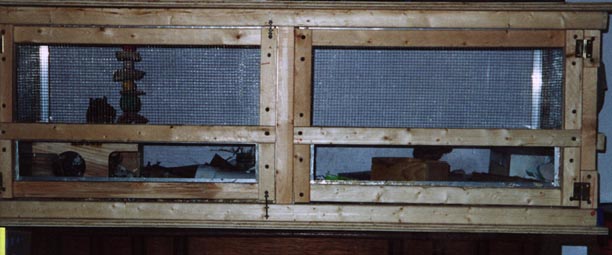 |
| This is a photo of the degu cage I built. It measures roughly 5x2x2 feet. This is a generously sized cage for a family of degus. |