from: http://ebs.gmnews.com/News/2002/0307/Bulletin_Board/013.html
War stories tell of progress
blacks have made since WWII
 |
| JERRY
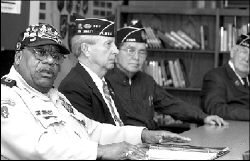
WOLKOWITZ Robert H. Yancey (left) leads a panel discussion last
week at Spotswood High School about the role of African
Americans in wars since World War II. With him are (from left),
Richie Alexander, Okie Okanura and Martin Farricker, all of
Woodbridge. |
|
SPOTSWOOD — Seeing Colin Powell holding high office may make some Americans
forget, but there was a time when black soldiers could not even fight alongside
whites, let alone represent the American people.
During a Feb. 28 presentation at Spotswood High School, students from the
History Club got a firsthand account of the internal military war
African-Americans once had to fight. The event was hosted by the club in honor
of "Black History Month" and featured both black and white soldiers
who fought during the Korean War, which was America’s first desegregated war.
About 35 students listened to the veterans, who came dressed in their
military uniforms.
"We fought a two-pronged war," said Robert Yancey, an African
American who spent his career in the military. "One war was for American
freedom, and one for our own freedom."
Yancey also spent time in World War II and Vietnam, and thus saw firsthand
the progress blacks made in the military from the 1930s through the 1970s.
During World War II, blacks were confined to their own regiments and were not
allowed to fight alongside whites.
"With every war we fought in, things got a little better," he said.
"Our whole objective today was to carry on our legacy and remember the
contributions that blacks have made to this great country," he said after
his presentation. "Freedom is not free. Freedom comes with a price. The
people we had here today are the people who paid that price."
Yancey said he started his military career when he was drafted at age 18 to
fight in World War II. A Navy man during World War II, he fought as part of the
Army’s 24th Regiment during the Korean War.
"I’m a Buffalo Soldier; it was an all-black regiment," he said.
"It had black troops but white officers until 1951."
During the Korean War, President Harry Truman desegregated the military, and
the 24th infantry became part of the 14th, which had been all-white. By that
time, however, Yancey’s term was up, and he had headed back to the States.
Frank Yusko, a Spotswood High School history teacher and adviser to the
History Club, said Truman’s desegregation of the military was very progressive
for the time.
"In many respects, the military was ahead of the loop," he said.
"In 1947, Truman desegregated it, but that took a while to implement."
He said the decision to desegregate was not a humanitarian move so much as it
was an attempt to improve the American fighting machine.
During World War II, the performance level of some all-black units was poor
because they got the worst equipment and leaders, he said.
"The only way to avoid that was to desegregate," Yusko said.
He said the military’s main concern was simply winning wars, and its
chances improved with desegregation.
In addition, there was pressure from public figures like Eleanor Roosevelt,
as well as the civil rights movement, which had been building for years even
though many ignored it.
"There was also pressure from certain politicians, particularly Northern
ones," he said.
Ironically, while the playing field was getting more level in the war zones,
things at home were as repressive as always, Yancey said. That realization
struck him as soon as he left Korea and was stationed in Georgia.
"Thank God, you survived the war, but you came home to the
prejudice," he said. "I experienced the old Southern mentality, which
I wasn’t used to because I was born and raised in Philadelphia."
"So when he stepped on the base, the stripes didn’t matter,"
Yusko said.
Yancey said the bases in Georgia still had dual facilities so that blacks and
whites would not be together, despite Truman’s edict. He said the extra
facilities were expensive to keep though, which is what led to their finally
becoming desegregated in the 1960s.
Black soldiers made progress in the military because they showed they had as
much fighting ability and responsibility as whites, he said.
"They were great fighters, carried responsibility and proved
themselves," Yancey said. "Therefore, they could not be denied."
— Vince Todaro
)