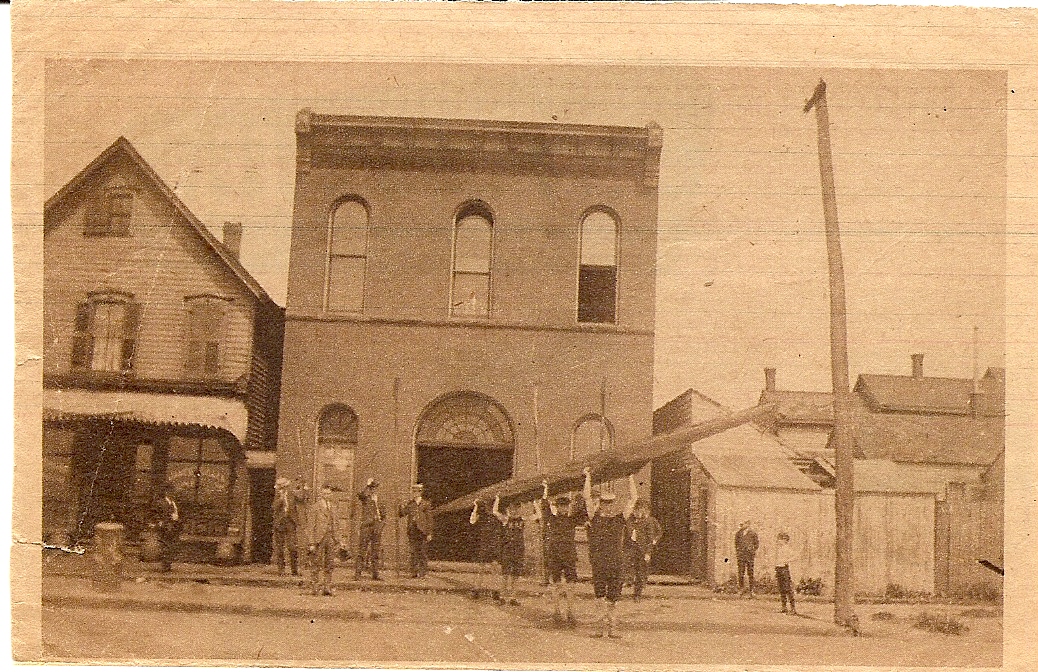
My brother, Bill Graham, went to Buffalo Technical High School in the late 1940�s. When he came home and announced he was going to start rowing, it caused a lot of excitement in our house. Little did he know he was carrying on a long family tradition.
My uncle, Victor Sullivan who lived downstairs from us at 146 South Street, was probably the most excited. He had been an oarsman and coach at the old Mutual Rowing Club.
The Mutual Rowing Club, built and incorporated in 1881, was located at 150 South Street near the foot of Hamburg Street in Buffalo�s Old First Ward. Meetings were held every Sunday in the club roo9ms and the Fourth of July started their summer season.
Our family tradition goes back over 100 years. When my grandfather, William P. Sullivan came to Buffalo from Dundas, Ontario, Canada, he may have been one of the charter members of the Club. William H. Driscoll, his brother-in-law, was very active and served as president at one time.
Rowing in the last part of the 19th Century and the beginning of the 20th Century was a big sport in Buffalo. A few local rowing clubs at that time were: the Queen City R.C., located on the west side of Buffalo, the Celtic R.C. at the foot of Michigan Ave. and the Lighthouse R.C. on the �Beach� just south of the present Coast Guard Base. With the Erie Canal, the Blackwell Canal, and the Buffalo River nearby, it was a natural sport to spring up in Buffalo.
One of the truly outstanding oarsmen was William Aman, who not only belonged to the Mutual Rowing Club, but also to rowing clubs in Philadelphia and New York City. He was such a great sculler, he would go to regattas and challenge other scullers. The other scullers, when challenged, would say they could beat anyone except William Aman.
The following unidentified newspaper article had to be dated circa 1891� �A BOAT HOUSE BURNED- The Mutuals are now Homeless. �The Mutual Rowing Club�s boat house on South Street, near Hamburg, was entirely destroyed by fire last night entailing a loss of $8,000. The flames were discovered in the rear portion of the building at 6:05 by a woman and officer James Sullivan immediately sounding an alarm from box 129. When the firemen arrived the destructive flames were eating up the rear and upper sections of ;the building and it required two hours of hard work to extinguish the flames. There was a brisk wind blowing and at times the surrounding property was in danger. The adjoining residence belongs to Peter P. Dalton and occupied by James Cullen was slightly damaged.
�The original boat house was erected in 1881 and was 70 x 20 feet in dimension. An addition 60 x 20 feet in size was built in 1883. The structure was two stories with a dome 45 feet in height. The rooms were handsomely furnished and the gymnasium was complete with many valuable boats. Among the property destroyed were eleven four oared shells, nine single sculls, two clinkers and two private boats some of which were new. The many valuable prizes won by the members at different times were consumed. The origin of the fire is a mystery but it is thought lit was caused by a lighted cigar carelessly thrown among some inflammable material. A meeting of the Club was held in the afternoon, but at the time of the fire no persons were in the rooms. The loss is estimated at $8,000 and the insurance at $4,000. Notwithstanding the severe loss President Daniel Nunan says the club will rebuild a house immediately. The burnt building was considered the finest boathouse in this section of the United States.�
Another unidentified newspaper article stated: �Mutual Rowing Club�s New Home� �Last evening the doors of the new home of the Mutual Rowing Club on South Street are thrown open with a reception and a ball. Notwithstanding the inopportune fall of the rain there was a large attendance and everybody enjoyed himself to the full. Much of ;the credit of the full measure of the success that attended the affair is due to Messrs. D. J. Nunan, D.J. Hayes, William Aman, Michael Kelleher, Samuel Shayer, P. J. Cotter and James Cullen.�
Still another clipping mentions a club smoker that was held. It also mentions Supervisor John Day spent part of the evening looking for the person that struck him in the head with a weiner wurst but was unsuccessful.
On July 4, 1915, the 35th annual Field Day and Regatta was held at Mutual Park with a ball game between the Andes and the Trentons (Official South Side Federal Game). There was a Fat Men�s Race with the prize being a Box of Good Cigars donated by James Cullen, 74 Hamburg Street, a baby show for the Prettiest Baby and the Fattest Baby, a ladies� 60-Yard Dash and a special Clinker Race between the Grain Shovelers and the different Elevators. Dave Regan rowed a single scull against a four-oared crew. There was also a greased pole climb with the prize being $1.00. That night there was dancing in the Club House.
In August 1923, my uncle Victor Sullivan coached Algie McGuire in the National Single Championship race in Baltimore, Maryland. Although Victor rowed himself and won many races, he was most proud of being the one to coach Algie McGuire in his winning at the Nationals.
The Rowing Club stayed active until about 1924 with regattas, boxing matches and dances. Many of the members worked in the grain elevators and continued to show their strength by rowing and boxing. Rowing as it was known seemed to lose its popularity with the coming of the automobile.
My brother Bill was not the only Graham to follow the family tradition. My brother Jim rowed and my brother Tom was a coxswain for many years with Timon High crews and West Side Rowing Club. Brother Bob tried it, but it wasn�t his cup of tea. They all went to the Henley Regatta in St. Catherins, Ontario. Our family tradition didn�t stop there. Bills son, Billy Graham had the nickname �Boat-House� and Bill�s son Paul also rowed.
Victor Sullivan must be smiling down from Heaven and reliving his youth on the Buffalo River.
If you have picutres or information regarding the Mutual Rowing Club please email them to Jim O'Dea at [email protected] for inclusion on this web site.