April 1, 2001
On Two
Presentations of “The Dora Camp and V-2 Construction Tunnels”
Given by
Torsten
Hess, Curator of the Mittelbau-Dora Museum
Alvin
Gilens, Photographer
As WWII came to
an end, the race between the powers escalated, and German “cleansing” efforts
increased. On 26 Aug. 1943, the German rocket production program relocated from
Peenemunde to Mittelbau-Dora. (The title Mittelbau means “central
building facility,” and was known as such because of its strategic location,
precisely in the center of Germany. The slave labor camps throughout the area
of Mittelbau-Dora are usually known as the Mittelwerke, or “central
works.”) There in dark underground tunnels, slaves created the V-2 rockets that
caused well over 5 000 deaths in London and Antwerp. By 2 June 1943, about 1
500 workers were laboring at the new site. Later this number would average 50
000 at any one time--mostly Jews, but many captive French soldiers and other
maligned people. 60 000 of these slaves were moved into Dora from other
concentration camps. The conditions were unimaginably horrid. Slaves were
killed at an almost-constant rate, slowly hung--a dozen at a time--on machines.
They were starved and worked to death. The statistical survival time at the
camps was seven months, though much less in reality for most captured slaves.
Dr. Hess
described the role of the new museum at Mittelbau-Dora as three-sided: a
memorial for the people and events of that place, a teacher for those alive
today and for the generations to come, and a keeper of authentic fact—not
opinion. This too was his role as presenter on behalf of the museum. It is not
mine, however, which allows the address of evident
oversights in thinking by some about the history of Mittlebau-Dora, the
German rocket program in general, and the Cold War missile race.
The attitude
maintaining that the ethical impact of a life can be divorced from the
immediate usefulness of that life is a convenient notion, but obviously a false one. As a
member who holds such creative power to direct the course of world change, the
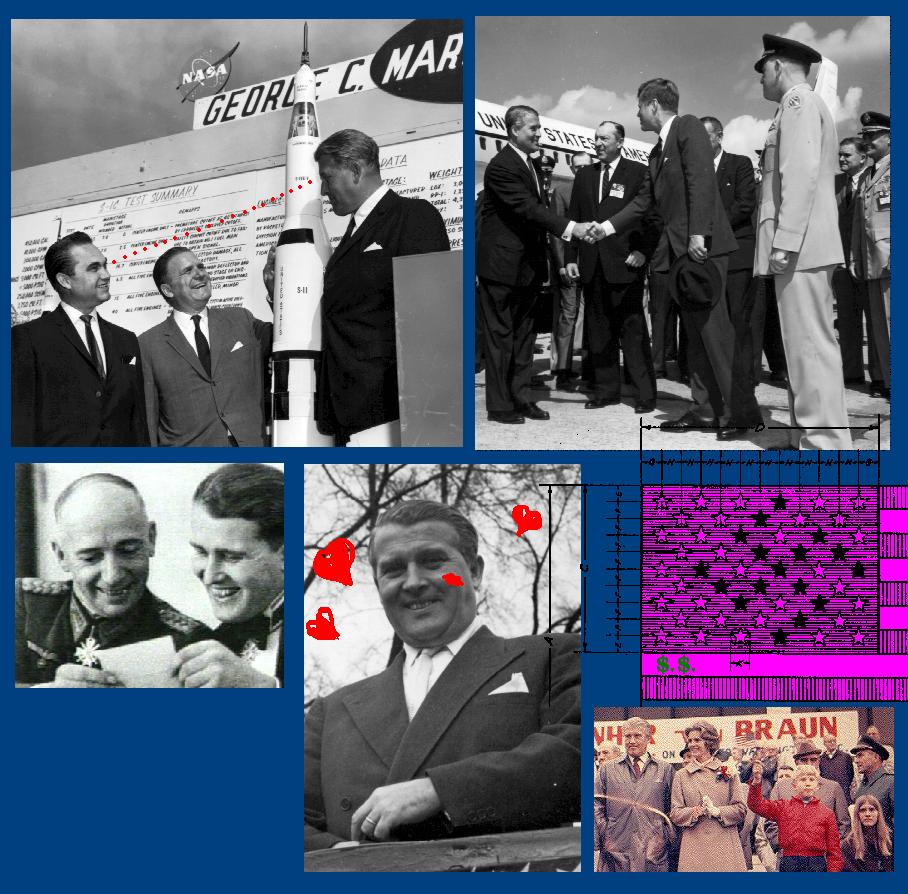
engineer bears more responsibility to the rest of society than does an average person. The recent naming of the UAH Von Braun Hall was yet another tribute to a man who, at best, knowingly showed a weak sense of ethical
duty or personal authenticity, and who, at worst, spearheaded a campaign that
meant death and misery to tens of thousands of human beings. S.S. Officer Von Braun’s move
to the U.S. (won from the Soviets)--along with Arthur Rudolph and a team of skilled German rocket scientists--is
taken by many to be his saving grace, proving that he was simply a
science-minded man and therefore immune to criticism. This is once again a
message of simple convenience. On entering Von Braun Research Hall one notices
the argument displayed proudly in his own words: “Scientific research is like
saving; if postponed until needed, it is too late to start.” Needed by whom? I
would agree with this advice, except that most would prefer not to invest their money
in the Reichsbank, so that it can later be used to buy Hitler the ICBM for his
birthday. We could honor other contributions to modern knowledge with biology classes in Mengele
Laboratory or political science in Himmler Hall.
Dr. Hess’s
official presentation later in the week engagingly related the circumstances of
today to those of the past, much in response to pointed questions from various
professors at UAH. The group effectively compared today’s international
economy, working conditions, and sensitivities toward labor to those during
WWII, without forgetting the terrible uniqueness of that time (pardon the cliché). Also adding
interest and excitement, witnesses of many different times and viewpoints were
present to argue and dissent with each other, even if it seemed evident that
some had lives, beliefs, reputations, and cognitive harmonies to maintain.
"I understand German, too, because I was raised in Alsace-Lorraine. I could hear von Braun talking about the ultimate weapon that's going to destroy the United States and everything else. We were not very close, but we could see them. He was very desperate to get this thing going, and he knew exactly what was going on."
--A captive Frenchman named Baum
"This is the decisive weapon
of the war; humanity will never be able to endure it. If I had had this weapon
in 1939, we would not be at war now."
--Adolf Hitler upon seeing Von
Braun's specially-requested footage of the first successful V-2 rocket test
launch
“…if
[the Germans] had managed to prolong the war some months longer, we would have
been confronted with a set of entirely new and deadly developments in air
warfare."
--Sir
Roy Feddon, Chief of the Technical Mission to Germany for the Ministry of
Aircraft Production
"And do not forget the petty
scoundrels in this regime; note their names, so that none will go free! They
should not find it possible, having had their part in these abominable crimes,
at the last minute to rally to another flag and then act as if nothing had
happened!"
--From the fourth leaflet of the
White Rose Resistance in Germany, 1942. Five students and a professor who wrote
and distributed the leaflets were executed in 1943.
“A great deal of intelligence can
be invested in ignorance when the need for illusion is deep.”
--Saul Bellow