 |
|
|
|
|
|
|
|
|
|
|
|
|
|
|
|
|
|
|
|
|
|
|
|
|
|
|
|
|
|
|
|
|
|
|
|
|
|
|
|
|
|
|
|
|
|
|
|
|
|
|
|
|
|
|
|
|
|
|
|
|
|
|
|
|
|
|
|
|
|
|
|
|
|
|
|
|
|
|
|
|
|
|
|
|
|
|
|
|
|
|
|
|
|
|
|
|
|
|
|
|
|
|
|
|
|
|
|
|
|
|
|
|
|
|
 |
|
|
|
 |
|
|
|
Welcome to Fort Martin Scott! The fort is located 2 miles southeast of Fredricksburg, Texas on Highway 290 and was founded on December 5, 1848 by Captain Seth Eastman, commander of Companies D and H of the First United States Infantry. Originally named Camp Houston, Fort Martin Scott, became one of the first in a line of forts stretching from San Antonio to Fort Worth. It was built soon after the German pioneers and the Comanche nation signed a formal peacy treaty in May of 1847. The fort helped guard the Fredricksburg-San Antonio Road and serve as a depot for other forts located to the northwest. The fort was named after Captain Martin Scott, who was killed leading his troops during the Mexican-American War. |
|
|
|
 |
|
|
|
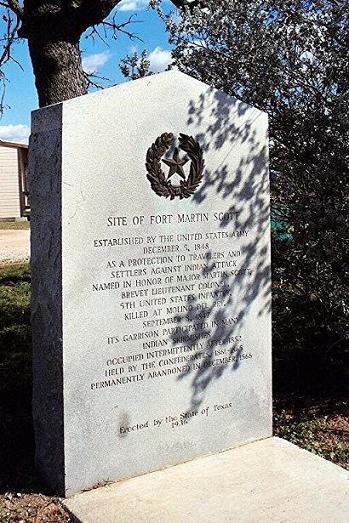
Here is the historical marker erected in 1936, at the time of the Texas centennial. It states:
Site of Fort Martin Scott
Established by the United States Army December 5, 1848 as a protection to travelers and settlers against Indian attack. Named in honor of Major Martin Scott, Brevet Lieutenant Colonel, 5th United States Infantry, killed at Molina Del Rey, September 8, 1847. Its garrison participated in many Indian skirmishes. Occupied intermittantly after 1852. Held by the Confederates, 1861 - 1865. Permanently abandoned in December, 1866. |
|
|
|
Officers' Row |
|
|
|
 |
|
|
|
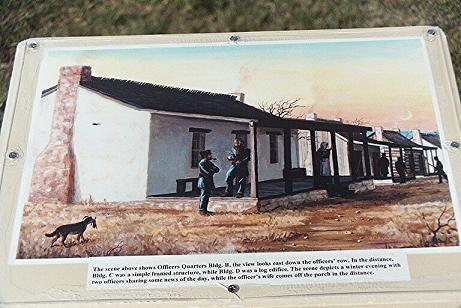
Artist, Lee Casbeer, provides all the artistic renditions seen in the placards seen all around Fort Martin Scott. Here is Officers' Row. The text reads:
The scene above shows Officers Quarters Bldg. B; the view looks east down the officers' row. In the distance, Bldg. C was a simple framed structure, while Bldg. D was a log edifice. The scene depicts a winter evening with two officers sharing some news of the day, while the officer's wife comes off the porch in the distance. |
|
|
|
 |
|
|
|
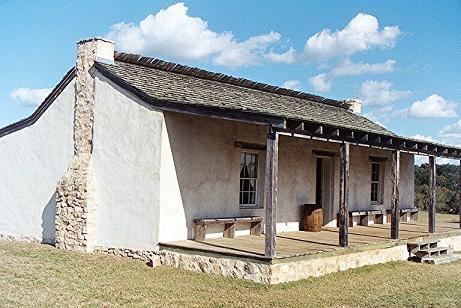
This is a reconstructed officers quarters, Bldg. B. The structure is made out of adobe and measures approximately 28 ft x 32 ft, with porches in the front and rear. This structure could have housed a married officer and his family. The turn-over in these quarters was frequent as new higher ranking officers arrived at the fort. |
|
|
|
 |
|
|
Now let's
look inside! |
|
|
|
|
|
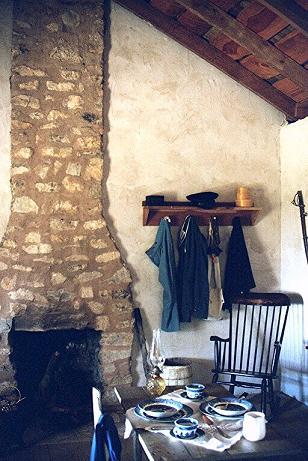
Here is the interior, of officers quarters (Bldg. B). This is the room on the left as you enter the building. It is refurbished with antiques to replicate the conditions of 1850's living. Notice the crude stone fire-place and the table settings. Life held few conveniences for frontier soldiers! |
|
|
|
|
|
|
 |
|
|
|
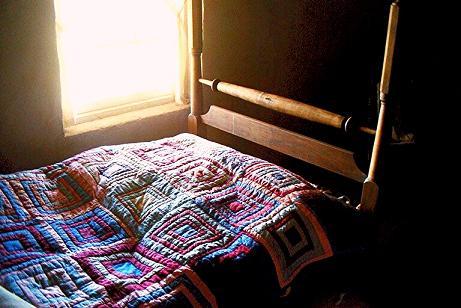
Here is a place for a weary officer to sleep . It was not uncommon for an officer's wife to laboriously put together a beautiful patchwork quilt for a bed spread. |
|
|
|
 |
|
|
|
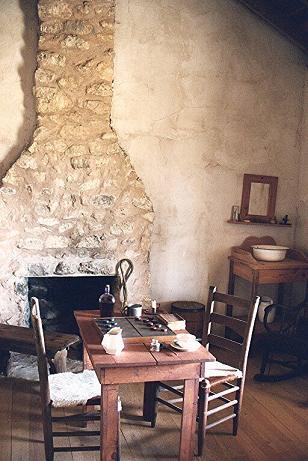
Across the breeze way is another small, single room for quartering another officer and family. Space was at a premium in the 1840's! Note the small size of the table. The seats of the chairs are set in leather. |
|
|
|
|
|
 |
|
|
|
|
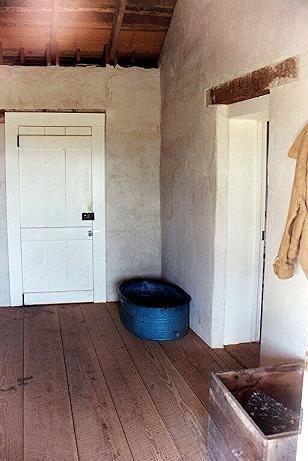
Here is the breeze way separating the two quarters. Notice the door at the rear which can be opened during hot weather to let cool breezes blow through. Conversely, it can be closed in the winter to prevent chilly drafts from cold winter winds. |
|
|
|
|
|
|
 |
|
|
|
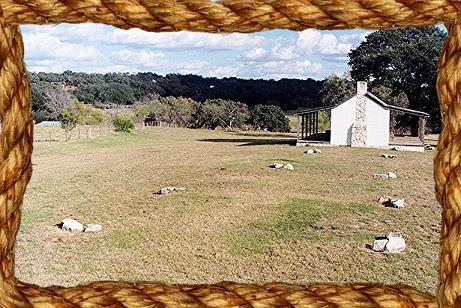
Here is a section of field with the corners of Officers Quarter, Bldgs. C and D shown by recently placed limestone blocks. Officers' Quarters, Bldg. C was very small, only 20 ft x 24 ft (foreground) and was framed with a weatherboard exterior. Officers' quarters, Bldg. D (background), was a 24 ft x 28 ft log structure which also made for very cramped quarters. Behind the location for Bldg D is restored officers quarter, Bldg. E. Notice the two porches for keeping cool. |
|
|
|
 |
|
|
|
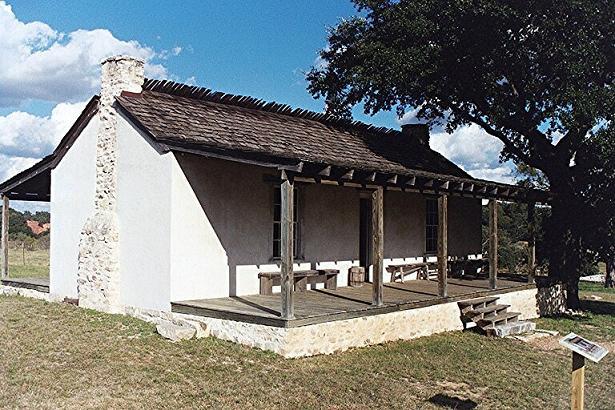
This is a view of Officers Quarters, Bldg. E. This was the last reconstructed officers quarters, being completed in the early 1990's. Originally this building had two 14 ft x 16 ft rooms with a dogtrot hallway as you see today. No major artifacts were found on this site during archeological digs in the mid 1980's. |
|
|
|
 |
|
|
|
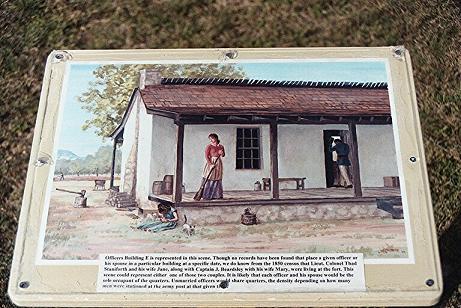
Here is an artist's depiction. The caption states:
Officers Building E is represented in this scene. Though no records have been found that place a given officer or his spouse in a particular building at a specific date, we do know from the 1850 census that Lieut. Colonel Thad Staniforth and his wife Jane, along with Captain J. Beardsley with his wife Mary were living at the fort. This scene could represent either one of those two couples. It is likely that each officer and his spouse would be the sole occupant of the quarters. Unmarried officers would share quarters, the density depending on how many men were stationed at the army post at that given time. |
|
|
|
Let's peek
inside again! |
|
 |
|
|
|
|
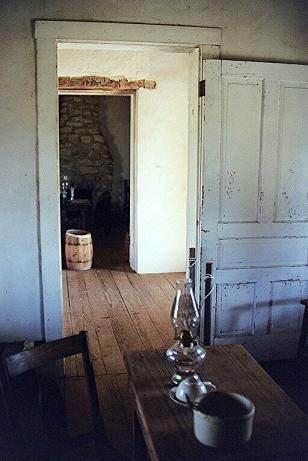
This is the room on the left as you enter Building E. Here you see a across the breezeway into the other room. Notice the old oil lantern on the table. |
|
|
|
|
|
|
 |
|
|
|
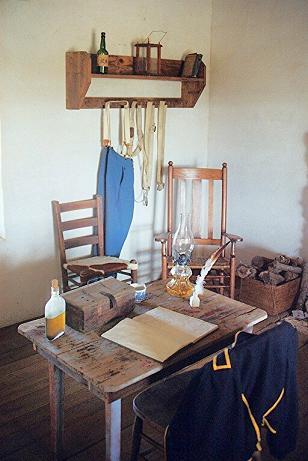
This is the room on the right. Note the uniform jacket draped over the chair, open ledger, two bottles of spirits and suspenders hanging up on the rack. Unfortunately loneliness and boredom on the frontier led to alcoholism for some of the enlisted men and officers as well. |
|
|
|
|
|
 |
|
|
|
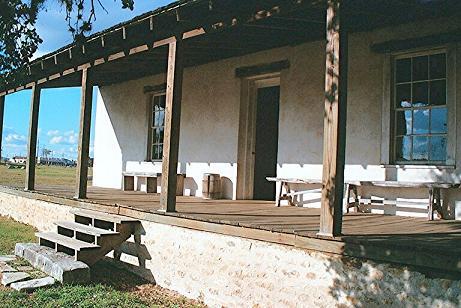
Here is another view of Officers Quarters, Bldg. E from beneath a lovely shade tree. Notice the wide porch, a nice place to catch a cool breeze on a hot summer evening. |
|
|
|
 |
|
|
|
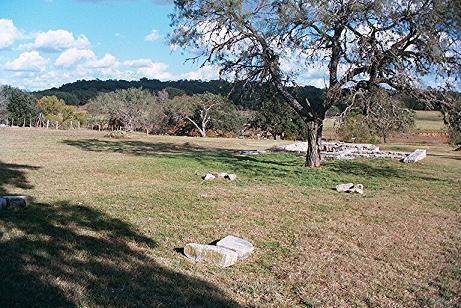
In the foreground you can see stones marking the corners of Officers Quarters, Bldg. F. This building was another small wood framed structure measuring only 16 ft x 17 ft. In the background, behind the tree, you can see the reconstructed foundations of Officers Quarters Bldg. G |
|
|
|
 |
|
|
|
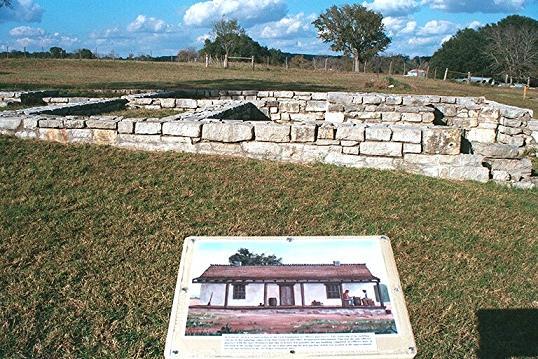
Here is an artist's depiction of Officers Quarters G. The text reads:
In front of you is a reconstruction of the rock foundation of officer quarters G. The rendering of the building you see in this painting comes from that research and other documented information. This was the only officers' quarters with the inset fireplaces and this structure was posssibly the last builing completed on Officers Row. If you look in the background you can see a man plowing the post garden, which was located in the approximated (sic) current location of the city water treatment lake. |
|
|
|
 |
|
|
|
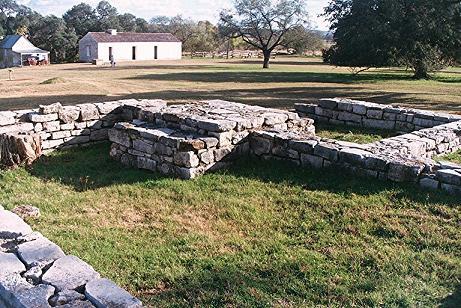
Here is another view of Bldg. G looking towards the guardhouse. Like Bldg. B and E this was also an adobe structure 28 ft x 32 ft in size. The layout indicated two family use. Depending on how many officers were at the fort at a given time and their rank, an officer and his family might have had complete use of such a building. |
|
|
|
Post Hospital, Sutlers
Store & Warehouse |
|
|
|
 |
|
|
|
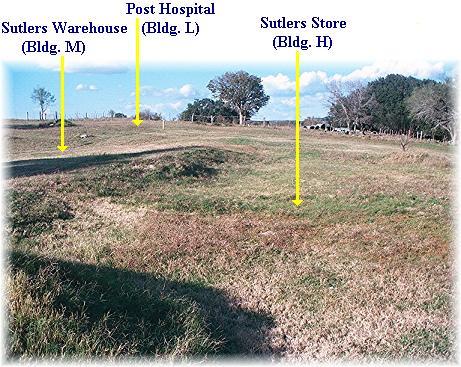
The post hospital was, according to the 1853 report, a 12 ft x 25 ft log structure that was "fast decaying". The main use of this structure was to provide quarantine and recuperation for soldiers stationed here. Cholera, digestive problems, fever, pleurisy, and gonorhea were common ailments, plus injuries suffered during work on the fort. One soldier died of typhoid fever in late 1849. With no major campaigns having been fought in this region, the hospital never served as a surgery center for battle injuries. Interestingly enough, in a 1986 archeological survey, surface investigations found historic and prehistoric artifacts but no materials related to hospital activity. |
|
|
|
The structures comprising the Sutlers Store/Warehouse served as a source for everything from clothing to firearms for the soldiers. Both were weatherboard exteriors. Later the Brautigams, who bought the land in 1870, built a barn in this part of the old fort. |
|
|
|
 |
|
|
|
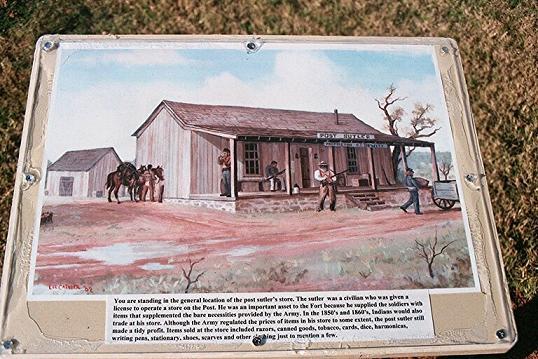
Here is artist Lee Casbeer's depiction of the Post Sutler's Store. The caption reads:
You are standing in the general location of the post sutler's store. The sutler was a civilian who was given a license to operate a store on the Post. He was an important asset to the Fort because he supplied the soldiers with items that supplemented the bare necessities provided by the Army. In the 1850's and 1860's, Indians would also trade at his store. Although the Army regulated the prices of items in his store to some extent, the post sutler still made a tidy profit. Items sold at the store included razors, canned goods, tobacco, cards, dice, harmonicas, writing pens, stationary, shoes, scarves and other clothing just to mention a few. |
|
|
|
Post Bakery |
|
|
|
 |
|
|
|
 |
|
|
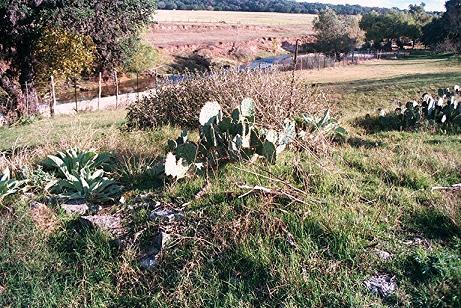
Above: On the left looking towards Baron's Creek you can still see the remnants of the foundation of the 12 ft x 12 ft bake oven through the cacti.
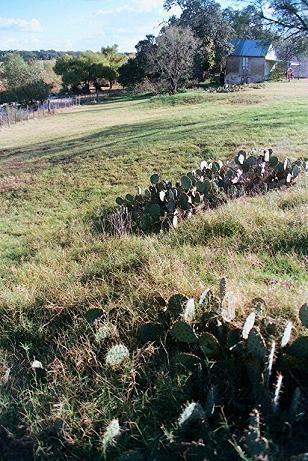
Right: On the right, you can see the site of the old bakehouse, outlined by the prickly pear cacti. The bakehouse was a log structure that measured approximately 20 ft x 14 ft.
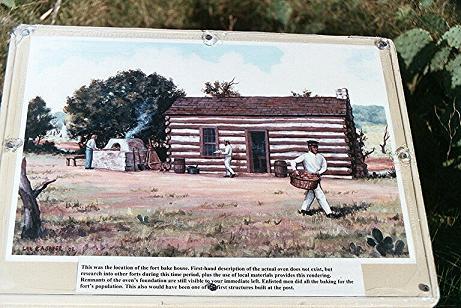
Below: An artist's depiction shows what the bakehouse would have looked like. The text reads:
This was the location of the fort bake house. First-hand description of the actual oven does not exist, but research into other forts during this time period, plus the use of local materials provides this rendering. Remnants of the oven's foundations are still visible to your immediate left. Enlisted men did all the baking for the fort's population. This also would have been one of the first structures built at the post. |
|
|
|
|
|
|
 |
|
|
|
Laundress Quarters |
|
|
|
 |
|
|
|
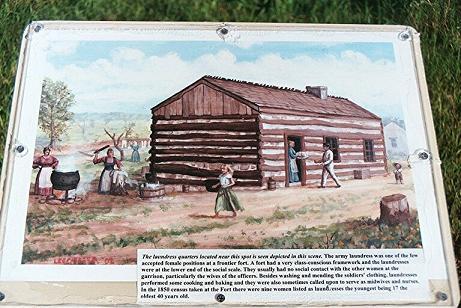
There are no remains of the laundress quarters. They were originally log structures that measured 20 ft x 14 ft. and were located parallel to the creek between the bakery and guardhouse. Often wives of enlisted men performed these duties. Shown above is an artist's depiction. The caption reads:
The laundress quarters located near this spot is seen depicted in this scene. The army laundress was one of the few accepted female positions at a frontier fort. A fort had a very class-conscious framework and the laundresses were at the lower end of the social scale. They usually had no social contact with the other women at the garrison, particularly the wives of the officers. Besides washing and mending the soldiers' clothing, laundresses performed some cooking and baking and they were also sometimes called upon to serve as midwives and nurses. In the 1850 census taken at the Fort there were nine women listed as laundresses the youngest being 17 the oldest 40 years old. |
|
|
|
The Guardhouse |
|
|
|
 |
|
|
|
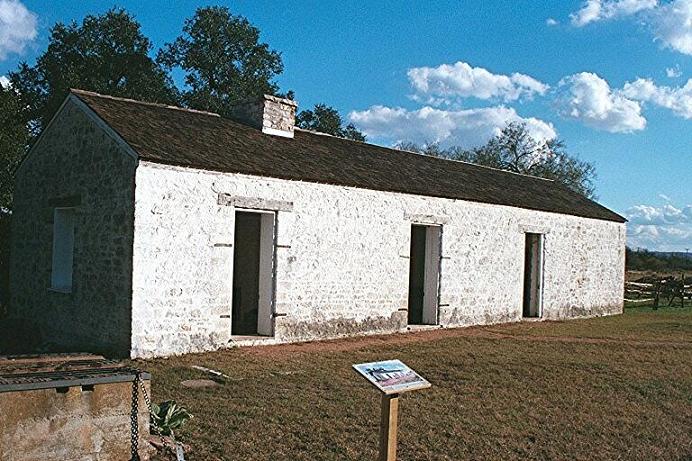
This cut limestone structure is the only surviving building from the original fort. It was restored in the early 1990's to its original design. This was where the officer of the day and associated guards did their activities. In the foreground is the artist's depiction of the guardhouse. The text on the sign reads:
...Only structure which has survived from the fort's original days to the present. This was the fort guardhouse. The room to your left was where the officer of the day worked. The middle room was a rest area for guards and the far door led to the actual lockup cells. Discipline was harsh on these frontier forts and hard labor with a ball and chain was common. Later, the Brautigam family remodeled this structure and they used this as their home for over 80 years. |
|
|
|
 |
|
|
|
 |
|
|
|
|
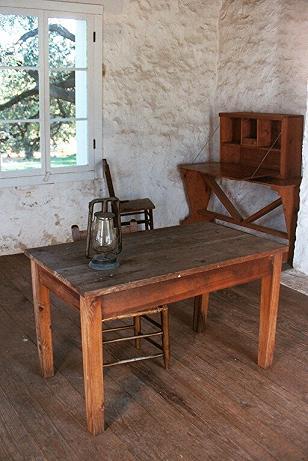
This is the office occupied by the officer of the day in the north end (left side) of the guardhouse. |
|
|
|
|
|
 |
|
|
|
|
|
|
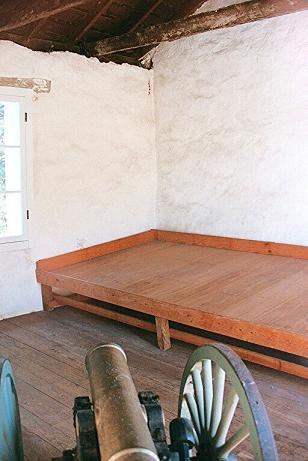
This is the rest area for the guards in the middle room of the guardhouse. Notice the wooden structure for bedding down at night and the old artillery piece in the foreground. |
|
|
|
|
|
 |
|
|
|
|
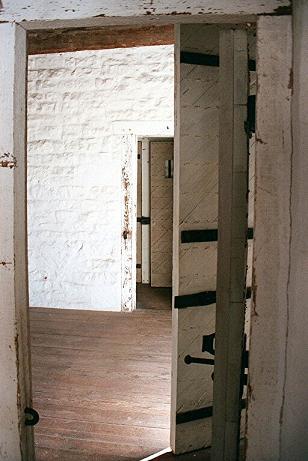
This is a view from the office of the officer of the day looking through the large wooden doors leading to the lockup cells at the south end (right side) of the guardhouse. |
|
|
|
|
|
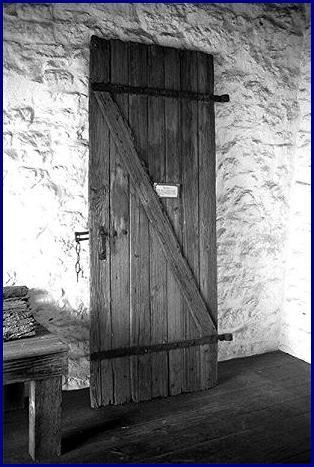
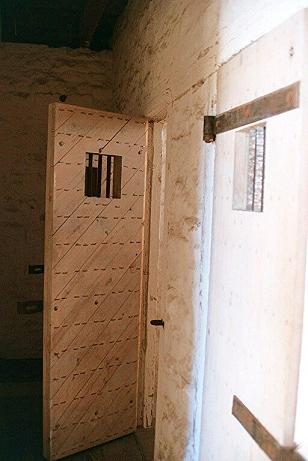
Right: This is an original stable door from Old Fort Martin Scott. The door was recovered during the demolition of a barn built ca. 1900 at the site of the fort. It matches the precise description of the door from the original stable at the fort. It is most noticeable for its hand-forged 3 foot hinges and large forged nails as well. |
|
|
|
|
|
|
 |
|
|
 |
|
|
|
|
|
|
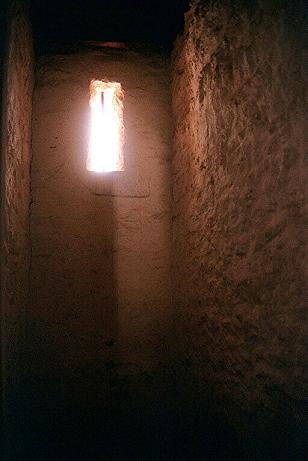
Now peering to the right, this is a very dreary view looking into one of the cells Notice the single open window cut out of the rock. |
|
|
Peering in to the left, this is the hallway leading to the three holding cells. Each cell measures approximately 8 1/2 x 3 1/2 ft. Notice the massive wooden doors. |
|
|
|
|
|
|
Enlisted Men's Barracks |
|
|
|
 |
|
|
|
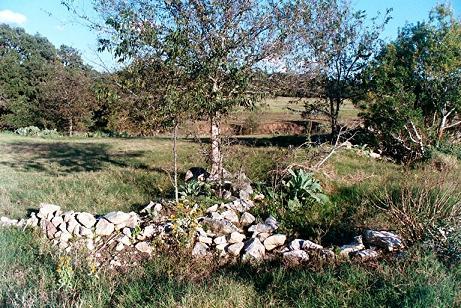
Here are some foundation ruins of Enlisted Men's Barracks O looking toward Baron's Creek. This barracks and also Barracks P were originally log structures measuring 18 ft x 60 ft. |
|
|
|
 |
|
|
|
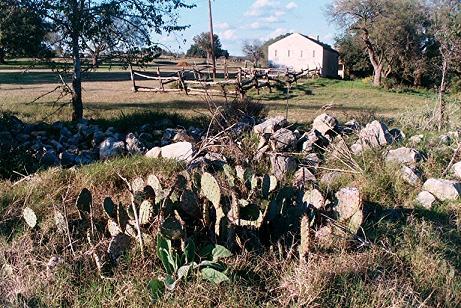
Here is another view of Barracks O ruins looking back toward the guardhouse. This barracks could house one company of men. |
|
|
|
 |
|
|
|
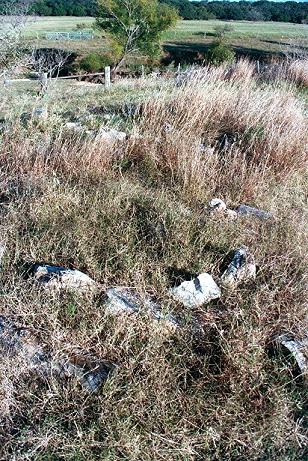
Here is what appears to be the ruins of a kitchen located to the rear of Barracks O. This fits with records that state that Barracks O and P had kitchens attached to the rear. |
|
|
|
 |
|
|
|
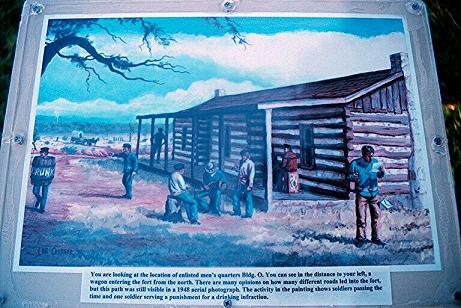
Now check out artist Lee Casbeer's depiction of Enlisted Men's Barracks O. The text reads:
You are looking at the location of enlisted men's quarters Bldg. O. You can see in the distance to your left, a wagon entering the fort from the north. There are many opinions on how many different roads led into the fort, but this path was still visible in a 1948 aerial photograph. The activity in the painting shows soldiers passing the time and one soldier serving a punishment for a drinking infraction. |
|
|
|
 |
|
|
|
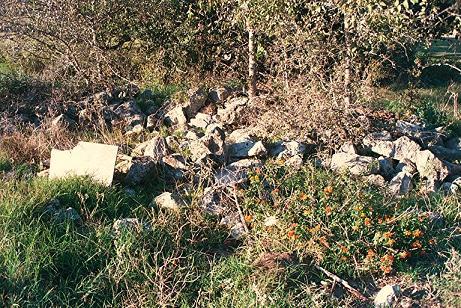
There is very little left of the foundations of Enlisted Men's Barracks P. Notice the wild flowers growing amidst the stones. The caption on the artist's rendition located nearby states:
The building depicted in this scene was enlisted men's building P. Constructed in the same fashion as buildings O and R, you can see the three separate living quarters divided by the dogtrot breezeways. This scene shows tents in the background, which illustrates the time period from March - May 1851 when between 150 and 370 soldiers were encamped in and around the fort preparing for Indian patrols. A year later, the population of the fort was dwindling and by the beginning of 1853 only 53 men were stationed at the post. |
|
|
|
 |
|
|
|
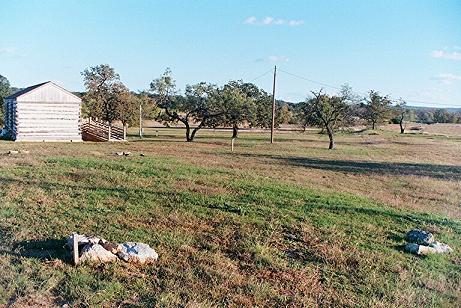
Here you can see stones marking the corners of the approximate location of Barracks S which measured about 48 ft x 18 ft. In the fort's last months of use, this building was used to store lumber and hay. There is a marker nearby with an artist's depiction of the barracks which states:
This scene shows the construction of Bldg. S, which was described as a "jacal" type structure. You can see how the construction of the enlisted men's quarters began, with a trench being dug and logs being lined up vertically then chinked (or stuccoed). The small inset view is what we assume the finished structure could have looked like.
In the background and to the left is the latest reconstructed building at the fort. The design is a loose imitation of the original general layout of Enlisted Men's Barracks R and also measured 48 ft x 18 ft.
In the background on the right is the area that was the approximate location of the fort stable. The 2nd Dragoons were mounted troops and when Fort Martin Scott was being built, a large number of horses were expected to be on site. The structure was 35 ft x 35 ft according to the 1853 inspector's report and had stalls for 12 horses. There is little first hand information about the construction style of the stable. We do know that the stable doors were reused by Henry Brautigam when he built a barn down on the family farmstead in the late 1880's. In the years after the fort was abandoned, travelers, homesteaders and horse traders that came to Gillespie County used the stable. An original stable door is shown above located in the guardhouse. |
|
|
|
Other Structures |
|
|
|
 |
|
|
|
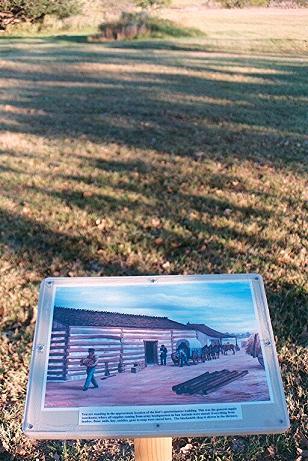
This is a view looking out over the area that once contained the Quartermasters Warehouse. The structure was the largest at the fort, measuring
18 ft x 78 ft, and was the supply storehouse for all foodstuffs, tools, weapons, uniforms, and other staples needed at the fort. The lower part of the picture shows an artist's depiction of the warehouse with the caption:
You are standing in the approximate location of fort quartermaster building. This was the general supply warehouse, where all supplies from army headquarters in San Antonio were stored. Everything from lumber, flour, nails, saddles, guns to soap were stored here. The blacksmith shop is shown in the distance.
Off directly to the right of this location, is another marker for the location of the blacksmith shop. Along with the artist's depiction it reads:
This was the location of the Fort blacksmith shop. This scene is representative of the activity in the first 3 years of the fort's occupation (1848 - 51) when larger numbers of dragoons were stationed here preparing for frontier expeditions. |
|
|
|
Flagpole & Parade Ground |
|
|
|
 |
|
|
|
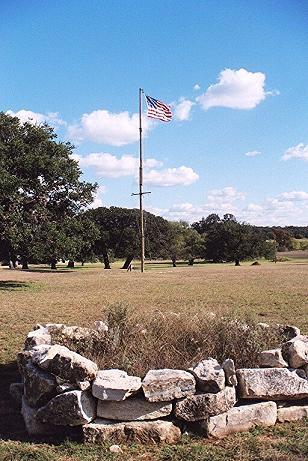
Now almost full circle, we come to a view of the parade ground and flagpole. You can see Old Glory with all 31 stars and in the foreground, John Brautigam's 1880's well. Lee Casbeer's illustration and additional information is given on a marker nearby. The text reads:
As you look down the parade ground toward the flagpole, imagine the scene before you. This is a rendering of what a typical morning review of the troops might have looked like. This scene could have taken place in 1852 or early 1853 when the fort's enlisted men population varied between 50 and 24. You can see enlisted men's barracks R and P in the distance. |
|
|
|
Post Commander's Quarters |
|
|
|
 |
|
|
|
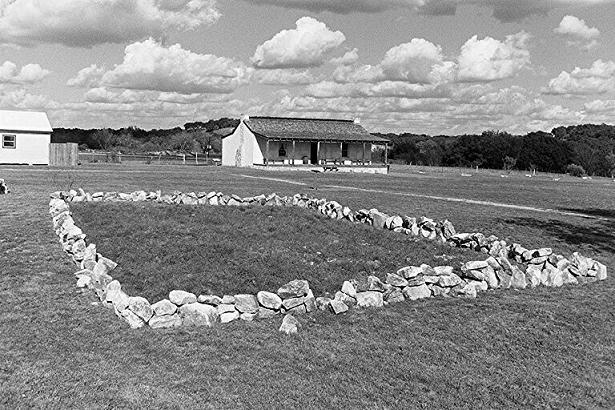
Step back and now you can see the rock outline recently made of the Post Commander's Quarters, Bldg. A. The building was a log structure measuring approximately 34 ft x 30 ft in size, with porches front and rear. In the late 1870's and 1880's, this was the general location of John Brautigam's saloon, store and dancehall. Artifacts found at this site range from glass shards to bullet casings to ceramic pieces. Officers' Quarters B can be seen in the background. |
|
|
|
 |
|
|
|
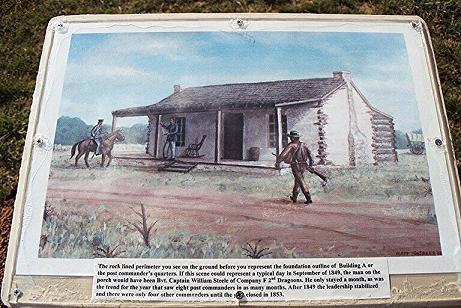
Here is the artist's depiction of the Post Commander's Quarters with text that reads:
The rock lined perimeter you see on the ground before you represent (sic) the foundation outline of Building A or the post commander's quarters. If this scene could represent a typical day in September of 1849, the man on the porch would have been Bvt. [Brevet] Captain William Steele of Company F 2nd Dragoons. He only stayed a month, as was the trend for the year that saw eight post commanders in as many months. After 1849 the leadership stabilized and there were only four other commanders until the post closed in 1853. |
|
|
|
So ends our tour of Fort Martin Scott. By 1850, settlers had pushed well past the the old 1848 frontier boundaries. Because of its distance from the front line of forts, Fort Martin Scott lost any strategic significance that it once held by the year 1853. From 1852 to its closure in December 1853, the fort served only as a forage depot. For a brief time, in September 1866 after the Civil War, General Philip H. Sheridan stationed elements of the 4th United States Calvary to secure the frontier once again from potential Indian depredations. By the end of 1866, however, the fort was abandoned for good.
Epilogue:
After the fort closed for the last time, John W. Brautigam (1829 - 1884) purchased a 640-acre tract of land, in March of 1870, for a total of $1600.00 in gold. The tract included the site of Fort Martin Scott. Little is known of the 27-year time span prior to his purchase. Once the family moved onto the property, they constructed their home from the existing old guardhouse and used the materials left over from the fort to build a store, saloon, and dance hall. The structures became known as "Brautigam's Garten" which was one of the first saloons in the outlying Fredricksburg area. Brautigam's Garten was the scene of numerous festivities and celebrations over the years and the first four Gillespie County Fairs were held on the old fort property from 1881 to 1884. Horse racing was an early tradition in Gillespie County and the track was located on the east bank of Baron's Creek in the big flat field you see today.
In September 1884 after the conclusion of some activity at the saloon, Mr. Brautigam was murdered in a robbery attempt. Following the murder, the family closed the saloon and it never reopened. Mr. Brautigam's son, Henry, later used the materials from the saloon to build a spacious barn to the north of the family home. Different members of the Brautigam family continued to occupy the property until 1955. The property was then sold to the city of Fredricksburg in 1959. The property is now managed by the Gillespie County Historical Society. |
|
|
|
In you, O LORD, I have taken refuge; let me never be put to shame; deliver me in your righteousness. Turn your ear to me, come quickly to my rescue; be my rock of refuge, a strong fortress to save me. Since you are my rock and my fortress, for the sake of your name lead and guide me, for you are my refuge. Into your hands I commit my spirit; redeem me, O LORD, the God of truth. Psalm 31:1 - 5 (NIV) |
|
|
|
Virtual tour created by David W. Astwood. All rights reserved. Photographs displayed
on this page are the property of the author. Email: [email protected] |
|
|
|
Home |
|
|
|
 |
|