 |
|
|
|
|
|
|
|
|
|
|
|
|
|
|
|
|
|
|
|
|
|
|
|
|
|
|
|
|
|
|
|
|
|
|
|
|
|
|
|
|
|
|
|
|
|
 |
|
|
|
 |
|
|
|
Welcome to Old Fort Lincoln located 2 miles north of D'Hanis on FM Road 1796. This fort was one of eight forts that formed the first line of frontier defense across Texas from Eagle Pass on the Rio Grande to Coffee's Bend on the Red River. It was named after Cpt. George Lincoln, an officer of Company E, 8th Infantry, who died at the Battle of Buena Vista, February 23, 1847. |
|
|
|
 |
|
|
|
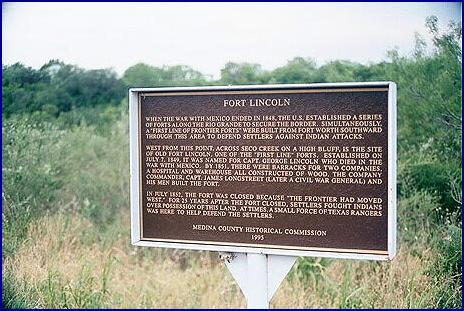
Here is the historical marker on the side of the road set up by the Medina County Historical Commission in 1995. It reads: |
|
|
|
"When the war ended with Mexico in 1848, The U.S. established a series of forts along the Rio Grande to secure the border. Simultaneously, a 'first line of frontier forts' were (sic) built from Fort Worth southward through this area to defend settlers against Indian attacks.
West from this point, across Seco Creek on a high bluff, is the site of Old Fort Lincoln, one of the 'first line' forts. Established on July 7, 1849, it was named for Capt. George Lincoln who died in the war with Mexico. By 1851, there were barracks for two companies, a hospital and warehouse all constructed of wood. The company commander, Capt. James Longstreet (later a Civil War General) and his men built the fort.
In July 1852, the fort was closed because 'the frontier had moved west.' For 25 years after the fort closed, settlers fought Indians over the possession of this land. At times, a small force of Texas Rangers was here to help defend the settlers." |
|
|
|
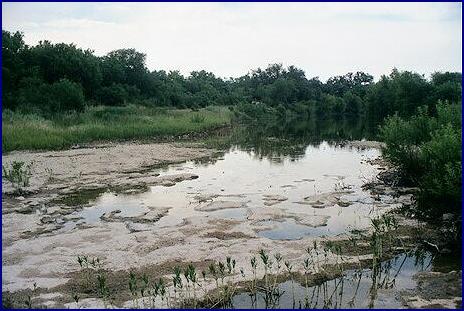
Seco Creek |
|
|
|
 |
|
|
|
Here is Seco Creek just west of the marker. Notice the bluff gently rising in the background. This was part of the 1,476 acre plot; leased by the U.S. government from the heirs of Milton Anderson. They had inherited the land 3 years earlier in 1846. The fort stood on the bluff overlooking the river and had a commanding view of the surrounding countryside. At first the buildings were made of poles or logs placed together and the roofs were thatched, or made of wooden shingles. Sometimes tarpaulins served as temporary roofs while the fatigue details worked on constructing the fort. |
|
|
|
 |
|
|
|
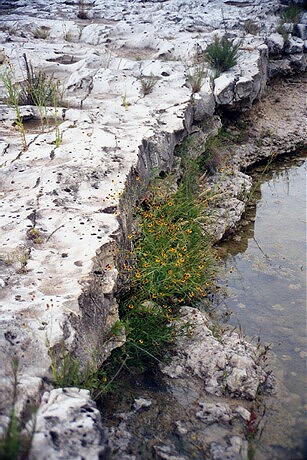
Notice the carved gray limestone that makes up the creek bed of Seco Creek. Imagine drawing stagnant water from standing pools like this for consumption at the post until a well could be dug. In 1851, builders used local gray limestone, much like this in building a hospital, a commissary store, a quartermaster's depot storehouse, facilities for two companies, and a storehouse for the companies' property. |
|
|
|
|
|
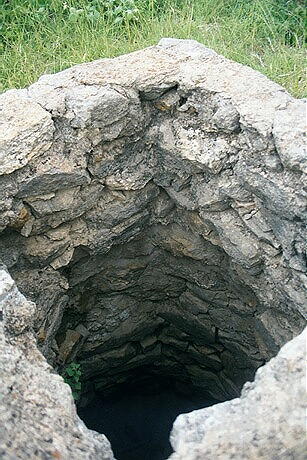
Fort Lincoln Cistern |
|
|
|
 |
|
|
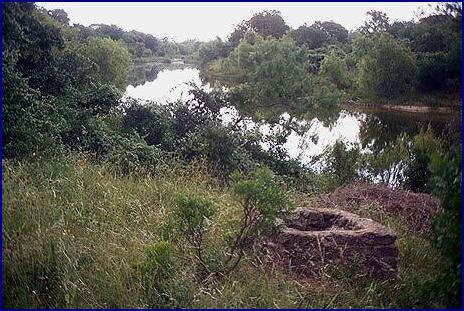
Here is what is believed to be the only structure remaining at the site of Fort Lincoln, the post cistern. Largely filled in with debris today, the well even now looks quite deep and must have been a much-improved source of water for the soldiers. This must have been a major priority for Major Longstreet who commanded Companies E and G of the Eighth Infantry. |
|
|
|
|
|
|
 |
|
|
|
Here is a peaceful view of the cistern with Seco Creek in the background, a lonely reminder of the distant past. |
|
|
|
Residential Ruins |
|
|
|
 |
|
|
|
 |
|
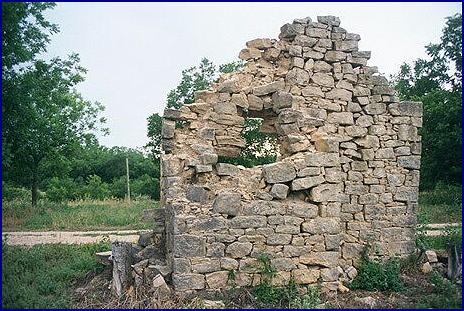
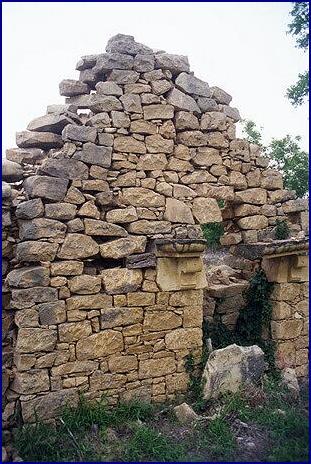
After the fort closed in 1852, Texas Rangers made their headquarters nearby. Though none of the fort buildings remain, today it is known that the barracks were torn down and used to construct residences east of Seco Creek. Could the stones, seen in these ruins of an old residence, have been part of the old fort? |
|
|
|
|
|
These two photographs were taken just east of Seco Creek across from the fort site. |
|
|
|
|
|
The army stationed infantrymen at Fort Lincoln to track down and fight Indian raiders who were attacking the European and American settlers who had just recently arrived. The men also protected the Woll Road and the transportation of military and commercial goods along that route. When the frontier moved westward, Fort Lincoln fell silent on July 20, 1852. |
|
|
|
The fortress will be abandoned, the noisy city deserted; citadel and watchtower will become a wasteland forever, the delight of donkeys, a pasture for flocks, till the Spirit is poured upon us from on high, and the desert becomes a fertile field, and the fertile field seems like a forest. Isaiah 32:14-15 (NIV) |
|
|
|
Virtual tour created by David W. Astwood. All rights reserved. Photographs displayed on this page are the property of the author. Email: [email protected] |
|
|
|
Home |
|
|
|
 |
|
|
|